NASA’s Perseverance Prepares for Mars’ Most Daring Landing
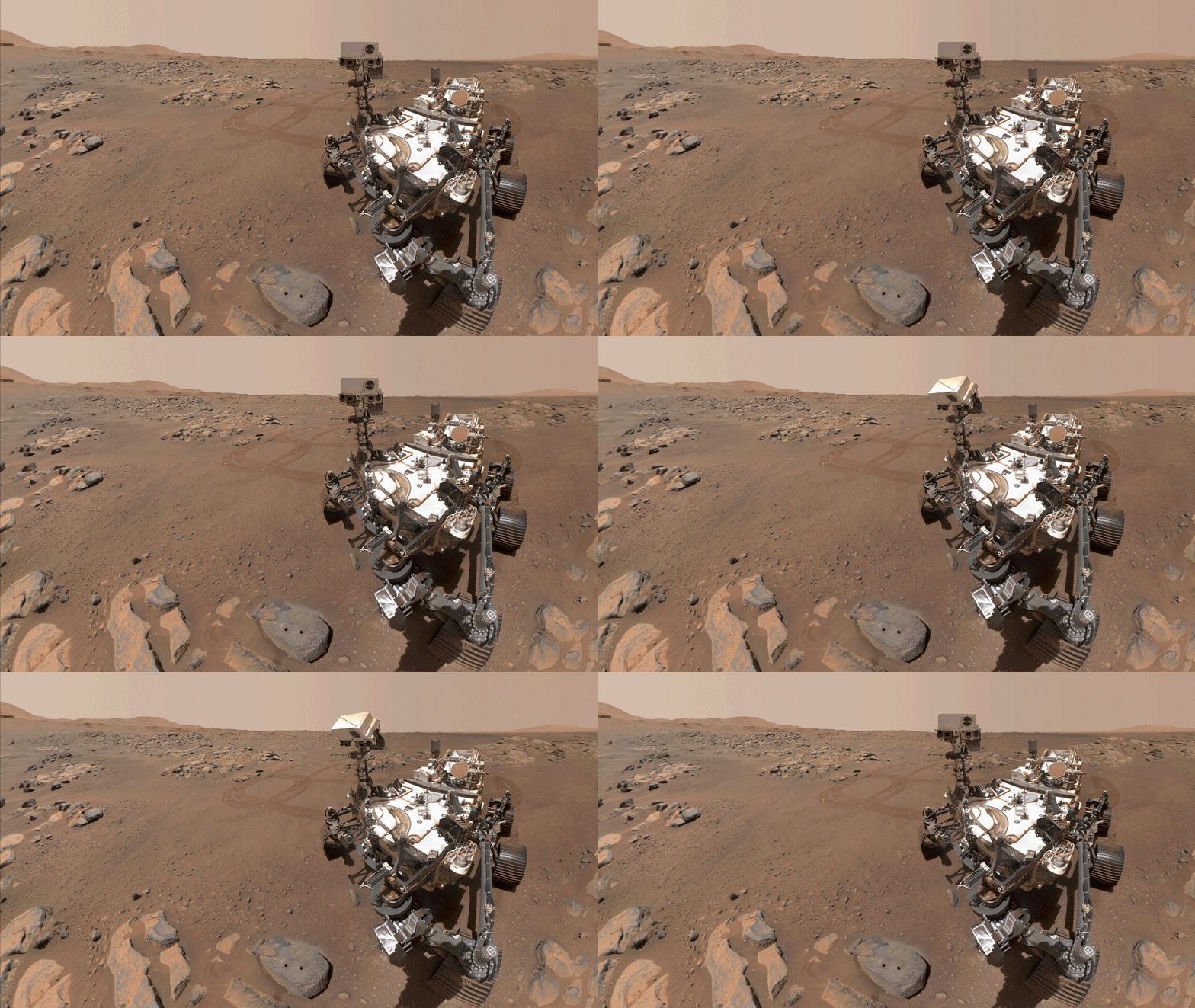
In less than a month, NASA’s Mars 2020 Perseverance rover will attempt a high-stakes landing in Jezero Crater, a 28-mile-wide ancient lake bed and river delta on the Martian surface. Designed to search for signs of ancient microbial life, the rover will act as a robotic geologist, collecting rock and soil samples intended for eventual return to Earth in the 2030s. The mission demands extraordinary cleanliness; Perseverance is the most sterile spacecraft ever sent to Mars, engineered to avoid contaminating samples with terrestrial microbes.

The landing is scheduled for February 18, with live coverage from NASA’s Jet Propulsion Laboratory beginning at 2:15 p.m. ET. Pandemic-related constraints have reshaped mission operations, but the team has adapted, conducting a three-day simulated landing to rehearse procedures. “Don’t let anybody tell you different – landing on Mars is hard to do,” said John McNamee, project manager for Mars 2020 at JPL. “But the women and men on this team are the best in the world at what they do. When our spacecraft hits the top of the Mars atmosphere at about three-and-a-half miles per second, we’ll be ready.”
Perseverance builds on decades of Mars exploration, from Mariner 4’s 1965 flyby to a fleet of orbiters and landers. “Perseverance, which was built from the collective knowledge gleaned from such trailblazers, has the opportunity to not only expand our knowledge of the Red Planet, but to investigate one of the most important and exciting questions of humanity about the origin of life both on Earth and also on other planets,” said Thomas Zurbuchen, associate administrator for NASA’s Science Mission Directorate.
After traveling 292.5 million miles since its July launch, the spacecraft has about 25.6 million miles remaining before arrival. The descent sequence—dubbed the “seven minutes of terror”—is entirely autonomous due to the 10.5-minute one-way light time between Earth and Mars. Once commanded to begin entry, descent, and landing (EDL), the spacecraft must decelerate from 12,000 mph to zero in seven minutes.
Ten minutes before atmospheric entry, the cruise stage detaches, and thrusters on the aeroshell adjust the entry angle. The heat shield will face peak heating of 2,370 degrees Fahrenheit just 75 seconds into the descent. Perseverance’s target site is strewn with dunes, cliffs, boulders, and craters, making it the most hazardous landing zone NASA has attempted. Two key upgrades—Range Trigger and Terrain-Relative Navigation—are designed to improve safety. Range Trigger deploys the 70.5-foot parachute based on position, while Terrain-Relative Navigation uses onboard cameras to identify and steer toward the safest landing spot, shifting by up to 2,000 feet if necessary.
At 1.3 miles above the surface, the back shell and parachute separate, and eight retrorockets fire to slow the craft from 190 mph to about 1.7 mph. The sky crane maneuver then lowers the rover on nylon cords to the surface, detaching once touchdown is confirmed, with the descent stage flying off to crash at a safe distance.
Following landing, Perseverance will undergo a checkout period before deploying the Ingenuity helicopter to a flat area for its first-ever powered flights on another planet. Over 30 days, Ingenuity will attempt up to five flights, with Perseverance observing from a safe distance. Once these tests conclude, the rover will begin its primary mission: searching for fossilized microbial life, studying Mars’ climate and geology, and collecting samples. Jezero’s ancient sediments may hold critical clues to Mars’ past environment.
Ken Farley, project scientist for Mars 2020, noted, “Perseverance’s sophisticated science instruments will not only help in the hunt for fossilized microbial life, but also expand our knowledge of Martian geology and its past, present, and future.” The rover’s planned route spans roughly 15 miles, a multi-year journey through varied terrain.
Among its payload is MOXIE, the Mars Oxygen In-Situ Resource Utilization Experiment, which will attempt to convert carbon dioxide from Mars’ atmosphere into oxygen. This technology could one day support human exploration by producing breathable air and rocket propellant on-site. “The mission provides hope and unity,” Zurbuchen said. “As our cosmic neighbor, Mars continues to captivate our imagination.”