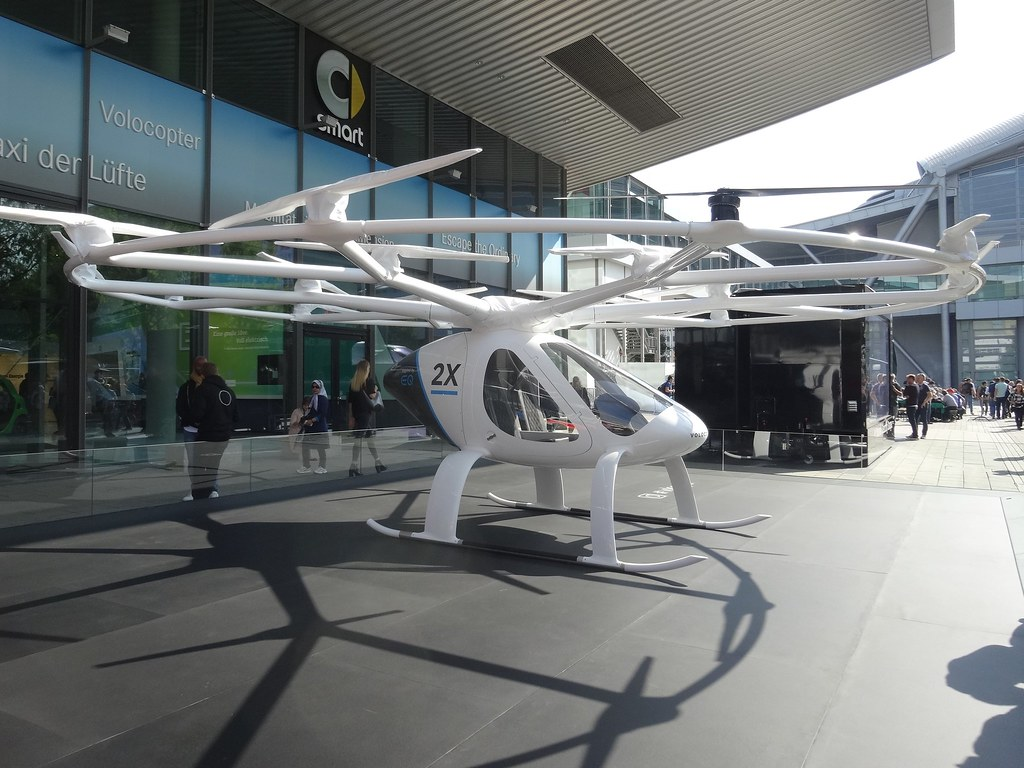
Volocopter Secures $182M to Advance eVTOL Certification
Volocopter, the German developer of electric vertical takeoff and landing (eVTOL) aircraft, has secured an additional $182 million in the second signing of its Series E funding round. This follows the $170 million raised earlier in the same round, which valued the company at $1.87 billion post-money. The new capital will be directed toward accelerating the testing and certification of its flagship two-seat VoloCity air taxi under the European Union Aviation Safety Agency’s (EASA) Special Condition for small category VTOL aircraft.

The company has been progressing through EASA’s rigorous certification process, having achieved Design Organisation Approval in 2019 and Production Organisation Approval in 2021—two critical milestones toward type certification. Volocopter aims to secure certification by the second half of 2023, with plans to initiate revenue-generating flights in 2024. According to a company spokesperson, the funds will also support the broader urban air mobility ecosystem, including infrastructure development, integration with existing transport networks, and public engagement to ensure readiness for immediate operations once certification is granted.
Helena Treeck, Volocopter’s head of PR, stated, “First commercial operations will be a small number of Volocopters flying on specific routes (maybe one or two) with paying customers. From there, the network of routes will continuously grow to offer more and more routes and flights on connections, where we can really add value (beyond the fantastic view) to our customers, like time savings and predictability of services.”
Earlier this month, the VoloCity completed its first crewed public test flight from Rome’s Fiumicino Airport. This demonstration also showcased the company’s VoloIQ digital platform, designed to handle customer bookings, flight operations management, and operational analytics. Rome is a strong contender for Volocopter’s initial market launch, though other potential launch cities include Singapore, Paris, and Neom—a planned smart city in Saudi Arabia’s Tabuk Province.
Neom participated as a lead investor in this funding round, alongside GLy Capital Management of Hong Kong, a Geely-backed private equity firm specializing in smart vehicles, electrification, and intelligent city systems. Neom and Volocopter established a joint venture in December of the previous year to integrate the VoloCity air taxi and the VoloDrone heavy-lift electric drone into Neom’s connected mobility framework. Neom has already ordered 15 Volocopter aircraft, with plans to commence flight operations within one to two years.
In parallel, Volocopter has formed a joint venture with Geely Holding to introduce urban air mobility solutions in China. Under an agreement signed last year, the Chinese venture will purchase 150 Volocopter aircraft, with Geely expected to contribute to production capabilities. This partnership underscores the strategic importance of manufacturing scalability and regional adaptation in deploying eVTOL services.
The VoloCity is engineered for short-range urban missions, optimized for low noise emissions and zero in-flight carbon output. Its design reflects compliance with stringent European safety standards, including redundancy in critical systems and advanced flight control architectures. The aircraft’s operational concept hinges on point-to-point service within congested metropolitan areas, aiming to reduce travel times and alleviate ground traffic density.
Urban air mobility remains a complex challenge, requiring not only certified aircraft but also robust infrastructure such as vertiports, integrated digital platforms, and harmonized airspace management. Volocopter’s VoloIQ system represents an effort to unify these elements, providing a backbone for scheduling, fleet monitoring, and customer interaction. Such systems are essential for scaling operations beyond initial demonstration routes.
The company’s funding trajectory and collaborative ventures indicate a deliberate approach to market entry, balancing technological readiness with ecosystem development. By securing strategic investors aligned with smart city initiatives and sustainable transport, Volocopter positions itself to bridge the gap between prototype demonstrations and sustained commercial service.