NASA Bets on Blue Origin’s New Glenn for Mars Mission
Blue Origin’s long-delayed New Glenn rocket now has a high-profile payload for its debut flight: NASA’s ESCAPADE mission to Mars. Rather than opting for a symbolic or purely promotional payload, the company will carry two scientific probes designed to study the red planet’s plasma and magnetic environment. This decision marks a notable departure from the approach taken by SpaceX during Falcon Heavy’s maiden launch, which famously sent a sports car into space.

ESCAPADE, short for Escape and Plasma Acceleration and Dynamics Explorers, is a relatively low-cost planetary science mission with a budget of about $79 million. That figure is significantly lower than recent Mars missions, making it a more acceptable risk for NASA to place on an unproven launch vehicle. The mission’s two spacecraft will operate in complementary orbits around Mars, gathering simultaneous measurements of plasma and magnetic fields. These data will help scientists better understand how atmospheric particles escape into space, a process that has influenced the planet’s climate over time.
Bradley Smith, NASA’s director of launch services, told a NASA advisory committee that ESCAPADE will “very likely be the very first launch of New Glenn” and described it as “an incredible ambitious launch for New Glenn.” The mission’s timing is critical due to the narrow launch window for Mars transfers. While earlier public documents suggested an August 2024 target, Smith now indicates the launch will occur “around this time next year.”
Rob Lillis, principal investigator at the University of California Berkeley’s Space Science Laboratory, noted earlier this year that the August 2024 window was “approximate and provisional,” with engineers still evaluating trajectory options. These include either deploying the satellites into Earth orbit before using onboard propulsion to reach Mars or launching directly to the planet. Given New Glenn’s heavy-lift capability—able to send payloads of nearly 100,000 pounds to low-Earth orbit—the rocket should be capable of a direct trajectory for the two half-ton spacecraft.
The stakes are heightened by the 26-month cadence of Mars launch opportunities. Missing the late 2024 window would push ESCAPADE’s flight to late 2026. The mission was initially slated to ride as a secondary payload on a Falcon Heavy launch alongside NASA’s Psyche asteroid mission in October, but trajectory constraints led to its removal. Subsequent redesigns leveraged a larger Rocket Lab spacecraft platform, providing more propulsion flexibility. In February, NASA announced the Blue Origin launch contract, and ESCAPADE has since moved to the front of New Glenn’s manifest.
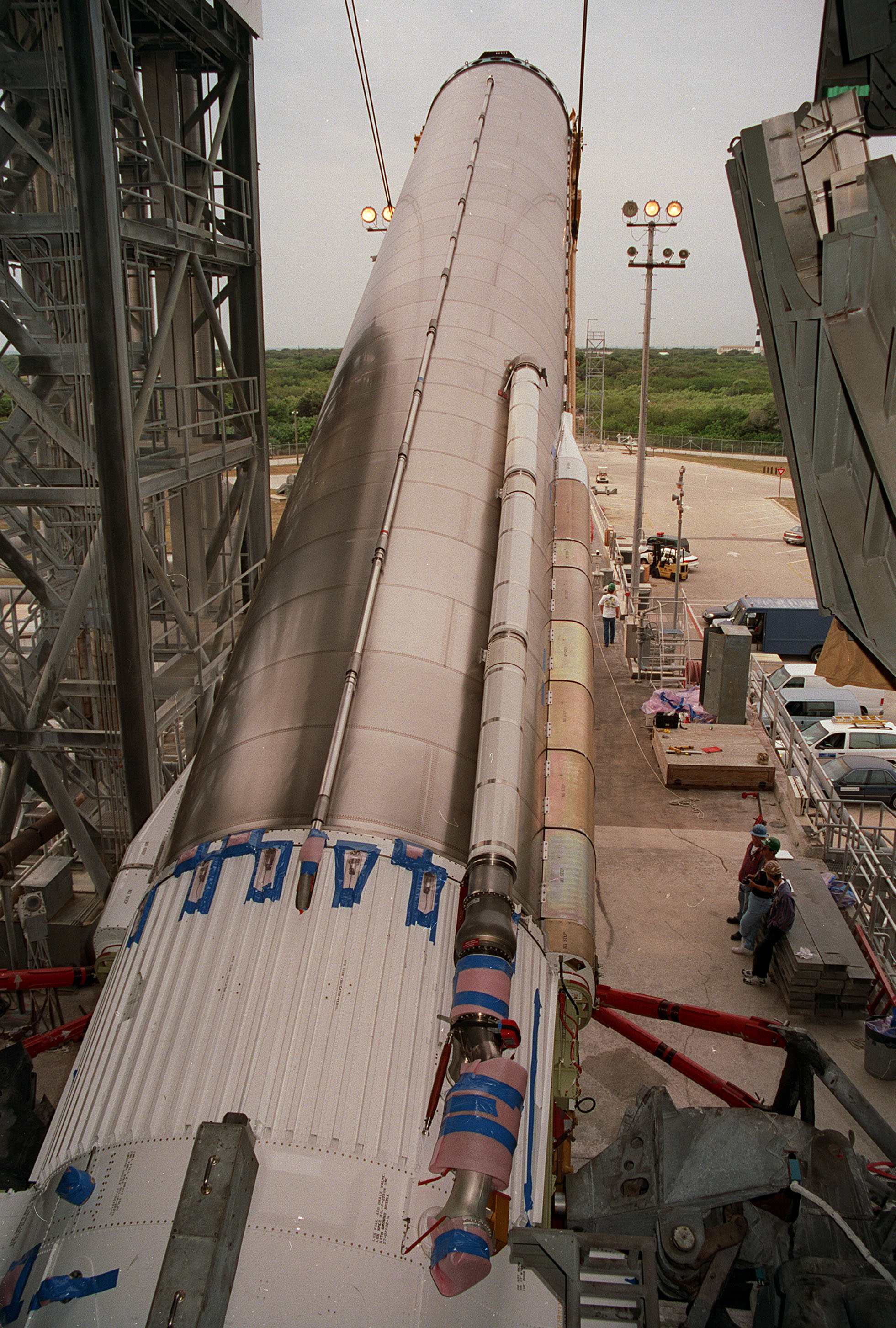
New Glenn’s development has been marked by delays. Originally planned for a 2020 debut, the rocket is now four years behind schedule. Standing over 320 feet tall with a 23-foot diameter payload fairing, it surpasses the dimensions of any currently operational rocket. Its payload capacity places it above United Launch Alliance’s Vulcan and SpaceX’s Falcon 9, though still below Falcon Heavy.
Procurement documents suggest NASA secured the ESCAPADE launch for about $20 million, a price reflecting the inherent risk of a first-flight mission. Smith acknowledged not only the risk of a potential launch failure but also schedule uncertainties, noting, “There’s certainly some schedule risk associated with New Glenn getting to the pad a year from now. They’re building hardware … I’ve seen their schedule. I’m not going to put a percentage out there.”
While Blue Origin’s launch pad at Cape Canaveral Space Force Station is complete and rocket components are in production nearby, the company has yet to roll out a full-scale New Glenn for integrated pad testing. Such tests, including propellant loading and countdown rehearsals, have taken months to over a year for other large rockets like SpaceX’s Starship, ULA’s Vulcan, and Europe’s Ariane 6.
NASA’s contract with Blue Origin falls under its venture-class procurement initiative, a program typically associated with smaller launchers such as Rocket Lab’s Electron or Firefly’s Alpha. Smith explained, “As a trade-off of taking a little more risk on an unproven rocket, your deliverables are a little bit different, and your confidence in making a call to your customer about when you’re ready to go fly is a little bit diminished.”