Drone Swarms Push Boundaries of Technology and Security
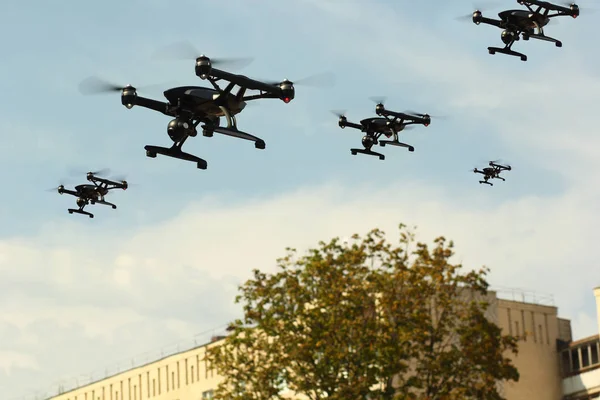
Uncrewed vehicle swarms—whether airborne or ground-based—are rapidly reshaping the landscape of both opportunity and risk in security and engineering. Advances in technical sophistication, falling costs, and increasingly creative applications have converged to make swarm systems viable for missions once thought impractical. The U.S. Government Accountability Office’s Science, Technology Assessment, and Analytics division highlighted these developments in its September 2023 report, noting that “drone swarm technologies coordinate at least three and up to thousands of drones to perform missions cooperatively with limited need for human attention and control.”

Swarm architectures vary in complexity. At the simplest level, centralized control places individual drones under direct human operation. More advanced decentralized control allows drones to receive commands from a human operator while exchanging data among themselves. The highest sophistication comes with fully autonomous swarms, in which vehicles are programmed with objectives and collaborate without further human input. Such autonomy relies heavily on artificial intelligence, a capability now maturing rapidly.
The first documented military use of a drone swarm occurred in 2021, when Israel deployed the technology in Gaza. According to Forbes, “Mortar support companies were re-equipped with swarm drones which reportedly gathered intelligence, located targets, and carried out attacks on Hamas forces. It also provided targeting information for guided mortar weapons and carried out more than 30 ‘successful operations’ against militants attempting to launch rockets at Israel.” This operation appeared to blend autonomous and semi-autonomous elements, distinct from Russia’s use of kamikaze drones in Ukraine, which lack inter-drone coordination.
Shield AI, a U.S. developer, has described its systems as enabling autonomous missions in “data-denied [and] GPS-denied environments,” underscoring the push toward resilience in contested domains. Outside military applications, swarm technology is finding roles in agriculture, emergency response, and entertainment. The GAO report cites uses such as planting seeds, detecting crop diseases, delivering disaster relief, and replacing fireworks with coordinated drone displays to reduce environmental impact.
Academic research is also expanding the scope of swarms. University of Houston’s Aaron Becker has explored aerial security coverage for commercial campuses, balancing patrol duties with battery limitations. At Virginia Tech, Ryan Williams is studying autonomous swarms for rapid search-and-rescue in wilderness areas—methods that could translate to industrial site monitoring or perimeter security.
Risks are equally pronounced. In one incident five years ago, organized criminals used dozens of drones to disrupt an FBI hostage rescue team, likely under centralized control. Techniques used for legitimate infrastructure inspection can be repurposed to identify vulnerabilities, and agricultural drones could just as easily disperse harmful agents as beneficial treatments. Corporate espionage poses another vector, with autonomous swarms potentially aiding in theft of intellectual property or unauthorized facility access.
Regulatory gaps compound these threats. Zev Faintuch wrote in Security Management that “the threat of a sophisticated, high-profile [aerial vehicle-borne improvised explosive device] attack is compounded by an inadequate legal and regulatory framework,” noting that only the Departments of Justice and Homeland Security currently have authority to disable drones. The Biden administration’s 2022 national action plan called for legislative updates and broader authority across government levels.
The trajectory of swarm technology points toward a more formidable future. As War on the Rocks warned in its commentary “Drones of Mass Destruction: Drone Swarms and the Future of Nuclear, Chemical, and Biological Weapons,” “As the technology underlying drone swarms matures and spreads, the barriers to entry will almost inevitably fall.” Samuel Bendett of the U.S. Center for Naval Analyses described autonomous swarms as “the holy grail,” pursued by nations including the United States, Israel, China, Russia, Turkey, Iran, India, and South Korea.
Such systems rely on inter-vehicle communication, making them susceptible to electronic warfare and cyber hijacking. Yet their potential destructive capacity is unmatched in cost-effectiveness. The Atlantic observed, “When you consider that a drone swarm consisting of many thousands of off-the-shelf drones would cost less than, say, one F-35 fighter or a ballistic missile, you have a weapon that would give rogue states or terrorist groups the means to launch devastating attacks or assassinations anywhere in the world.” The implications for airspace dominance and strategic deterrence are profound, with even high-value assets potentially rendered vulnerable.