


Ariane 6, Falcon 9, Atlas V, Electron Lead Record-Breaking Launch Week

Over the course of one week, an unprecedented demonstration of worldwide spaceflight capability will unfold with no less than 13 orbital and suborbital flights-a lineup encompassing every major launch region-sketching the fast-paced development of both large-lift and small-satellite launch industries. In a week that ranges from Europe’s Ariane 6 to SpaceX’s relentless Starlink cadence, from South Korea’s first commercial orbital rocket to Blue Origin’s historic accessibility milestone, the industry is showing unprecedented breadth and operational tempo.
1. China’s Long March 4B Opens the Week
A week that started in perfect fashion for the China Aerospace Science and Technology Corporation saw the Chang Zheng 4B loft the Ziyuan-3 04 satellite from Taiyuan Satellite Launch Center on Dec. 16 at 03:17 UTC. For civilian high-resolution stereoscopic mapping, the Ziyuan-3 series is equipped with a three-line panchromatic camera and multispectral imager. It was the 55th flight by the rocket since 1999, with just one failure during that time – again showing the reliability of China’s workhorse for Sun-synchronous orbit missions.
2. Atlas V Delivers Amazon Leo Satellites
United Launch Alliance’s Atlas V 551 launched 27 Amazon Leo satellites from Cape Canaveral on Dec. 16 at 08:38 UTC. The mission brings Amazon’s constellation to 180 operational spacecraft, still a far cry from the FCC-mandated 1,616 by July 2026. As analysts point out, regulators are likely to accommodate their applications to prevent the further solidification of Starlink’s dominance. This was ULA’s last launch of 2025; future deployments depend on Vulcan Centaur, Ariane 6, and Blue Origin’s New Glenn.
3. Japan’s H3 Rocket Expands QZSS
JAXA’s H3-22S will be launching the Michibiki 5 on Dec. 17 at 02:10 UTC from Tanegashima. The 4,900 kg satellite will add to the Quasi-Zenith Satellite System, which will provide GPS-interoperable signals and 6–12 cm horizontal accuracy through the Centimeter Level Augmentation Service. The satellite constellation enables disaster communications, and it is expanding to seven spacecraft to allow better coverage in the Asia-Pacific urban and mountainous regions.
4. Ariane 6 Places Galileo Satellites in MEO
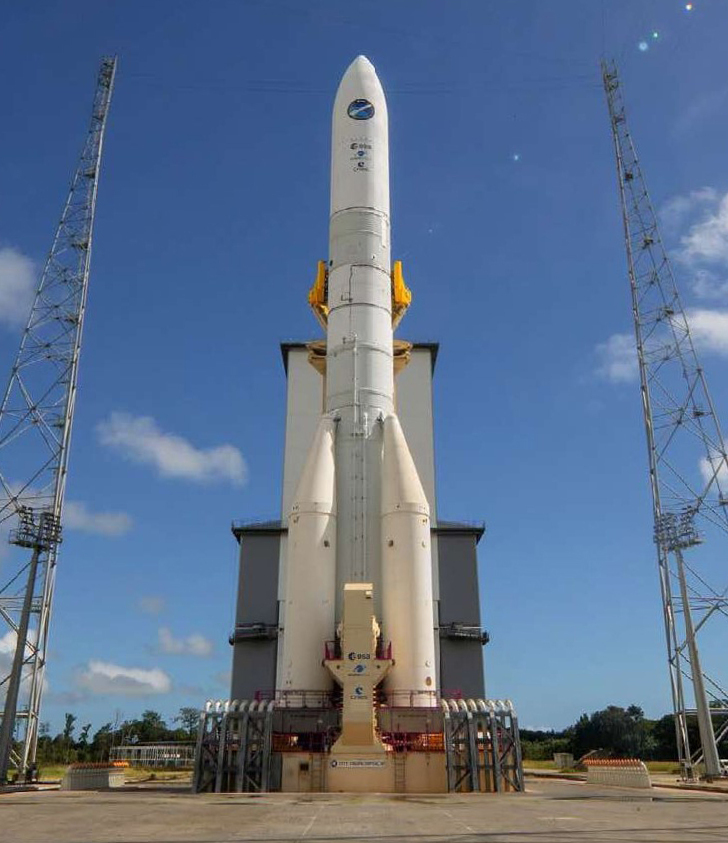
The Ariane 62, produced by Arianespace, will carry Galileo FOC satellites SAT 33 and SAT 34 to orbit on Dec. 17 at 05:01 UTC, lifting off from the Guiana Space Centre in French Guiana. Today, Galileo is used by more than four billion users around the globe, providing passive positioning accuracy as low as 20 cm using its High Accuracy Service. The Vinci-powered upper stage of the mission will perform multiple burns to reach an accurate medium-Earth orbit, with each satellite equipped with Search and Rescue transponders supporting the Cospas-Sarsat network.
5. SpaceX’s Record Starlink Cadence
SpaceX will launch three Starlink missions just this week. Falcon 9 booster B1094 will make its sixth flight from Florida’s LC-39A on Dec. 17, deploying 29 v2 Mini satellites. Just hours later, California’s SLC-4E will host the 30th flight of veteran booster B1063, carrying 27 satellites. Then on Dec. 20, debut booster B1101 will take 29 satellites from SLC-40 with a record two-day, two-hour pad turnaround. With more than 10,000 orbiting Starlink satellites, 2025 has seen 166 Falcon 9 flights to date from SpaceX – the leader in global launch cadence by a large margin.
6. South Korea’s Innospace Debuts Hanbit-Nano
Innospace’s maiden commercial orbital mission, Spaceward, is scheduled to lift off on Dec. 17 at 18:45 UTC from Brazil’s Alcântara Space Center. The solid-fueled Hanbit-Nano is capable of delivering 90 kg to LEO and will carry eight payloads comprising climate monitoring and tech demonstration satellites. According to CEO Soojong Kim, becoming the first Korean private company to deploy customer satellites into orbit will be symbolic, embedding the company in history as the country’s very first commercial space launch provider.
7. Rocket Lab’s Electron Launches DiskSats
Rocket Lab’s Dec. 18 STP-S30 mission from Wallops Island will carry four DiskSats — flat, one-meter-diameter spacecraft the company designed for very low Earth orbit operation. Developed on contract with The Aerospace Corporation using NASA funding, the DiskSats are capable of generating up to 100 watts of power and reducing drag to maintain altitudes below 300 km for extended periods. Quick-maneuvering capability, electric propulsion, and multi-orbit capability will be demonstrated on this mission, accelerated from 2026 at the request of the Space Force
8. Blue Origin’s Historic Accessibility Flight
On Dec. 18, Blue Origin’s New Shepard NS-37 will fly six passengers to space, including the first wheelchair user to do so, aerospace engineer Michaela Benthaus. Benthaus is an AstroAccess ambassador, one of several people with disabilities who have flown or will fly on New Shepard flights to help raise awareness and assess accessibility in space travel. “This feels like an important step since space travel for people with disabilities is still in its very early days. I’m so thankful, and hope it inspires a change in mindset across the space industry.” The suborbital flight will last 10-12 minutes in total, providing several minutes of weightlessness and views beyond the Kármán line to add to accessible spacecraft environments research.
9. China’s Chang Zheng 5 Closes the Week
The China National Space Administration will launch its heavy-lift Chang Zheng 5 from Wenchang on Dec. 20 with a classified payload. Standing 57 m tall with four strap-on boosters, the CZ-5 is China’s most powerful rocket, capable of delivering large payloads to high-energy orbits. This will be its second flight of 2025, following a 58-day turnaround at the coastal site. This concentrated sequence of launches-navigation constellations, broadband megaconstellations, experimental satellite architectures, and inclusive human spaceflight-showcases the acceleration in diversification and operational maturity in the global space industry.


