Tesla Optimus’ Viral Wipeout Exposes the Hard Part of Humanoids
Because the public reads a stumble as a verdict on autonomy, safety, and honesty all at once, a single clumsy fall can undo months of carefully curated “progress” in humanoid robotics. That’s why the leaked clip from Tesla’s “Autonomy Visualized” event in Miami-showing an Optimus robot toppling while handing out bottled water-landed as more than slapstick. The moment compressed a set of engineering realities that rarely fit inside highlight reels: balance is fragile, demonstrations are staged to varying degrees, and the distance between a lab video and a fieldable product remains large.

In the video, Optimus seems to fumble the handoff task, scatter bottles, lift its hands toward its face, and then fall backward. The gesture is the detail that drove the clip’s second life online, because it resembles an operator’s muscle memory: the two-handed motion used to remove a VR headset. Commentators tied the movement to teleoperation workflows common in robotics development-an approach that can be legitimate for data collection and training, but becomes controversial when a demo is framed as fully autonomous.
Tesla has acknowledged the use of remote operators in earlier Optimus showcases-a dynamic which became part of the broader Wizard of Oz debate around humanoids: when a machine looks capable in public, observers ask how much of the competence is software on-board, and how much is a human behind the curtain. That question got re-litigated with the Miami clip because the robot’s “phantom headset” gesture looks less like a control policy and more like a mirrored human habit-just the kind of artifact that teleoperation can leak into motion.
The deeper issue is not that a biped fell. Humanoids fall because they are, by design, dynamically balancing machines with high centers of mass, intermittent foot contact, and limited margins against unexpected pushes, slick floors, or slight timing errors in joint torque. What does change in a public setting is consequence: a fall is no longer a safe lab incident; it becomes a perceived safety failure near bystanders, and a credibility test for anyone selling the idea of general-purpose robots.
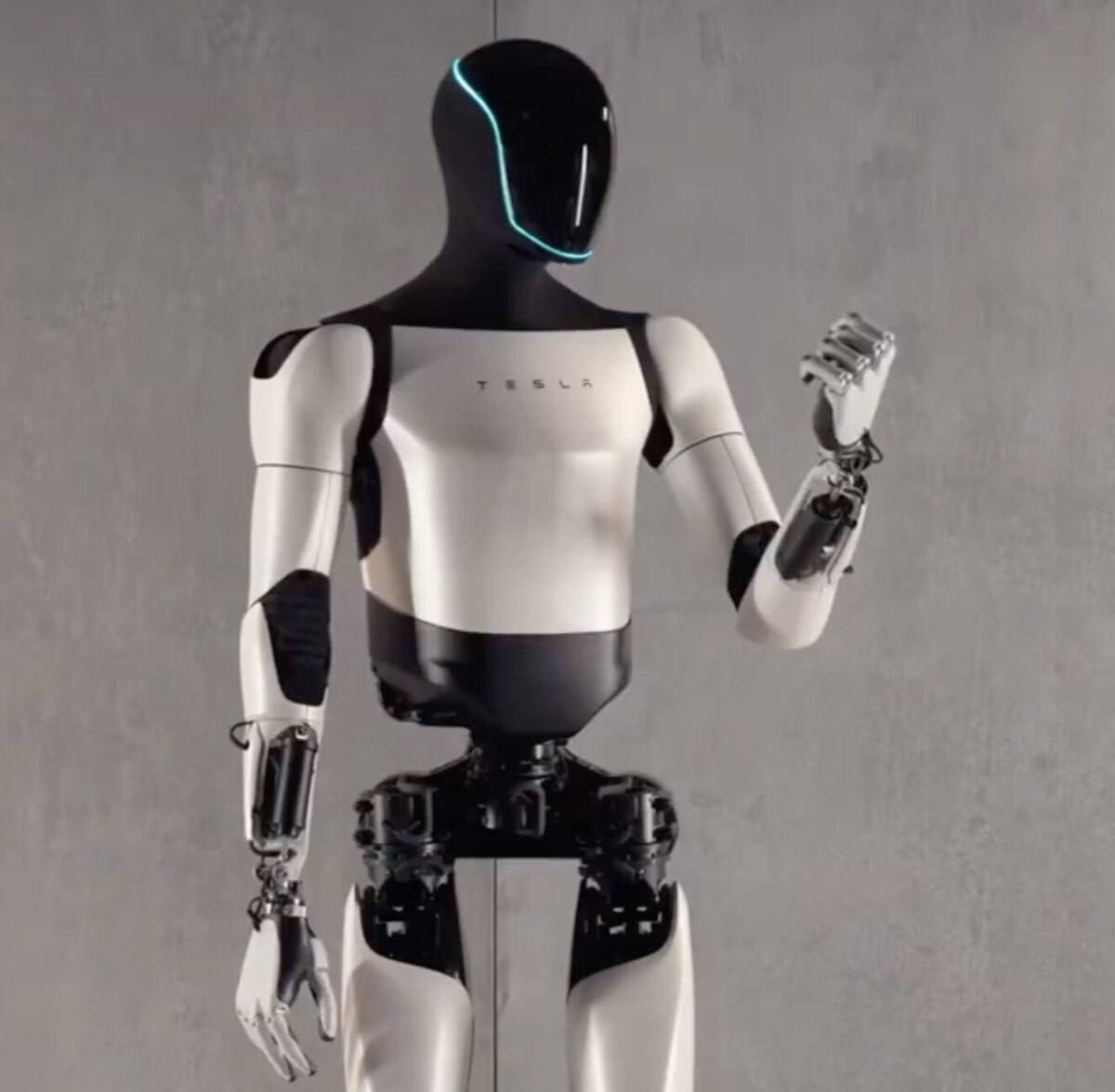
That credibility matters because Optimus is not positioned as some niche automation product. Musk has repeatedly described Optimus as transformative, including the claim that it “has the potential to be the biggest product of all time,” and Tesla has floated pricing in the consumer-electronics range. Meanwhile, Tesla’s own published specs and demo footage frame Optimus as a high-DoF platform-about 5 feet 11 inches, roughly 160 pounds, with 11-DoF hands and a 2.3 kWh battery that Tesla has characterized as supporting near full-day operation under certain loads, with power draw ranging from idle to walking. Those numbers are not trivial; they imply a machine intended to operate around people, for long durations, while manipulating objects that humans care about. That is exactly the regime where “mostly works in a demo” is not an acceptable quality bar.
One reason the Miami incident resonates with engineers is that bottle handoffs sit at the intersection of two hard problems. The first is whole-body control: stabilizing a tall, heavy machine while it reaches, shifts weight, and deals with the coupled dynamics of arm motion and torso sway. The second is manipulation under uncertainty: grasping objects with variable friction, inconsistent placement, and social constraints-no sudden jerks, no dropped items-while the robot’s perception is being challenged by glare, clutter, and people moving through its field of view. If teleoperation is involved, it can patch over the long tail of these failures, but it also masks which parts of the stack are truly robust.
The same gap is being wrestled with in the broader humanoid sector: AI labs and robotics companies are converging on “physical AI,” including approaches that use large language models to translate natural-language goals into action plans for robot arms and mobile platforms. Google’s Gemini Robotics framing is one example of this trend: language becomes an interface layer, while the hard work remains in perception, control, and safety constraints at the actuator level. In practice these systems still require long test cycles in real environments—and in many deployments, structured workcells that limit what can go wrong.
Workcells are also where safety standards are most mature. The 2025 revision of ISO 10218 pushes functional-safety requirements to be more explicit and expands coverage for collaborative applications and cybersecurity considerations. That matters for humanoids even when they are not “industrial robots” in the classic sense. Design intent-robots operating near humans-forces the same questions: what hazards exist, what protective measures are built in, what operational modes are permitted, and what happens under fault conditions such as a fall, a sensor dropout, or a network interruption. Commercialization pressure adds another layer. Tesla has spoken about deploying Optimus in its own factories, but building a handful of prototypes and sustaining production at scale are radically different challenges.
A report cited by The Information cited Tesla was only in the hundreds of produced units in 2025 against an earlier goal of 5,000, a shortfall that aligns with an industry-wide reality: humanoids are still supply-chain experiments as much as they are control problems. Actuators, transmissions, hands, sensors, thermal management, and battery systems all interact in ways that are expensive to iterate, and small changes can ripple through reliability, runtime, and maintainability. Competitors have meanwhile pursued more narrow paths to “real work”. Agility Robotics’ Digit, for instance, has been deployed in logistics settings, where it moves items and interacts with conveyors-tasks chosen because they can be bounded and instrumented. The headline may be the humanoid form factor, but the product strategy is often more about reducing open-world unpredictability rather than embracing it.
The Miami clip is best read, then, as a stress test of messaging more than mechanics. When a robot is framed as autonomous, observers scrutinize it for autonomy signatures-and teleoperation signatures. When it is framed as a near-term coworker, people look for safety cues, graceful degradation, and controlled failure modes. A fall with an uncanny “headset removal” gesture collapses all those interpretations into a single viral moment, and forces an uncomfortable but technically meaningful question: what, exactly, was demonstrated—an embodied AI system, a human-in-the-loop training method, or a choreography that blurred the line between the two? For the humanoid industry, the practical takeaway is clear: the next phase of progress will be measured less by acrobatic clips and more by repeatable, audited performance in constrained environments, with transparent operating modes and safety cases that can survive scrutiny. The public demos can still help, only if they show what the robot does reliably, instead of what an audience wants to believe it does.