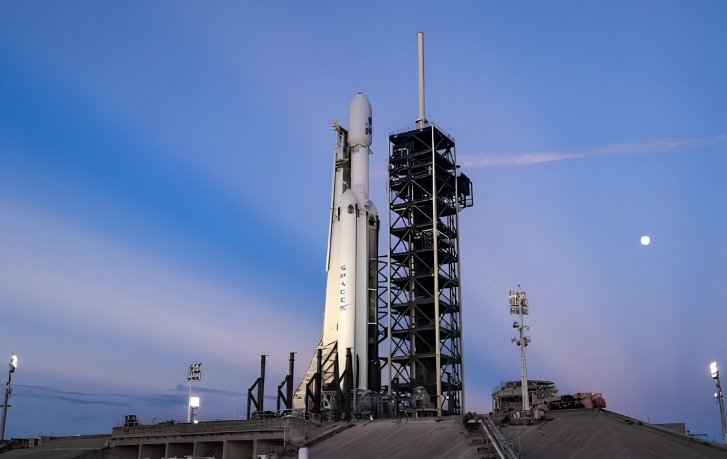
Artemis 2 Puts NASA’s Moon Rocket and Orion to the Test
“What is more consequential than a mere journey round the moon is not the destination, but the test that Artemis 2 is heading for? With its next-generation crewed lunar flyby, NASA will seek answers to a question it has not tackled since the Apollo days: whether its deep-space capability can safely transport people well beyond low Earth orbit and safely bring them back home. In their maiden voyage, the Space Launch System rocket is combined with the Orion spacecraft and four astronauts are sent on a 10-day trip around the moon and back. Provided a successful flight, Artemis 2 will be the first NASA mission to carry crew on the SLS rocket and the Orion spacecraft, a milestone that is much more significant than any single launch date.

The crew shows the extent to which the program has expanded. The mission will be commanded by Reid Wiseman with Victor Glover as pilot and Christina Koch and Jeremy Hansen as mission specialists. Another point highlighted by Hansen about the role of Canada in Artemis is beyond astronaut involvement into infrastructure in the future to the moon. Artemis 2 will not be a landing mission. It is tasked with validating the machinery, procedures and human factors that subsequent missions will rely on when the stakes are further escalated.
And that is to demonstrate far more than rudimentary launch capability. Following a launch at Pad 39B at the Kennedy Space Center, Orion will enter Earth orbit, burn a series of thrusters and then launch out on a hybrid free-return orbit that encircles the moon, which would naturally bring the spacecraft back to Earth. The astronauts will test the life-support performance, navigation, communications and habitable in actual deep-space conditions, on the way. Here too, the role of ESA plays a central part since the Orion capsule relies on the European Service Module to supply power, propulsion and other important life-support requirements of the capsule.
The technical worth of the mission is more apparent in the details. Orion will be equipped with a full life-support system instead of the uncrewed nature of the Artemis 1. The crew will also perform a demonstration of proximity-operations in space, an exercise related to the level of rendezvous and docking accuracy future lunar operations will need. Construction of Artemis architecture is in flights and this flight is the one that several of those flights finally get human rated as opposed to theory.
The center of the vehicle design is, therefore, safety. Orion uses guidance, propulsion, power and crew redundancy and contains five autonomous flight computers. It also has a launch abort system that can pull the capsule out of the rocket in milliseconds should a serious ascent issue arise. Those are not decorative engineering. The mission, Artemis 2, will prove whether all that fault tolerance is a functioning system with people on board.
Of greater significance of Artemis 2 is its successor. NASA has already demonstrated that Orion can make a trip around the moon without astronauts; this flight will reveal what the spacecraft will do when the health of the crew, along with cabin processes and decision-making, are added to the equation. According to NASA, Artemis 2 is a step towards subsequent surface missions and eventually towards future missions to Mars, though its immediate meaning is much closer to home. Until a new trip back to the moon becomes regular, NASA must demonstrate that its new system can meet the oldest challenge in exploration: the ability to transport human beings into deep space and bring them back alive.”