Hubble at 36 Gets Rare Close-Up From Another Satellite
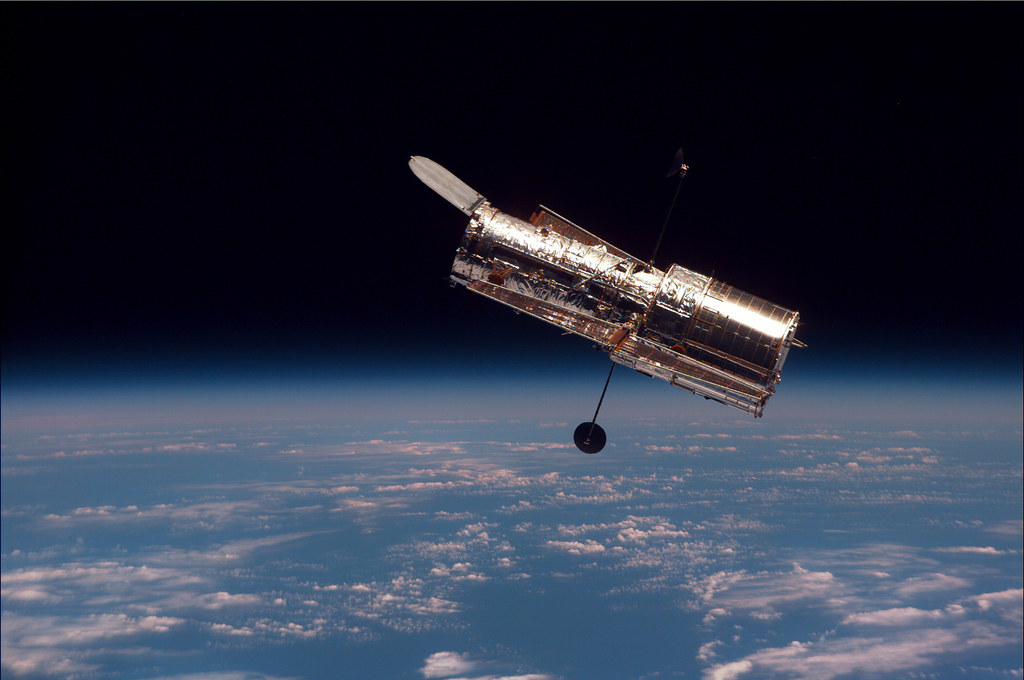
Even for an instrument that has been serving humanity for several decades, being photographed from orbit is still an uncommon occurrence. This makes the 36th anniversary of Hubble’s launch particularly special: an image of the observatory was obtained using a World View Legion spacecraft from Vantor, which captured Hubble from a range of roughly 34.8 miles away. This is a unique photo not just because it shows the Hubble Space Telescope itself in exquisite detail, but also because it shows one of the developing capabilities satellite-on-satellite imagery with enough resolution to see the structure, condition, and arrangement of the object.

According to Vantor, the image was taken by World View Legion 4, one of the six satellites operating at a height of about 322 miles above Earth. In this picture, the viewer can see Hubble’s tubular body, its thermal protection, solar panels, and an open aperture door. The company noted that the image had a space sample distance of 4.0 centimeters, which is an unusually precise rendering of the spacecraft that has become so iconic after years of observing nebulae and galaxies.
Hubble Space Telescope has remained uniquely mechanical as a result of efforts to make it function as a laboratory of optics in space. Specifically, Hubble is known to be a Cassegrain reflector featuring a 2.4-meter primary mirror. As the name suggests, it uses a system wherein light coming from the main mirror goes to a secondary mirror and back to the telescope itself in order to feed its scientific instruments. This, together with the fact that Hubble is positioned above most of Earth’s atmosphere, allows it to conduct extremely accurate visible and ultraviolet observations.
However, Hubble has demonstrated surprising durability as a result of its long history. After its successful deployment in 1990 and subsequent discovery of a flaw in the mirror, NASA engineers made repairs in 1993 with the help of astronauts. This approach of maintaining and upgrading the telescope on orbit has turned a potential engineering catastrophe into one of the greatest success stories in aerospace.
Hubble’s current durability has more to do with meticulous engineering than dramatic rescues. Gyroscopes, reaction wheels, guidance systems, batteries, and solar arrays allow the observatory to control its orientation in space, and NASA reports that three of the gyros are operational. Of those, one is currently dedicated to scientific observations while the others serve as reserves. This resource management approach makes it possible for Hubble to operate successfully even in the times of James Webb Space Telescope, providing some overlap between the telescopes’ functions and extending coverage into different wavelengths.
On the industrial front, this might be equally or even more important than just a birthday photo. While commercial imagery providers have traditionally offered pictures of objects on Earth, the ability to photograph satellites in orbit is becoming increasingly commonplace. For instance, this kind of service is vital for space situational awareness a broader term describing space-based surveillance of orbital traffic. A detailed picture of Hubble is indeed fascinating but is also a good example of a valuable capability that is used in various practical applications including inspection, monitoring, and space operations.
In this case, the picture of Hubble performs a dual role as a tribute to the veteran and an illustration of space observation becoming much more multi-dimensional. For decades, the majority of satellites looked out of the planet. Now, some satellites are looking at the universe while others continue to focus on Earth. In addition, some of them look at each other.