Artemis 2 Moon Photos Expose a Hidden Face of Lunar History
How could these few shots taken by astronauts matter if the moon has been mapped for decades? Because only the far side holds a secret that cannot be captured by orbiting spacecraft cameras and Earth telescopes a combination of human-timed and color-corrected imagery taken at a spot almost never pointing to the earth directly. This is the significance behind the recent partnership of Reid Wiseman, commander of the Artemis 2 mission, and Andrew McCarthy, an astrophotographer.

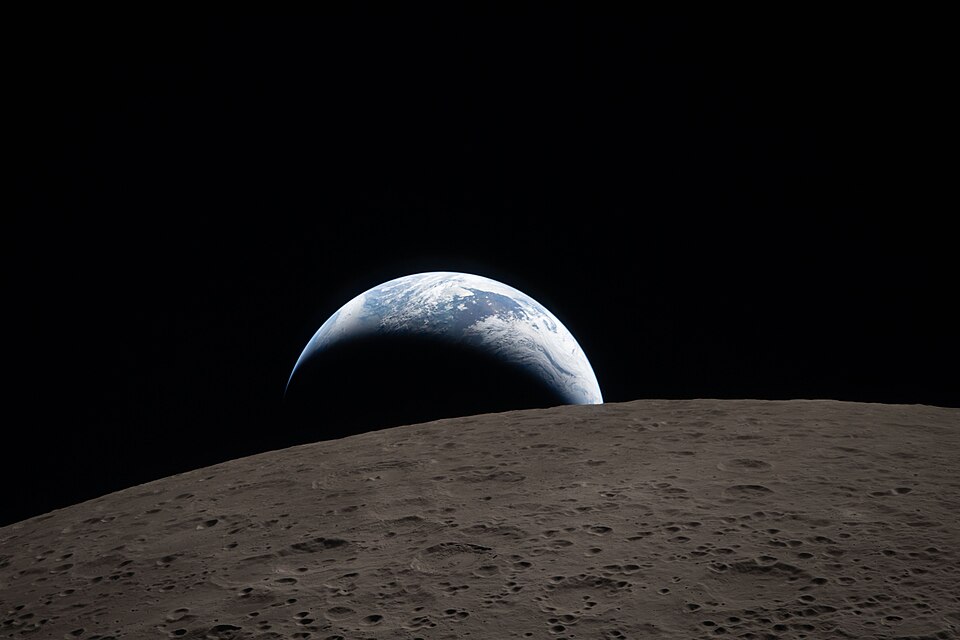
Andrew McCarthy creates his lunar photos by using hundreds or even thousands of images stacked on top of each other until they reveal faint traces of minerals with shades of blue, brown, and red. The point of such a technique is not to duplicate the eye perspective of the surface of the moon. Rather, McCarthy tries to create a photograph that shows how the Moon looks like “as if you had cyborg eyes.” With Wiseman and NASA’s photo experts, he applied his technique to the shots taken from the Orion capsule as the crew went over the far side of the Moon, which is always facing away from Earth and can only rarely make it visible due to libration effects. This means the partnership resulted not only in new images of the Moon but in a new approach to viewing the far side.
Indeed, the far side of the moon has always seemed more inhospitable than its visible counterpart viewed from Earth. Far side craters appear denser, more brightly colored, and with fewer volcanic plains. Only 1% of the far side contains maria, whereas extensive lava flows created huge areas of black plains on the near side. The fact that there is so much difference between the two halves of the Moon allows for the formation of some hypotheses about its origin. The difference in crust thickness, heat distribution, and composition of elements explains why one half became more volcanically active than another.
Thus, enhanced color comes as a bonus. McCarthy doesn’t invent new features in his photographs but enhances existing ones by focusing on different spectra of light and colors. Titanium-rich basalt tends to give off blue hues, while iron-enriched or older material is more likely to be reddish-brown. These colors can help researchers with the study of the far side since its old surface wasn’t affected by volcanic processes much, allowing them to explore traces of Moon’s early history preserved here. As the Planetary Society notes, these parts of the far side provide invaluable information regarding Moon-Earth collision and their early evolution.
Furthermore, Wiseman’s shots offer an additional technical bonus. Since there was no atmosphere getting in the way of the camera, McCarthy could take advantage of the fact that the photos required fewer frames to minimize background noises and extract information necessary for creating color photos. It is phenomenally clean, McCarthy commented. It’s the best data I’ve ever worked. This means that despite the fact that there have been plenty of missions photographing the far side, the new images provide additional depth of analysis.
From this perspective, the choice of timing seems rather fitting. In 2019, China’s Chang’e 4 landed on the far side, becoming the first spacecraft in the history of space exploration to do so. In 2024, Chang’e 6 brought to Earth the first ever samples taken from the far side. Moreover, scientists consider the far side of the Moon to be a perfect place for developing radio astronomy research since Earth’s radiation can be blocked, as well as a great spot for exploring the dichotomy of the two sides of the Moon. In other words, the interest in studying the far side of the Moon is currently increasing, and Wiseman and McCarthy provided a wonderful boost to this effort.