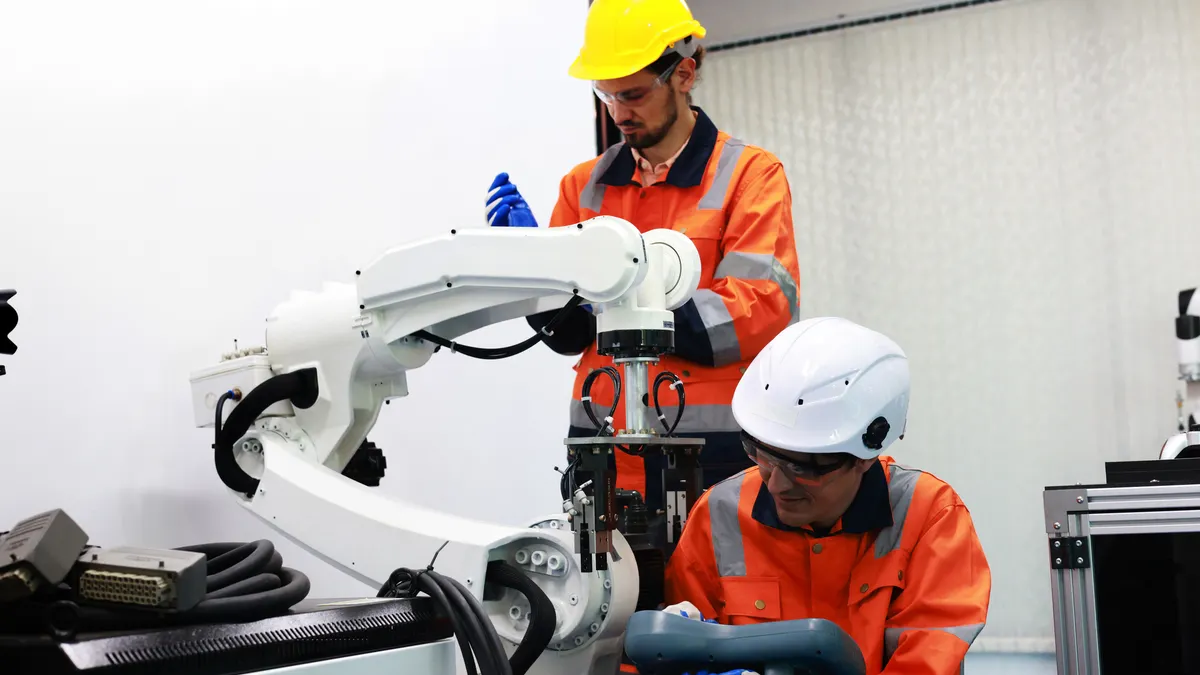
Humanoid Robotics Poised to Reshape Construction Productivity

Labor shortage and productivity growth have long been pressing problems for the construction sector, but it is soon set to be derailed by the rapid increase in humanoid robots. According to the latest research from McKinsey Global, productivity growth in the sector has been at a mere 0.4 percent per year ever since 2000 and fell by 8 percent between 2020 and 2022. By contrast, global demand for housing and infrastructure will trail supply by no less than $40 trillion. It is against this background that general-purpose humanoid robots, which have a multitude of functions on chaotic and unstructured construction sites, shifted from the “dreamy vision” realms to imminent realization.
1. From Task-Specific Machines to General-Purpose Humanoids
Historically, robotics for the construction sector has focused on specific solutions: autonomous excavators, bricklaying robots such as Hadrian X, drones for surveying functions, and robotic arms for off-site construction. These solutions are highly efficient at repetitive and structured operations but are very costly and not very adaptable. The goals of a McKinsey proposal include creating humanoids capable of working amidst an unfavorable and dynamic construction site, responding to changes, and preventing collisions as they embark on various functions ranging from preparation for tools and equipment all the way to installing pipes without constant supervision. “It needs to be able to respond to unexpected changes, prevent collisions with people and objects, and have some form of reasoning capabilities,” Aarni Heiskanen explained.
2. Advances in AI and the Creation of Autonomy in Complex Environments
A general-purpose humanoid robot and the Embodied AI technologies that enable them are being driven by innovation. Chinese vendors have demonstrated cutting-edge capabilities with UBTech’s Walker S2, a humanoid robot with the capability to replace its batteries independently and, thus, work continuously for 24 hours. Presence and understanding abilities have made it possible for vision and language action models to enable a robot to grasp images and act on voice commands. It will take a human apprentice years to learn these skills.
3. China’s Lead in Humanoid Robotics
Noetix Robotics, based in Beijing, presold 500 units of its child-sized humanoid robot Bumi at roughly US$1,400 per unit, thus demonstrating how lowing hardware costs might unlock mass market opportunities. Though Bumi is intended for residential and educational usage, Bumi’s sensor package, including RGB cameras, an IMU, microphones, force and ultrasonic sensors, typifies the hardware requirements necessary for flexible worksite helpers. China’s national AI plan clearly identifies embodied AI as a cornerstone of China’s plan for enhancing economies. According to Apptronik’s own Jeff Cardenas, there appears to be a new Chinese humanoid start-up every week.
4. Economic Feasibility and Cost Targets
To achieve widespread adoption, unit costs have to drop from today’s $150,000-500,000 range down to $20,000-50,000, so as to match developing-country labor costs. As costs reduce, “humanoids might be competitive with humans.” So, these factors make it feasible for adoption within a decade. According to a note given by Susanna Tulokas at McKinsey, “Regions with high labor costs and strong productivity gains will likely be the first adopters. Others will follow at a slower pace”.
5. Early Use Cases and Deployment Strategy
First operations will focus on repetitive and relatively complex activities within structured environments: unloading materials, sorting garbage, removal of debris, or serving as a helper delivering drywall and tools. Nondemanding operations will be the entry point into robotics proof of safety and value before undertaking more hazardous and dexterous actions like scaling a ladder or using a precise tool. Tulokas recommends testing robotics partnerships help set standards and incorporate simulations and digital twins.
6. Worksite Connectivity and Digital Infrastructure
Humanoid systems will need high strength connections, sensoring, and automation-ready designs. The automation at site poses challenges with dynamic worksite configuration, multiple mobile machines, and laborers offering large safety risk levels. Its digital infrastructure upgrade with high-speed networking, locationing, and data services will be an essential task for enabling humanoid operations.
7. Global Competitive Dynamics
Despite China’s build-out and government support, a disadvantage for them will be that US startups like Apptronik and Figure AI have raised hundreds of millions of dollars to attempt to close the gap. The first versions made in Russia have literally stumbled, as they have been shown literally. It will not be a competition limited to who can build better hardware, as data for learning embodied AI will be a highly influential factor.
8. Regulatory and Safety Frameworks
The scaling of humanoids will require a set of comprehensive safety norms. Collision avoidance systems, malfunction prevention, and cyber-security will be necessary. There exist some gaps with regards to specific regulations, particularly with regards to “fenceless” operation, whereby robots would be roaming with humans. Compliance with regulations will be necessary for early adopters so they can work with regulators.
9. Long-term Vision: Human-Robot Collaboration
The consensus among people like McKinsey and various sector specialists would be that these humanoid robots have to be looked at as assistive tools working with humans and not as competition. The humanoidrobots working on tall buildings or large infrastructure projects would be useful for things like repeated lifting, site surveying, and site demarcation, which would allow qualified people to focus on high-end problem-solving.
It would be completely consistent with developments pertaining to AI-based work arrangements, indicating that without active human intervention on adaptability and judgment within the specific context, no benefits would accrue either to or from these humanoid robots once large deployments become feasible projects.