SpaceX Sends 21 Starlink Satellites Into Orbit
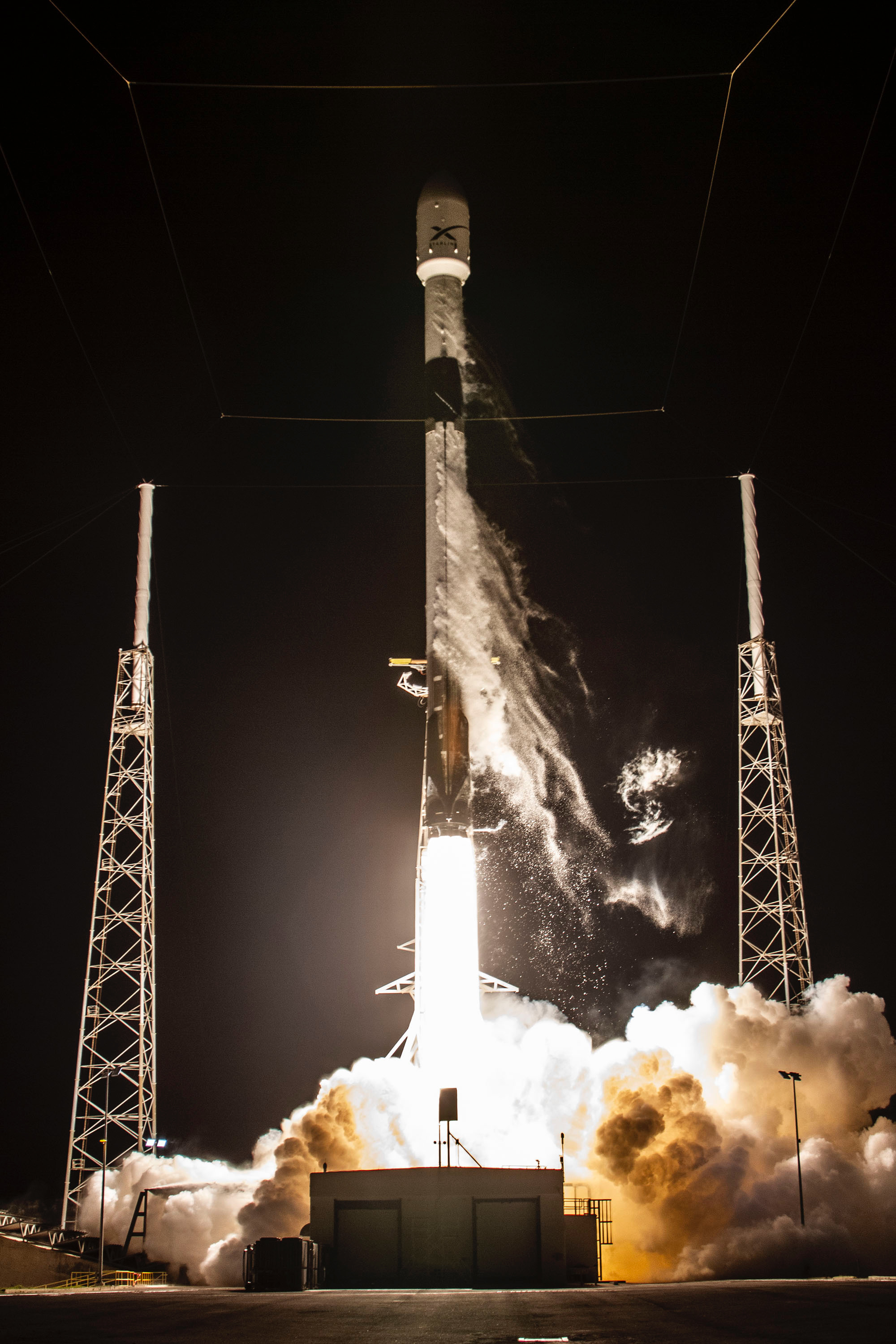
SpaceX began Wednesday’s operations with the launch of 21 Starlink satellites aboard a Falcon 9 rocket from NASA’s Kennedy Space Center in Florida. Liftoff from Launch Complex 39A occurred at 10:27 a.m. EST (1527 UTC), under near-ideal conditions forecast by the 45th Weather Squadron. The squadron had predicted a 95 percent chance of favorable weather, noting liftoff winds as the primary concern, with upper-level wind shear rated as a moderate risk and booster recovery weather assessed as low to moderate risk.

Of the 21 satellites deployed, 13 carry hardware designed to deliver text and data services directly to cellphones. This capability, known as Direct to Cell (DTC), represents a growing segment of the Starlink network. SpaceX confirmed successful deployment of all satellites at 11:37 a.m. EST (1637 UTC).
The mission utilized Falcon 9 first stage booster B1086, a veteran of previous flights. B1086 had served as one of two Falcon Heavy side boosters for the GOES-U mission in June 2024, later flying on the Starlink 12-5 mission in December. After completing its latest ascent, the booster returned to Earth, landing on the droneship “A Shortfall of Gravitas” stationed in the Atlantic Ocean. This touchdown marked the 93rd recovery on ASOG and the 393rd overall booster landing for SpaceX.
The DTC program entered its second year in 2025, having first flown in January 2024 with six satellites carrying the technology. Over the course of that year, SpaceX launched 31 missions with DTC payloads, totaling 401 satellites equipped for direct phone-to-space communication. However, 13 of those failed to reach operational orbit due to an upper stage anomaly during the Starlink 9-3 mission on July 11, 2024.
In its Progress 2024 report released in December, SpaceX stated that the operational DTC network consists of “nearly 350 satellites.” This figure suggests that some of the satellites launched in 2024 may have deorbited or are otherwise excluded from the company’s active service count. SpaceX did not provide further clarification in the report. The company also announced plans to double the number of DTC satellites by mid-2025, signaling an aggressive expansion of coverage and capacity.
The DTC Starlink satellites employ “innovative, custom silicon phased array antennas and advanced software algorithms to overcome the challenges of phone-to-space communications,” according to SpaceX. Phased array technology allows electronic steering of radio beams without moving parts, enabling rapid signal acquisition and tracking. This is critical for maintaining connectivity between a fast-moving satellite in low Earth orbit and a handheld device on the ground. The custom silicon likely integrates high-performance RF front ends with digital signal processing optimized for the narrow link budgets inherent in direct mobile-to-satellite communication.
Low Earth orbit offers latency advantages over geostationary systems, but also imposes constraints. Satellites pass over a given location for only minutes at a time, requiring a dense constellation to ensure continuous coverage. The advanced software algorithms referenced by SpaceX likely manage handovers between satellites, mitigate Doppler shifts, and adapt to varying atmospheric conditions. These functions are essential for sustaining a reliable user experience when connecting directly from a mobile phone without specialized ground equipment.
The booster recovery on ASOG underscores SpaceX’s continuing emphasis on reusability. Each successful landing reduces launch costs and accelerates turnaround times, enabling a high launch cadence that supports rapid constellation growth. With 393 total booster landings achieved, the company has demonstrated consistent performance in precision recovery operations, a capability that has reshaped the economics of orbital access.
This latest launch contributes to the steady build-out of Starlink’s infrastructure, particularly the DTC segment aimed at extending connectivity to remote and underserved regions. By combining reusable launch systems with specialized satellite hardware, SpaceX continues to integrate advancements in aerospace engineering and telecommunications into a single operational framework.