Epson Targets Easier Factory Automation With Cobot, Compact Robots
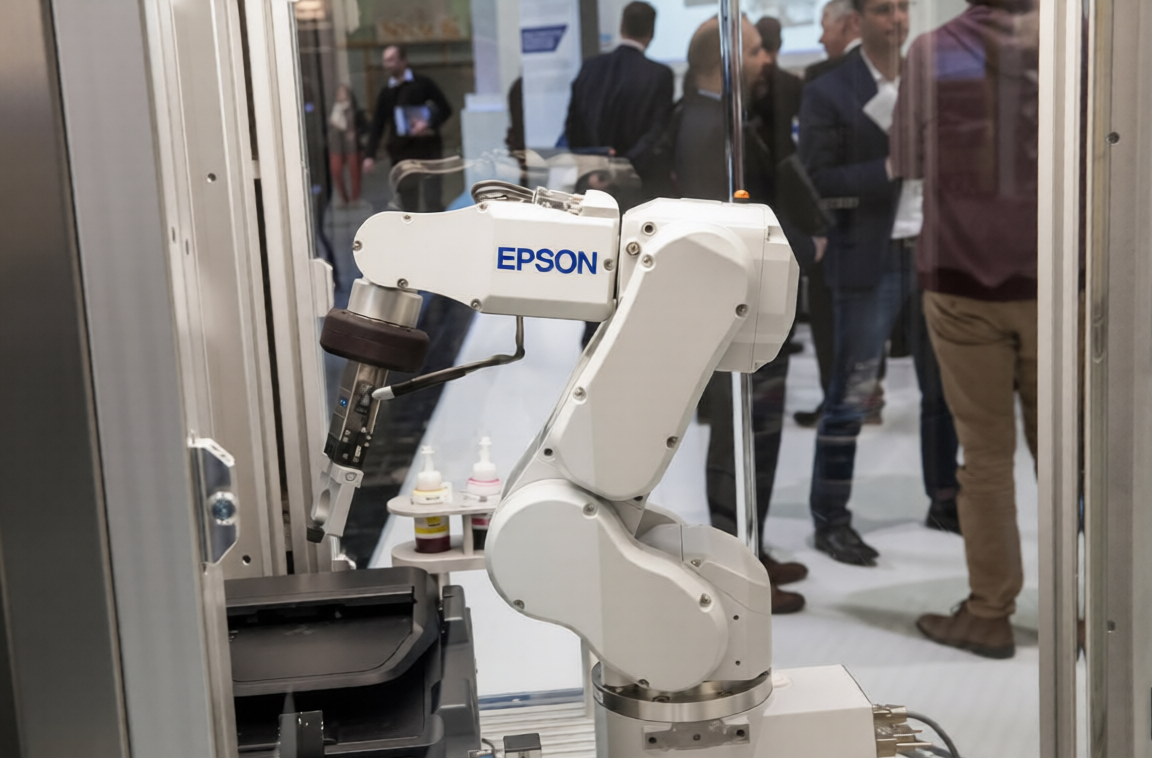
With its attendance at Automate 2026 in Chicago, Epson Robots is looking to drive home a specific point to manufacturers in the United States: automation that is compact, safe, easy to integrate, and ready to deploy with minimal floor-space impact. Epson Robots plans to reveal a future collaborative robot offering while also emphasizing compact SCARA and 6-axis architectures, safe sensing, part feeding, and a common software ecosystem.

Why? Because many automation decision makers are no longer concerned with raw robot performance. When it comes to small and medium-scale production operations, a key question may come down to how much engineering effort is required to create a safe, fed, footprint-friendly cell with reliable transition from proof of concept to production without creating a patchwork system of third-party components.
This is why Epson Robots’ Automate line-up centers around simplification. In addition to launching a new cobot, the company will highlight SafeSense a solution designed to detect when operators are in the robot workspace and ensure safe human-robot interaction in automated processes. In factories working on tasks such as injection molding, packaging, and assembly, this places the focus on designing the architecture for safety rather than adding a safety layer later on.
For U.S. manufacturers, this is not an abstract integration issue. Collaborative and semi-collaborative workcells still require careful risk assessment, safeguarding design, and disciplined system integration. What Epson Robots seems to be focusing on is a sensing and controls solution intended to minimize complexity associated with human-robot interaction and allow continued productive operations.
A similar simplification theme will be evident in part feeding. Epson Robots says that its IntelliFlex Feeding System is compatible with Epson Robots, RC+ Development Software, and vision guidance, with a starting price under $36,000. While the importance for buyers does not lie in the price itself but in the fact that all the components a robot, a feeder, vision guidance, and software are provided in a single vendor package.
Footprint constraints are another key design parameter emphasized by Epson Robots. The company will showcase its RS-Series SCARA robots and N-Series 6-Axis robots that are optimized for compact facilities. According to the manufacturer, the RS-Series uses a zero-footprint design, while N-Series robots minimize workspace requirements by up to 40% in comparison with standard 6-axis robots. From a factory deployment standpoint, these features refer specifically to brownfield installations, in which case the constraining factor may well be not cycle times but ability to squeeze automation between conveyors, molding equipment, packing stations, and manual workbenches.
Epson Robots will also showcase GX-series, T-series, and VT-series robots for injection molding part handling, precision assembly, and packaging. This makes the company’s message more comprehensive by referring to a wide portfolio instead of focusing on a single new product release. Robot architecture, reach, feeding, vision, and software are supposed to be chosen as a coherent system.
Speaking of software, Epson Robots will demonstrate its RC+ Development Software a PC-based software suite with a GUI Builder for customized operator interface and IntelliFlex capabilities supported by Epson, as well as PC-based simulation tools for robotic programming and education. Simulation allows manufacturers to test the entire process of workcell operation, operator interactions, and programming in advance of physical deployment.
This software-centric approach will extend to manufacturing skills development. Scott Marsic, Epson Robots Group Product Manager, will give a session on choosing automation solutions depending on the specific application needs. Also, Jim Shimano, Product Manager at Epson Robots, will conduct workshops dedicated to robotics education and skills training, cost reduction, and risk mitigation. These topics coincide with a general reality of the U.S. manufacturing market: automation adoption can be limited by lack of skilled engineers and operators as much as by robot availability.
Automate 2026, organized by A3 at McCormick Place on June 22-25, will provide Epson Robots with two platforms to deliver this message exhibition in the main hall and the education pavilion. This emphasis is not only on the fact that a cobot is coming soon. It is on the combination of safe sensing, compact architecture, feeding, vision, and software that can be offered as a more convenient automation option for manufacturing operations without unlimited engineering capabilities and floor space.
The underlying lesson is rather obvious. With today’s U.S. factory market, the best robot pitch is increasingly the fit of the whole system: how safely a cell can be integrated, how compactly installed, and how fast moved from virtual design to stable operation. Epson Robots Automate 2026 presence is geared towards precisely this challenge.
By Jonathan Barrett — Editor for AMI’s future mobility and autonomous systems section, with two decades of experience covering robotics, e-mobility, drone-vehicle convergence, and transport mechanical systems.