UNISIG Expands Wisconsin Tech Center for Deep-Hole Process Validation
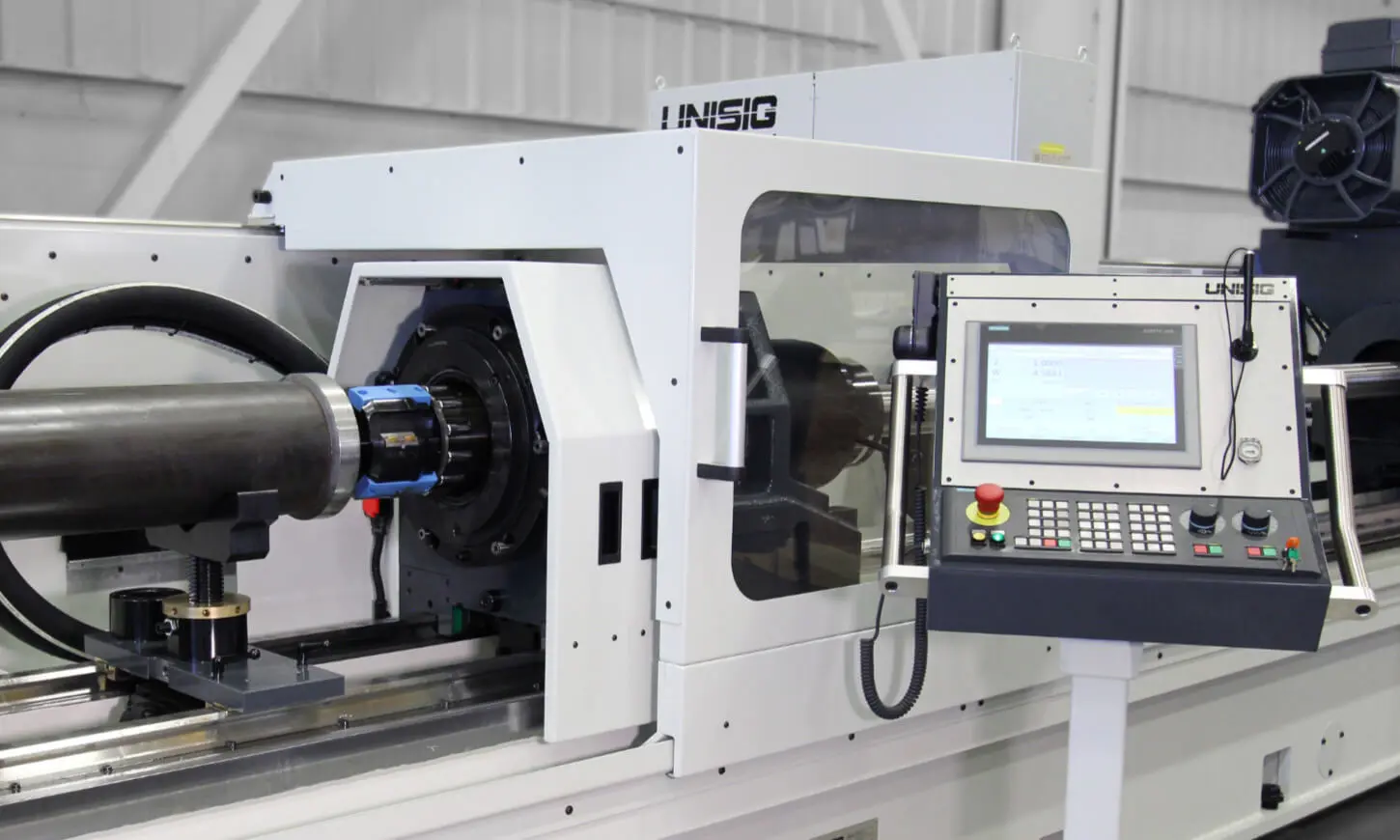
UNISIG is opening an expanded Tech Center in Menomonee Falls, Wisconsin, with updated facilities and more than $1 million worth of equipment to support research and development. While the dollars figure on its own is not the key detail, the function of the center is: to test deep-hole drilling procedures, controls and automation using working machines prior to delivery to a customer floor.
The significance of that detail comes into focus for American manufacturers who must work with tight tolerances, exotic materials and a longer installation period. Deep-hole drilling is not a simple matter of spindle and tooling. This process involves a whole set of parameters such as workholding, setup procedure, feeds and speeds, tooling choice, machine performance, controls integration and user interface. UNISIG’s Tech Center appears to be designed to test all these elements and optimize them before a machine arrives at a customer location, either as a pre-sale effort or as part of machine construction itself.
The company uses the center to develop gundrilling and BTA drilling processes for customers and test machine changes designed to improve its performance and user interface. The company claims that these efforts serve the purposes of validating applications, confirming process capability and reducing installation time. This is a very tangible goal from a manufacturer’s perspective: shifting the risks associated with the machine installation into an engineering-controlled environment to measure performance against expectations.
And there is something more in this approach than updating a showroom. According to UNISIG, the company engineers apply a systematic process involving process planning, time study, tooling choice and setup modeling. In simple words, the center serves to produce the engineering data rather than to show that the hole could be drilled. For the aerospace, medical, moldmaking and similar industries that involve precise engineering, repeatable and consistent process is far more valuable than a one-time successful drilling.
Both mechanical and electrical engineering teams use the same facility, which is an important component of the approach. Mechanical engineers use the center to perfect drilling processes, validate tooling options and analyze machine performance characteristics with regard to different materials and applications. Electrical engineers use active machines to test sensor performance, develop user interface elements and write machine controls code outside of simulations.
It is becoming increasingly important feature for modern machine tools. Today a drilling platform consists of not only rigid spindle and accurate axes. Modern machining platform also consists of performance of various sensors, controls, software and operator interfaces. Testing software on working machines brings real-world variables into development process sooner and, according to UNISIG, allows the software to be developed before the machine completion. It also gives the engineers a way to test whether or not new technologies will integrate smoothly with the company’s control systems, rather than performing well on their own.
The same goes for automation. UNISIG claims that robotics and machine systems are integrated and tested in the Tech Center before being deployed. It is one of the most important aspects of the center expansion for a manufacturer. A robot loading, machine tending and changeover strategy might seem simple on paper but become problematic after taking into account actual cycle times, interface performance and variations in workpiece geometry. Prior testing of this combination allows to optimize changeover, flexibility and overall system performance before the system is installed on production floor.
There is a workforce and services aspect of the project which should not be underestimated. The center is used for training machine builders and service technicians, while also allowing customers to visit for demonstrations, testing and application validation. Practically, it produces a tighter feedback loop between development, assembly, field service and end-user process planning. As a result, for a machine builder this approach can improve not only product development but also maintenance and installation readiness of its products.
UNISIG CEO Anthony Fettig put it quite concisely: Our Tech Center allows us to test and validate in real-world conditions. That drives better machine design, stronger performance, and more practical solutions for our customers. The general takeaway for manufacturing industry is quite obvious. Machine builders located in the United States are forced to provide not only the hardware but the whole system with lower commissioning risks and better controls integration. Validation center helps to achieve this goal by bringing process development, software testing and automation integration into development cycle. In case of deep-hole drilling, where stable process and correct setup are crucial, such approach becomes almost equally important as the mechanical specifications of the machine itself.
Edward Collins – Senior editor for AMI’s performance systems and mechanical design coverage, focused on powertrains, drivetrain systems, manufacturing precision, materials and high-performance engineering.