


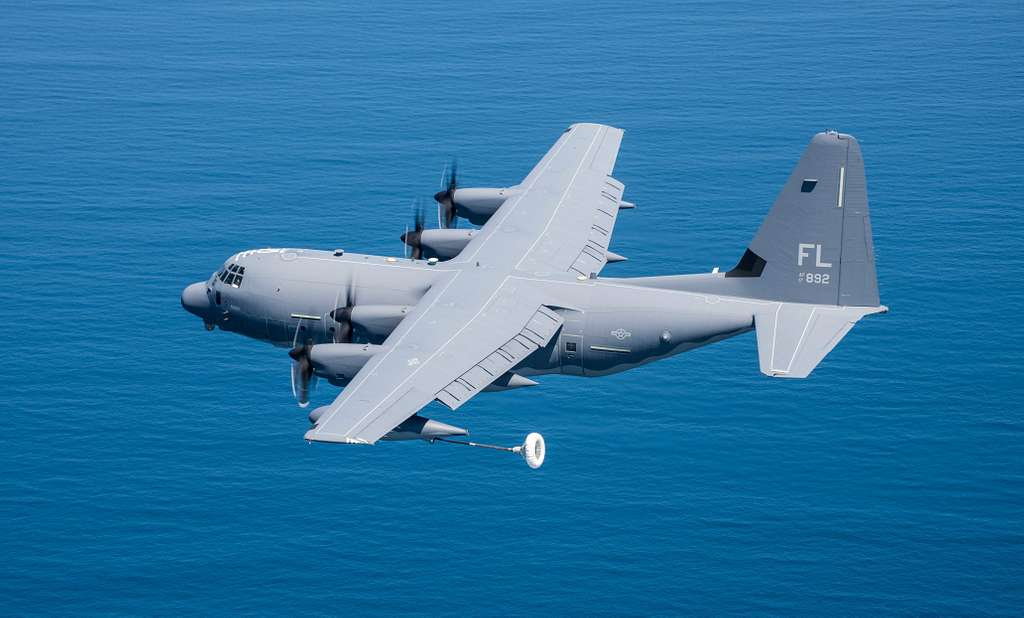
Coast Guard Delivers Sacramento’s First HC-130J for Long-Range Surveillance
The Coast Guard delivered Air Station Sacramento’s first missionized HC-130J Super Hercules on Sept. 10, 2026. The aircraft adds long-range maritime patrol, heavy air transport, and intelligence, surveillance and reconnaissance capability at the California station.

The arrival followed an integrated process that covered funding, aircraft construction, installation of mission equipment, testing and delivery. That sequence matters because acquiring an airframe is only one part of building a usable government aviation capability. Sensors, communications, support arrangements, trained personnel and validated aircraft systems must come together before a platform can consistently perform its assigned missions.
Mission equipment distinguishes the delivered aircraft
The aircraft, designated CGNR-2018, is the Coast Guard’s 18th missionized Super Hercules. Its configuration allows it to operate as a surveillance asset or an on-scene command-and-control platform, detecting, classifying and identifying objects and sharing information with other operational forces.
The HC-130J has a stated cruise speed of 320 knots, a range of 4,900 nautical miles and endurance exceeding 20 hours. Those figures support missions in which distance and time over an operating area matter, including search and rescue, maritime monitoring, crisis response and transportation. They do not by themselves establish mission readiness, however. Endurance has practical value only when aircraft availability, crews, maintenance, communications and mission systems can be sustained together.
That is the significance of the term “missionized.” A transport aircraft can move people and equipment without necessarily possessing the sensor and information-sharing package needed for persistent maritime surveillance. Sacramento’s delivered aircraft combines the underlying airlift platform with equipment intended to collect and distribute operational information. In systems terms, the Coast Guard is adding a networked mission platform rather than receiving an unmodified transport.
One delivery begins a longer station transition
Sacramento is not scheduled to stop at one aircraft. A second HC-130J for the station is undergoing missionization at L3Harris in Waco, Texas, with delivery anticipated in spring 2027. The Coast Guard also plans third and fourth aircraft for Sacramento, with those deliveries expected to begin in fiscal 2030.
This staggered schedule creates both a benefit and a constraint. The first aircraft lets the station begin establishing local experience with the type and its mission equipment. But a single delivered airframe does not provide the depth of a larger fleet when an aircraft is unavailable for maintenance, training or another assignment. The second delivery is therefore an important next measure of whether Sacramento is developing a repeatable capability rather than receiving a one-aircraft increment.
The expansion is being supported with a portion of the $1.142 billion provided for fixed-wing aircraft in fiscal 2025 budget reconciliation funding. The Coast Guard says that funding will extend HC-130J operations to two additional air stations, including Sacramento. Its announcement does not specify Sacramento’s exact share or provide a lifecycle operating-and-maintenance total, so the public cost of sustaining the new capability cannot be calculated from the delivery release alone.
Fleet accountability extends beyond the purchase contract
The completed funding-to-testing sequence offers a useful comparison with a separate Department of Homeland Security aviation procurement. DHS reportedly spent $464 million through a noncompetitive contract for 10 used aircraft, including seven older Boeing 737 passenger jets and three business jets, after citing urgent operational needs. Subsequent reporting said the aircraft saw little use, and senators requested contracts, flight logs, missionization records and lifecycle-cost analyses. It remains unconfirmed whether DHS supplied those records by the requested Aug. 26 deadline.
The two cases are not equivalent programs, and limited information does not establish that one procurement method caused either outcome. The comparison instead shows why fleet accountability must extend beyond the number of aircraft purchased. Utilization, crew availability, mission-equipment status, maintenance funding and planned assignments determine whether public spending produces operating capability.
For Sacramento, the first missionized HC-130J is a documented delivery rather than proof that the entire planned expansion is complete. The next concrete test comes in spring 2027, when the station’s second aircraft is anticipated to arrive and begin giving the new long-range capability greater operational depth.
| More aerospace and engineering stories, right in your MSN feed. Follow AMI on MSN |
By Thomas Caldwell — AMI’s senior editor for mechanical and mobility engineering, covering vehicle electronics, systems integration, electrification, chassis systems, propulsion, and safety policy.


