Dongfeng Nissan N7 Update Follows 91% Drop in Monthly Sales
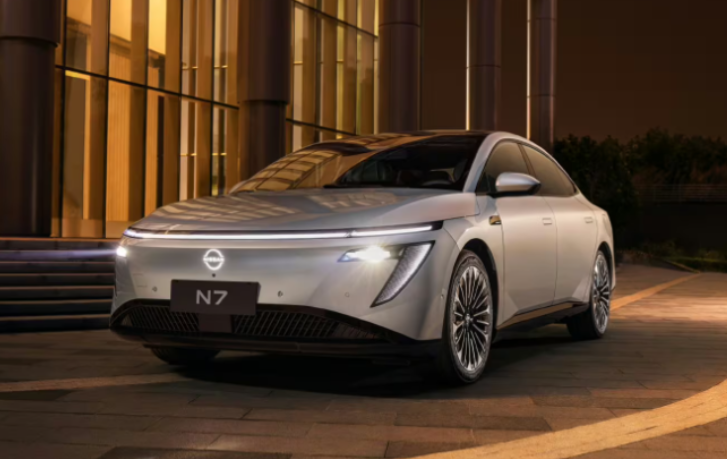
A fall from 10,148 vehicles to 928 in one year is driving the next turn in the Dongfeng Nissan N7’s short product cycle. The joint venture plans to introduce an updated version of its China-developed electric sedan on September 22, according to CnEVPost. That follows a 90.9% decline in monthly retail volume between August 2025 and August 2026.

The revision is expected to adjust equipment specifications across the N7 range, but the precise changes have not been identified. Dongfeng Nissan had not announced the update through its official channels when the plan was reported, so details of its content, pricing and availability remain unconfirmed.
The sales numbers nevertheless establish the pressure behind the timing. The N7’s 10,148 retail deliveries in August 2025 represented its monthly record. A year later, retail volume stood at 928 vehicles, while wholesale shipments the vehicles sent into the distribution channel were lower still at 619. Dealers had also been clearing inventory aggressively during the summer of 2026.
A fast revision for a recently launched sedan
The original N7 did not reach the Chinese market until late April 2025. It arrived with nine variants priced from 119,900 yuan to 158,900 yuan, placing substantial importance on how equipment was divided among versions. Revising those specifications can change the model’s value proposition without requiring a completely new vehicle architecture or body design.
That distinction matters because an equipment refresh can be implemented more quickly than a conventional model redesign. Automakers can reconsider which comfort, computing or assistance functions appear at each price point, although no particular N7 feature change should be treated as confirmed yet. The September update will reveal whether Dongfeng Nissan is making a narrow configuration adjustment or a broader attempt to reposition the sedan.
The N7 is more than a localized version of an established Nissan electric car. It was engineered entirely by a domestic team and became the first Dongfeng Nissan model built on the company’s proprietary Tianyan vehicle architecture. Its cockpit incorporates artificial-intelligence models including DeepSeek-R1, and Chinese technology company Momenta supplies its driver-assistance software. Dongfeng Nissan and Momenta previously described their work as a collaboration on an end-to-end assisted-driving system.
Two single-motor powertrains are offered, rated at 160 kilowatts and 200 kilowatts. Depending on configuration, the sedan has a stated range of 510 to 635 kilometers under China’s light-duty vehicle test cycle. Those figures describe the certified test-cycle offering, not necessarily the distance every driver will obtain in daily use.
Local engineering has not removed market pressure
The N7 combines several elements that established international joint ventures have adopted to compete more directly with Chinese electric-vehicle manufacturers: local development, domestic software partners, integrated cockpit computing and a wide selection of configurations. Its decline shows that those ingredients alone do not secure sustained demand in a market where competitors continue to adjust prices, batteries, computing hardware and product lineups.
A nine-variant range also creates a systems-integration and manufacturing tradeoff. More combinations can address different budgets, but they increase the number of specifications that purchasing, production, software validation, dealer ordering and service operations must manage. An equipment revision may improve the offer presented to customers, yet it can also require coordination across suppliers, factories, software teams and existing inventory.
The wider N family provides important context without resolving the N7’s individual problem. Total N-series production passed 100,000 vehicles in June 2026, and Dongfeng Nissan has added the N6 plug-in hybrid sedan and NX8 extended-range vehicle. Two further utility models are scheduled to reach dealerships before the end of 2026, including the NX7 plug-in hybrid SUV, which completed its regulatory filing in August.
That expansion gives Dongfeng Nissan more powertrain types and body styles with which to compete, but September 22 will test a more immediate proposition: whether a recently launched, locally engineered electric sedan can be repositioned quickly enough after monthly retail demand fell by more than 90% from its record level.
| More aerospace and engineering stories, right in your MSN feed. Follow AMI on MSN |
By Thomas Caldwell — AMI’s senior editor for mechanical and mobility engineering, covering vehicle electronics, systems integration, electrification, chassis systems, propulsion, and safety policy.