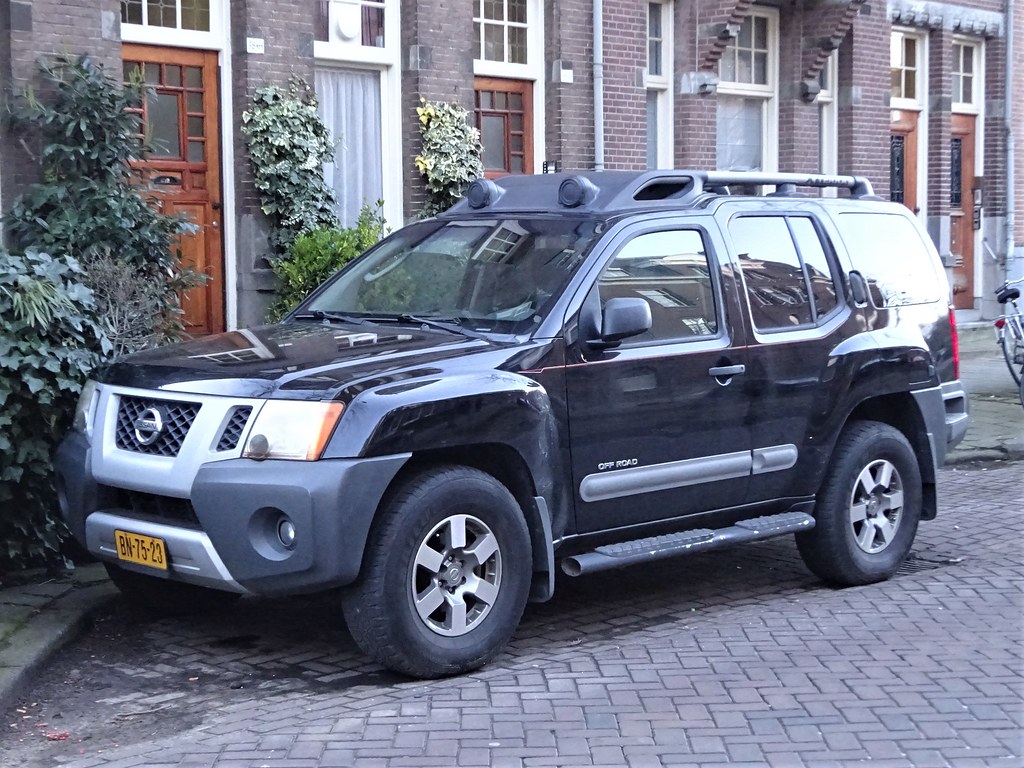
2015 Nissan Xterra Crosses Same Utah Obstacles More Smoothly Than Newer Trucks
A stock 2015 Nissan Xterra Pro-4X reportedly crossed the same Utah trail obstacles more smoothly than newer Nissan Frontier Pro-4X and Armada Pro-4X models. Driven in the same convoy and without special treatment, the decade-old sport-utility vehicle exhibited less slipping and wheel hop in the author’s firsthand comparison.

This was a real-world trail drive rather than an instrumented test, so it does not establish a universal performance ranking. It does, however, offer a useful comparison of two off-road design approaches: the Xterra’s relatively direct mechanical package and the more complex systems fitted to newer Nissan trucks.
Mechanical hardware carried much of the load
The tested Xterra combined a 4.0-liter V6, five-speed automatic transmission, part-time four-wheel drive and a locking rear differential. According to Nissan’s 2015 Xterra specifications, the engine produced 261 horsepower and 281 pound-feet of torque. Pro-4X equipment included Bilstein gas shocks, all-terrain tires and skid plates protecting the oil pan, fuel tank and transfer case.
The chassis was similarly conventional. The Xterra used a fully boxed steel ladder frame, a double-wishbone front suspension and a solid rear axle located by leaf springs. Its proportions included a short front overhang, while the suspension appeared to provide more articulation than the newer vehicles during this particular drive.
Articulation can be valuable because it helps tires remain in contact with uneven ground. When a wheel stays loaded rather than lifting or rapidly losing and regaining traction, the vehicle may need less brake-based intervention to continue moving. The locking rear differential can also force both rear wheels to turn together when engaged, giving the drivetrain another way to maintain progress on low-grip terrain.
Those characteristics align with what the driver observed. Where the Frontier and Armada displayed wheel hop and slipping, the Xterra reportedly climbed the same obstacles without comparable protest. It also remained composed through sand washes and rocky sections, while its hydraulically assisted steering and body motion communicated changing trail conditions to the driver.
Simple did not mean electronics-free
The old Xterra should not be reduced to a purely analog machine. Its four-wheel-drive system used an electronically controlled transfer case, and the automatic Pro-4X included hill-start and hill-descent assistance. It also had vehicle stability control and an electronic locking rear differential.
The meaningful distinction was the way these elements supported a straightforward mechanical foundation. The driver still needed to select an appropriate line and choose the relevant four-wheel-drive or differential setting. The test linked the Xterra’s smooth progress to that combination of articulation, mechanical grip and driver judgment not to the absence of every electronic aid.
Nor can the newer trucks’ behavior be assigned to complexity alone. Vehicle mass, wheelbase, suspension tuning, tires, throttle calibration and the precise line through an obstacle can all affect wheel hop and traction. No measurements of wheel travel, speed, tire pressure or control-system activity were provided. The comparison captures how these vehicles behaved during one shared outing, not why every difference occurred.
The tradeoff appeared on pavement
The Xterra’s age was more apparent during highway driving. Its five-speed automatic reportedly shifted into fourth gear too frequently, and the cabin admitted more wind noise than the newer trucks. Those limitations illustrate why additional ratios, refined aerodynamics, improved isolation and modern control systems have become common: complexity can purchase lower noise, smoother power delivery and better everyday efficiency.
Even so, the Xterra’s road behavior was judged comparable to that of a modern truck in broad terms. Its hydraulic steering delivered noticeable feedback, and it handled gentle bends competently. The result was not an old vehicle winning every category, but a design whose off-road strengths remained visible despite dated transmission and noise performance.
Nissan has now referred publicly to an all-new Xterra, but it has not confirmed the powertrain or detailed chassis specifications discussed around a prospective model. The Utah comparison identifies a practical benchmark rather than a production formula: preserve useful articulation, durable underbody protection, a rear locker and controls that clearly tell the driver what the vehicle is doing. More sophisticated hardware can improve refinement and capability, but the old Xterra showed that added complexity must still produce cleaner tire contact and more controlled motion on the trail.
| More aerospace and engineering stories, right in your MSN feed. Follow AMI on MSN |
By Thomas Caldwell — AMI’s senior editor for mechanical and mobility engineering, covering vehicle electronics, systems integration, electrification, chassis systems, propulsion, and safety policy.