Samsung Sets Texas Chip Plant Groundbreaking Without Naming Any Customers
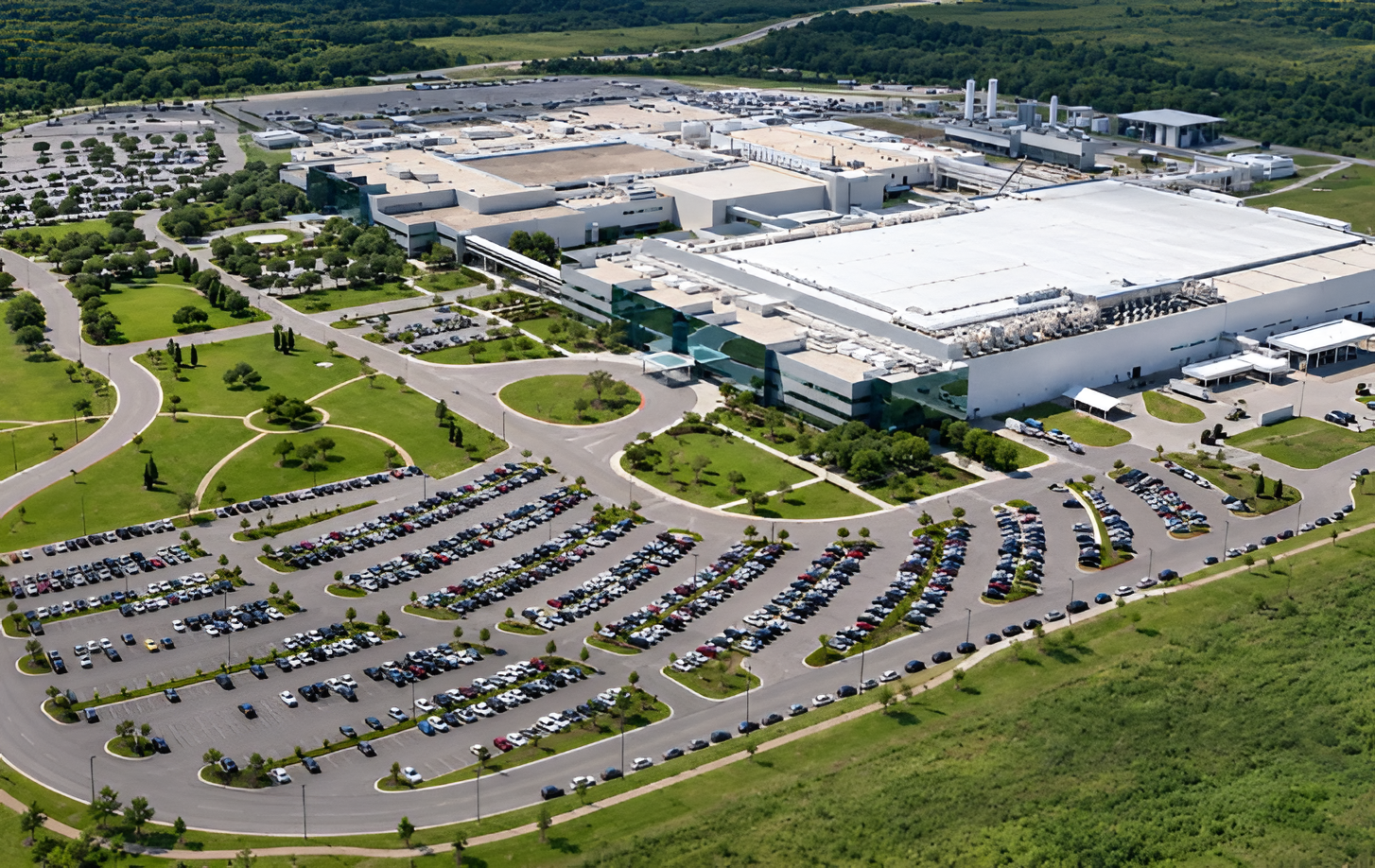
Samsung Electronics plans to break ground in November on a 2.7-million-square-foot chip factory in Taylor, Texas, even though it has not disclosed a customer, an order volume or the production capacity assigned to the project. Known as Taylor Fab 2, the facility is targeted to begin mass production in 2030.
The scale makes those unanswered questions consequential. Fab 2 is expected to be roughly 1.5 times the size of Samsung’s adjacent Fab 1, but the company has not published the new plant’s investment total or planned wafer output. Samsung is therefore moving the physical project forward before revealing how much manufacturing equipment it will contain or which customers will keep that equipment productive.
There is a practical reason to start this early. An advanced semiconductor plant takes years to construct, equip, tune and qualify. Samsung said in July that the pace of capacity expansion for cutting-edge processes is currently failing to keep up with rising demand. It said it was preparing Fab 2 to respond to customer demand, with production planned for 2030.
The equipment schedule cannot wait for customer announcements
The building is only one part of the production system. A working chip factory also requires tightly coordinated lithography, deposition, etching, inspection and other specialized tools. Each set of machines must be installed and integrated into a repeatable process before customers can qualify chips for volume production.
Samsung is discussing Fab 2 equipment with suppliers, and orders are expected as early as the end of 2026 or during 2027. That timing puts procurement decisions near the beginning of the project rather than close to the 2030 production date.
Tool availability is already constrained. ASML and Applied Materials have said their orders extend through 2028, while some customers are asking about deliveries associated with 2030 volumes. KLA reported that lead times for some products had lengthened from approximately 12 months to between 18 and 24 months. ASML also said it would begin raising shipment prices in 2027, with increases accelerating from 2028.
For Samsung, ordering early can protect the installation and qualification schedule, but it also means committing to costly equipment before Fab 2’s customer mix and required output are public. Waiting could provide greater commercial clarity while increasing the risk that a critical tool arrives too late or at a higher price. Because fabrication lines operate as interconnected systems, one constrained equipment category can limit the output of a much larger collection of installed machinery.
Tesla’s contract belongs to the neighboring factory
Samsung already has a major customer for its first Taylor plant. The company’s semiconductor supply agreement with Tesla was reported at about $16.5 billion. The disclosed contract term began July 26, 2025, and runs through Dec. 31, 2033, providing a long production window for the secured work.
Elon Musk said Tesla’s next-generation AI6 chip would be manufactured at Taylor Fab 1 using Samsung’s 2-nanometer gate-all-around process. That commitment does not extend publicly to Fab 2, for which Samsung has disclosed no equivalent order.
AMD and Qualcomm have been mentioned by industry observers as possible Fab 2 customers, but neither has announced a commitment. Samsung’s memorandum of understanding with Broadcom covers expanded cooperation, including processes at 2 nanometers and below, but it likewise does not establish a Fab 2 order or production volume.
Terafab adds competition on two fronts
Musk’s planned Terafab introduces another variable. The project is intended to combine chip design, logic and memory wafer manufacturing, and advanced packaging in one operation. It is targeting full-scale production in the third or fourth quarter of 2028, with test-semiconductor production planned at an Austin research facility during May or June 2027.
If Terafab reaches those goals, it could influence where Tesla places later chip orders and become another large buyer of fabrication equipment. Tesla has not said Terafab will replace Samsung, and an integrated operation spanning several manufacturing stages still must bring multiple complex systems into stable production.
Fab 2 consequently faces two overlapping schedules. Samsung has about four years to move from groundbreaking to mass production, but its window for securing key machinery is much shorter. The plant’s 2.7 million square feet establish its physical ambition; its useful output in 2030 will depend on customer commitments and equipment orders that Samsung has yet to disclose.
| More aerospace and engineering stories, right in your MSN feed. Follow AMI on MSN |
By Thomas Caldwell — AMI’s senior editor for mechanical and mobility engineering, covering vehicle electronics, systems integration, electrification, chassis systems, propulsion, and safety policy.