USV SEADRAGON Maps and Analyzes a Drifting Iceberg
Icebergs, born from calving glaciers, drift and rotate under the combined forces of wind, waves, and ocean currents. Their melting injects freshwater into the ocean, altering local salinity and temperature, influencing regional circulation, and contributing to global sea-level rise. They also present hazards to offshore infrastructure and shipping, making accurate drift prediction and shape modeling critical for both climate science and maritime safety.

Historically, iceberg surveys relied on ship-based photogrammetry for above-water profiles and sonar for underwater mapping, with statistical models estimating draft from visible dimensions. However, these methods suffer from low confidence due to sparse data and the difficulty of capturing an iceberg’s full geometry while it moves. Unmanned platforms such as Unmanned Surface Vehicles (USVs) and Autonomous Underwater Vehicles (AUVs) have emerged as safer, more versatile alternatives, capable of carrying multiple sensors for high-resolution, multi-modal measurements.
The USV SEADRAGON project advanced this approach by developing an algorithm to estimate iceberg motion and reconstruct its shape from in-situ point cloud data. The system integrates a scanning LIDAR for above-water profiling, a side-looking multi-beam sonar for underwater mapping, and meteorological and oceanographic sensors including a weather station, CTD, and ADCP. Motion estimation is essential because iceberg self-motion distorts point clouds when referenced to Earth-fixed coordinates.
The algorithm uses point cloud matching, policy-based optimization, and Kalman filtering. It down-samples data into depth bands and spatial bins to reduce computation, then iteratively aligns overlapping regions from successive passes around the iceberg. Iterative Closest Point (ICP) registration yields translation and rotation offsets, which update motion estimates. A Kalman filter fuses these with a linear motion model, dynamically adjusting measurement uncertainty based on ICP consistency. This process corrects for iceberg translation and rotation, enabling accurate shape reconstruction.
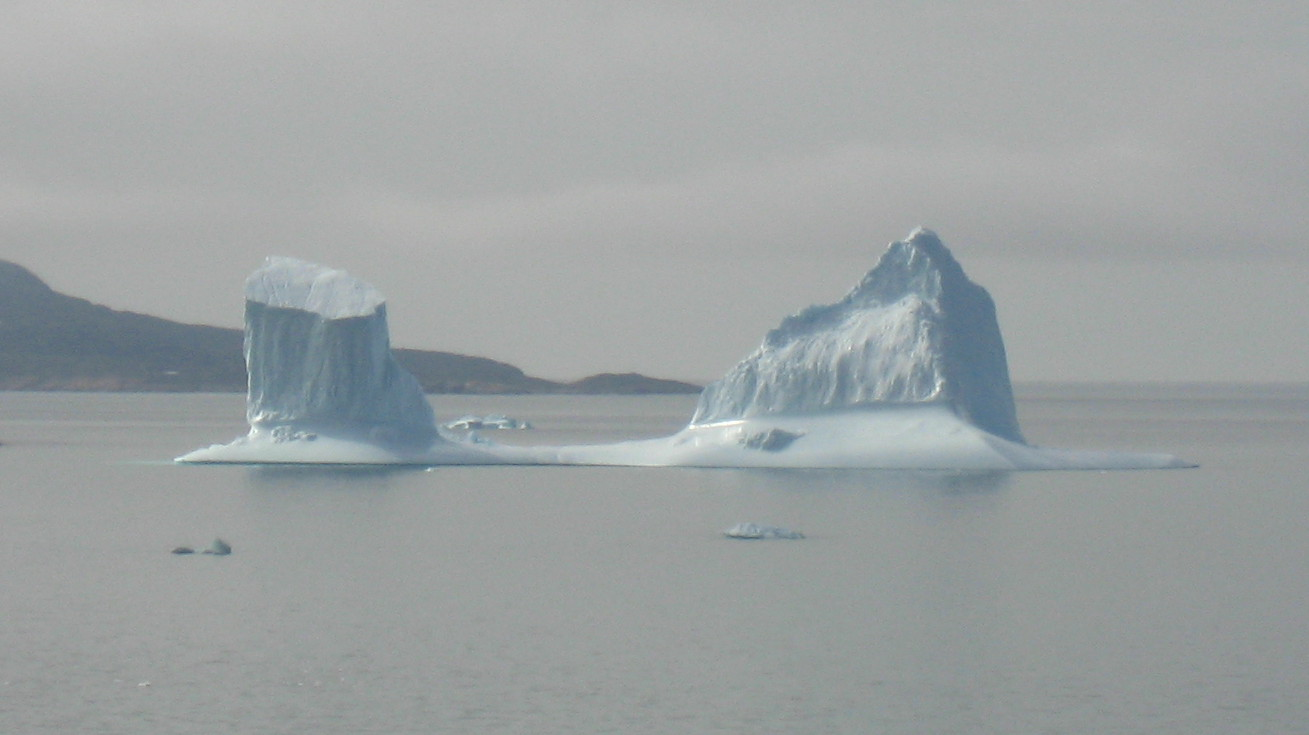
Simulations with known iceberg motion validated the method, achieving normalized RMS errors under 2% for velocity estimates and shape alignment within 8 m of ground truth. Field trials in June 2017 near Portugal Cove, Newfoundland, applied the algorithm to SEADRAGON’s LIDAR and sonar datasets. The USV circled the iceberg four times over 1.5 hours, maintaining a 50 m standoff via a wall-following guidance law. Motion estimates from both sensors were consistent, with LIDAR providing denser, less noisy data.
The reconstructed iceberg measured about 120 m by 100 m above water, with a maximum freeboard of 21 m. Using density-based draft estimates and observed sonar depths, the team calculated submerged and emerged volumes, deriving an iceberg density of roughly 881 kg/m³—higher than Antarctic averages but consistent with Labrador Sea observations. Limitations in sonar range and grazing angle meant the deepest keel portions might have gone unmapped.
Beyond geometry, SEADRAGON’s environmental sensors revealed dynamic interactions. ADCP data, corrected for vehicle and iceberg motion, showed downstream upwelling and a colder, fresher surface plume, consistent with meltwater release. CTD readings identified a 1°C temperature drop and slight salinity decrease in the plume. Wind measurements indicated a northeastward drift direction more aligned with wind than current, echoing analytical drift models.
Using sectional environmental data and surface area calculations from the 3D model, the team estimated melt rates from sensible heat flux above and below water, and from surface wave erosion. Below-water sensible heat melt rates were about ten times higher than above-water rates, with spatial variation linked to wind and current patterns. Total melt volume was estimated at 1.088 × 10⁵ m³/day for the mapped portion, implying a lifespan under six days.
The study underscores the value of integrating autonomous platforms, multi-modal sensing, and real-time motion correction for iceberg research. It also highlights challenges: sonar dropouts at depth, the need for complementary AUV surveys for full keel mapping, and the potential for AI-based reconstruction of unsurveyed regions. Enhanced downstream CTD profiling could further resolve freshwater plume dynamics and their role in iceberg deterioration. These advances promise not only improved climate and oceanographic models but also better risk assessment for offshore operations in iceberg-prone waters.