Carbon Fiber Skeleton Boosts Soft Robotic Actuators
Soft robotics continues to push the boundaries of mechanical design, particularly in applications demanding high flexibility, adaptability, and gentle interaction with the environment. Yet, one of the persistent challenges in electrically triggered soft actuators has been achieving both large, reversible deformation and substantial force output without sacrificing robustness. A recent study introduces a biologically inspired approach that addresses these limitations by embedding a carbon fiber skeleton within a graphene/polyimide thin-film actuator.

The concept draws from the structural role of a chordate’s skeleton, where rigid elements provide mechanical support while allowing surrounding muscles to generate controlled motion. In the engineered version, the “muscle” is a composite of graphene and polyimide (PI), while the “skeleton” is a parallel array of high-strength carbon fibers. The PI layer offers significant thermal expansion for deformation, graphene delivers excellent electrical conductivity and electrothermal conversion, and the carbon fibers contribute mechanical reinforcement along with enhanced thermal and electrical pathways.
Fabrication involved a straightforward two-step process. Carbon fibers, each about 7.5 μm in diameter, were laid in parallel on a silicon wafer and bonded to a 50 μm-thick PI adhesive tape under pressure. The fiber mass ranged from 0.84 to 1.01 mg per square centimeter. A graphene solution was then coated over the assembly and dried, creating a tightly integrated composite film. This architecture ensures that the carbon fibers not only carry current efficiently but also maintain structural integrity during repeated actuation cycles.
Performance gains over non-reinforced actuators were significant. Under a driving voltage of just 6 V, the skeletal actuator achieved a bending angle of 112° and a blocking force of 7.5 mN—equivalent to lifting 10.3 times its own weight. In contrast, a similar actuator without the carbon fiber skeleton reached only 47° and 1.86 mN, or 2.9 times its weight, under identical conditions. The marked improvement stems from the dual role of the carbon fibers: they reduce electrical resistance for faster, more uniform heating, and they provide a stable framework that resists undesired deformation modes.
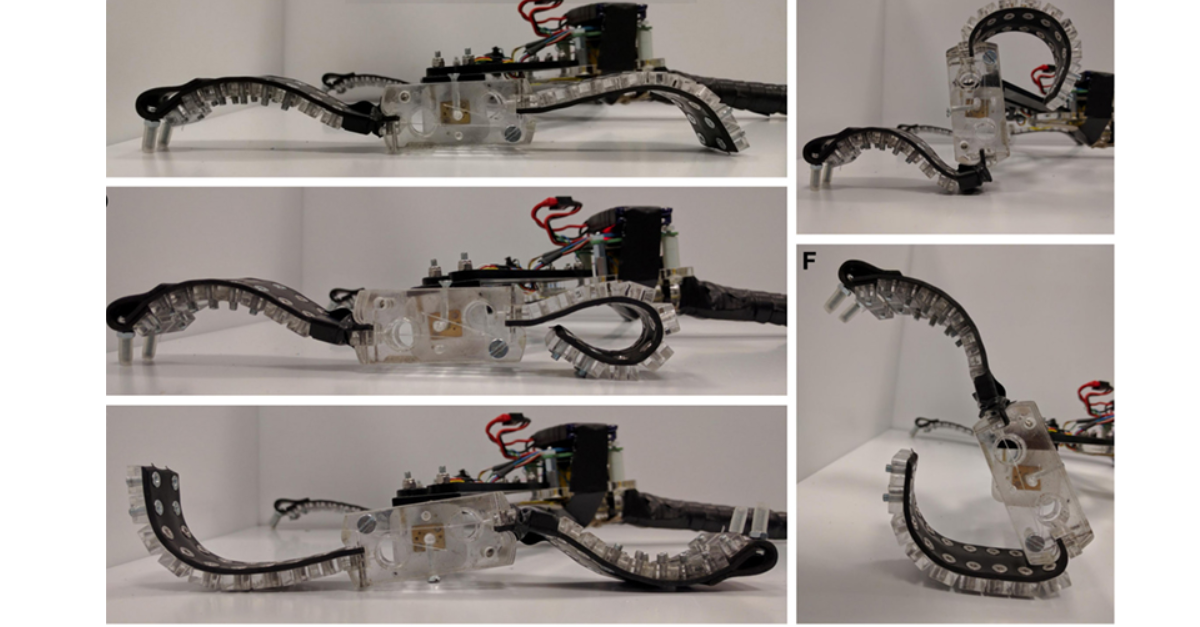
The research team demonstrated the actuator’s versatility through several prototype devices. A simple gripper was able to grasp and hold objects with precision, benefiting from the enhanced blocking force. A self-walking robot used sequential actuation to generate crawling motion, showcasing the actuator’s potential for autonomous locomotion in constrained environments. Two types of weightlifters, each leveraging the improved load capacity, further illustrated the practical implications of the carbon fiber reinforcement.
This work builds on a broader trend in soft robotics toward integrating high-performance materials with functional composites. Conductive shape-memory polymers, dielectric elastomers, and liquid crystal polymers have all been explored for similar applications, often combined with nanomaterials such as carbon nanotubes or metal nanowires to improve electrothermal efficiency. However, many of these systems have struggled with mechanical durability and limited force output. By contrast, the carbon fiber skeleton approach directly addresses mechanical reinforcement without compromising flexibility.
Carbon materials are particularly well-suited for such roles. They offer exceptional tensile strength, high modulus, and thermal stability, with properties that remain stable at elevated temperatures. In aerospace and automotive engineering, carbon fiber composites are already valued for their strength-to-weight ratio and fatigue resistance—qualities that translate effectively into the microscale demands of soft actuators.
The study’s authors emphasized the simplicity of their method. “Carbon fibers played the roles of mechanical reinforcement and enhancers of thermal and electrical conductivity of actuators, just like embedding flexible ‘skeletons’ into ‘muscles’,” they stated. This analogy underscores the biomimetic inspiration and the elegance of combining disparate material properties into a unified, high-performance system.
Beyond robotics, such actuators could find roles in adaptive aerospace components, morphing UAV control surfaces, or lightweight deployable mechanisms where low-voltage operation and high actuation force are critical. The compatibility of the fabrication process with existing flexible electronics manufacturing further broadens the potential application space.
By leveraging the complementary strengths of graphene, polyimide, and carbon fiber, this skeletal actuator design demonstrates a pathway toward soft robotic systems that are both powerful and resilient, capable of executing complex tasks while maintaining structural integrity over repeated cycles.