


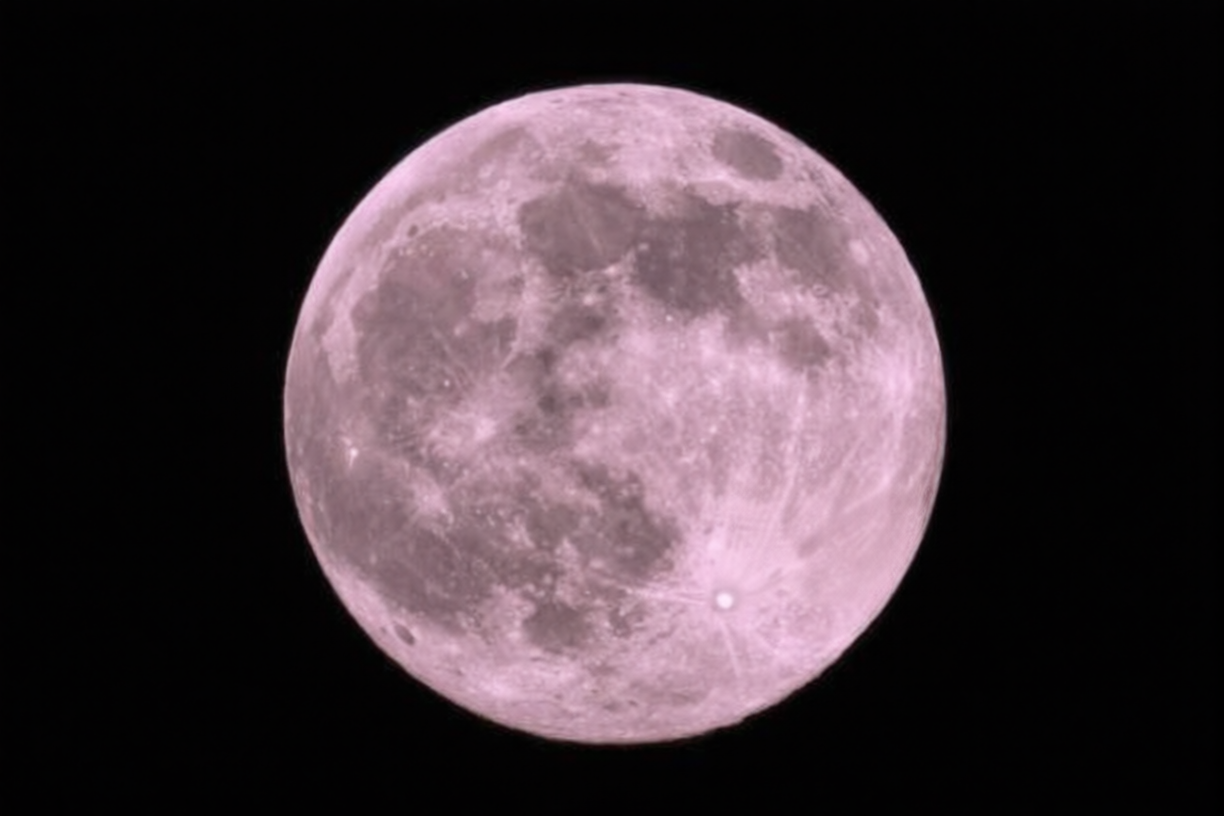
Pink Moon Glows as Artemis II Tests NASA’s Return to Deep Space
For the first time since 1972, a full moon arrived not just as a sky watching event, but as a backdrop to a crewed mission pushing beyond Earth orbit again. During the night of April 1, the April’s “Pink Moon” became full at 10:12 p.m. Eastern time. The full moon is named Pink for the blooming of the spring phlox flower. To Earth’s inhabitants, the event meant viewing of the flattened shadows and bright side of the moon. However, for NASA and its crewed mission, it symbolized much more. On April 16th, NASA launched Artemis II, a 10-day crewed test flight that will send four astronauts around the moon.

The contrast between the Earth-based observations and Artemis II’s mission can be traced by understanding the characteristics of the full moon phenomenon. It is usually very easy to detect due to its brightness, but the shadows become flattened and are difficult to notice. Moreover, the spacecraft will encounter a differently shaped object due to sunlight being at a certain angle and due to the fact that the object is located farther from the planet.
This aspect makes Artemis II mission unique since, despite the fact that it may seem simple, NASA wants to check whether the spacecraft works properly. Artemis II marks NASA’s return to sending crewed missions to deep space after nearly five decades. It is necessary for testing of such processes as life support, communications, manual handling, and navigation. After launch, the Orion crew module will enter a high Earth orbit to conduct checkout procedures prior to critical translunar injection burn. As soon as the maneuver takes place, it will put the spacecraft on a free-return lunar flyby trajectory. The latter allows the mission to take place without additional burns and is one of the reasons why Artemis II mission is viewed as a systems validation. In addition, NASA needs to validate Orion’s heat shield, which will have to bear temperatures up to 5,000 degrees Fahrenheit when the spacecraft crashes into the Earth’s atmosphere at about 25,000 miles per hour.
There are two other important aspects related to the moon. While a full moon allows viewing the large dark regions on its surface (Mare Frigoris, Mare Vaporum, Mare Nubium, Mare Humorum) with telescopes, a partly illuminated one will allow Orion’s crew members to see craters’ walls, ridges, and slopes more clearly. They are caused by the shadows made by the sun, which is at some angle relative to the moon. Moreover, Artemis II’s mission includes visiting the moon’s far side.
The Artemis II mission has a number of distinctive features that differentiate it from similar missions. It is not conducted to study the space phenomena alone; it is a transition from one stage of development of spacecraft towards another. While Artemis I was an uncrewed test and the next missions will include sustained lunar operations, international partnerships, and Mars preparations, Artemis II’s mission can be viewed as a kind of handover between those stages. For Earth’s inhabitants, April’s “Pink Moon” means nothing but a pleasant spring phenomenon. For NASA, however, it means something else, as the mission is not about studying anymore now the moon starts being useful for spaceflight.


