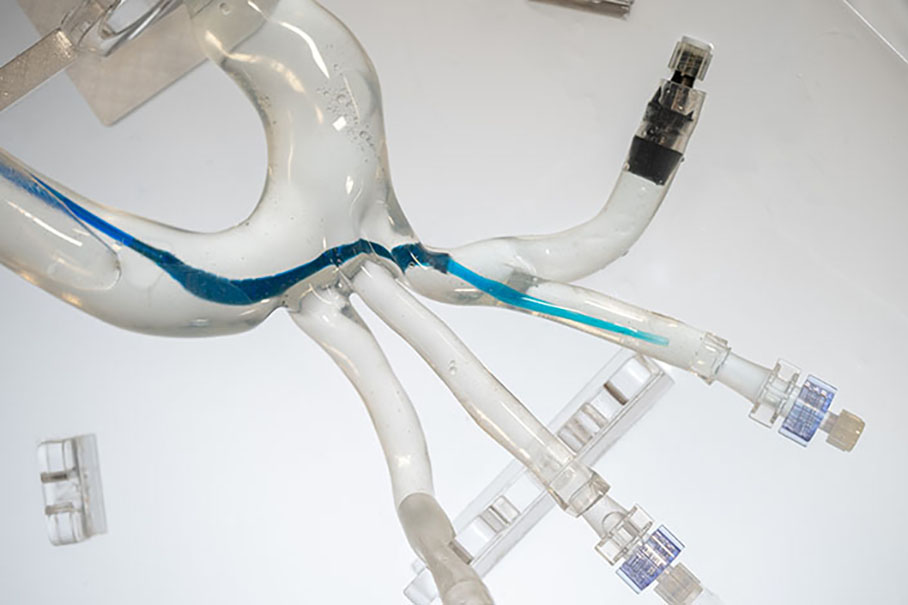
Graphene-Laced Fibres Mimic Human Muscle Mechanics
Researchers have developed a single-fibre actuator inspired by human muscle, integrating graphene platelets into a liquid crystalline polymer matrix to achieve reversible percolation under mechanical deformation. The work combines precision synthesis, fibre extrusion, and computational modelling to explore how embedded conductive networks form and break during strain cycles.

The process began with electrochemical exfoliation of natural graphite foil, 0.254 mm thick, serving as the anode against a platinum wire cathode. The electrolyte consisted of 0.1 M sodium sulfate solution, prepared by dissolving 1.42 g of Na₂SO₄ in 100 ml of water. Electrodes were positioned 2 cm apart, and an alternating bias from –10 to +10 V was applied to the graphite electrode. The exfoliated product was collected via vacuum filtration through a 0.45 μm membrane, washed repeatedly with 0.1 M hydrochloric acid to remove ionic residues, and dried. Dispersion in dimethylformamide (DMF) under mild sonication followed, with centrifugation at 2,000 rpm for 30 minutes to remove large flakes. All exfoliation steps were performed at room temperature.
The liquid crystalline oligomer (LCO) dope was synthesized by combining RM82, n-butylamine, and photoinitiator Irgacure-369 in a molar ratio of 1.01:1.00, with I-369 at 2.5 wt% of the total LC mixture. Vigorous vortexing under heat ensured uniform mixing, followed by aza-Michael addition-based step-growth polymerization at 60–80 °C for 24 hours. The resulting oligomer was stored at 5 °C to prevent further reaction. For graphene-enhanced LCO, exfoliated graphene (EG) dispersion in DMF at 1.15 mg/ml was added, vortexed for 5 minutes, and then subjected to 75 °C in a vacuum oven for 24 hours to complete oligomerization and remove DMF.
Fibre formation involved extruding the LCO dope through a 400 μm nozzle using a stainless steel syringe, onto a laterally moving glass substrate. The dope was heated to 15 °C below the nematic–paranematic transition temperature, with the nozzle tip positioned 1 mm from the collector. Fibres were quenched at room temperature and photopolymerized under 365 nm ultraviolet light at 30 mW/cm² for 30 minutes. The fibres were then immersed in water to release them from the substrate and wound onto a Teflon reel.
Mechanical modelling employed the Mori–Tanaka mean-field homogenization method to predict the effective Young’s modulus of graphene-loaded fibres relative to EG content. The EG flakes were modelled as oblate spheroids with an aspect ratio of 1,500, aligned during manufacturing. Conversion from 0.3 wt% to approximately 0.45 vol% allowed direct comparison with theoretical predictions. With the LCE matrix modulus set at 12.8 MPa and EG modulus at 1 TPa, both materials were assigned Poisson’s ratios of 0.3. Deviations between predicted and measured moduli suggested agglomeration of EG flakes, despite strong π–π interfacial bonding.
To investigate reversible percolation, simulations treated EG platelets as rigid oblate bodies with aspect ratio 1,000 and volume fraction 0.45%. An affine transformation model described changes in platelet position and orientation under compressive strain. Connectivity analysis determined percolation by calculating inter-platelet distances and applying a cutoff contact threshold. Clusters were identified using a depth-first search algorithm, starting from arbitrary nodes and exploring all reachable connections. Kirchhoff’s current law was then applied to estimate conductivity, assuming current flowed along the shortest path with resistance proportional to distance.
Structural alignment influenced percolation behaviour. In film structures, polar angles were near π/2 and azimuthal angles near 0 or π, aligning platelets to the x₁–x₃ plane. Fibre structures maintained polar angles near π/2 but had random azimuthal orientations. Thirty simulations per structure revealed distinct percolation fractions after compression, underscoring the role of initial platelet orientation in network formation.