


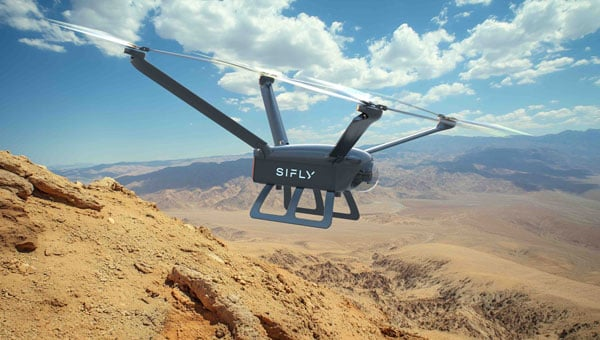
Why Seeing SiFly Drones on Public Flight Maps Matters
One sky was always neat on paper. Showing it to be so is another matter entirely. With its latest integration with ADS-B Exchange, SiFly Aviation offers some insight into that challenge its cloud-connected Q12 drones can now show up in the live airspace maps that track traditional planes. For unmanned aerial systems, that means something more than an unusual feature it is proof that long-endurance drones can start to fit into the broader aerial ecosystem as participants rather than as individual systems isolated in their own technology stack.
Why does that matter? Because the commercial drone market has begun expanding out of the realm of short-range flights around restricted sites. Environmental monitoring, inspection, disaster response and other services rely on drones with BVLOS capability, meaning that they operate far from the line of sight of pilots or operators. SiFly is positioning the Q12 in precisely that space as a machine capable of hours-long missions and range that extends to tens of miles. At that scale, the ability to be seen becomes integral to mission planning, not an extra feature.
According to the companies behind the new integration, the process has already been validated in practice. Drone telemetry is presented in real-time through ADS-B Exchange, giving pilots, dispatchers and others a window onto drone operation in airspace where it otherwise wouldn’t exist. That difference is critical because traditional aircraft use onboard ADS-B transponders to communicate their positions. Instead, the Q12 sends its telemetry information via its cloud connection before presenting it in the airspace map. The distinction addresses a key issue the FAA’s Remote ID requirement is designed to identify drones and the locations that control them, but not necessarily to incorporate that data into a system of situational awareness. The need to connect those two pieces of technology has come more into focus as regulators have built out digital infrastructures to support unmanned flight.
The FAA, for example, emphasizes Remote ID’s importance as the backbone of safe unmanned flight in the NAS, with separate enforcement tools that will make it possible to match the identities of drones broadcast through Remote ID with their registration and authorization through the DISCVR API. In that context, a key question becomes not only who is flying but who can see the aircraft in context with other aircraft nearby. By presenting drone telemetry in the context of the airspace display, SiFly and ADS-B Exchange are addressing that latter issue, which is essential both to BVLOS flight in crowded airspace and to the larger concept of unmanned traffic management.
“Adapting to those capabilities, drones need to become visible within the same airspace awareness tools used by pilots,” said Brian Hinman, founder and CEO of SiFly. ADS-B Exchange Chief Product Officer Greg Kimball framed it similarly, adding that integrations like this one “expands situational awareness and supports the safe integration of new aircraft types into shared airspace.” Where the announcement marks a turning point is not in the fact that drones can now be tracked online. It is in the demonstration of the fact that a long-endurance unmanned aircraft can be integrated seamlessly into airspace tracking infrastructure without creating a whole new technology platform.


