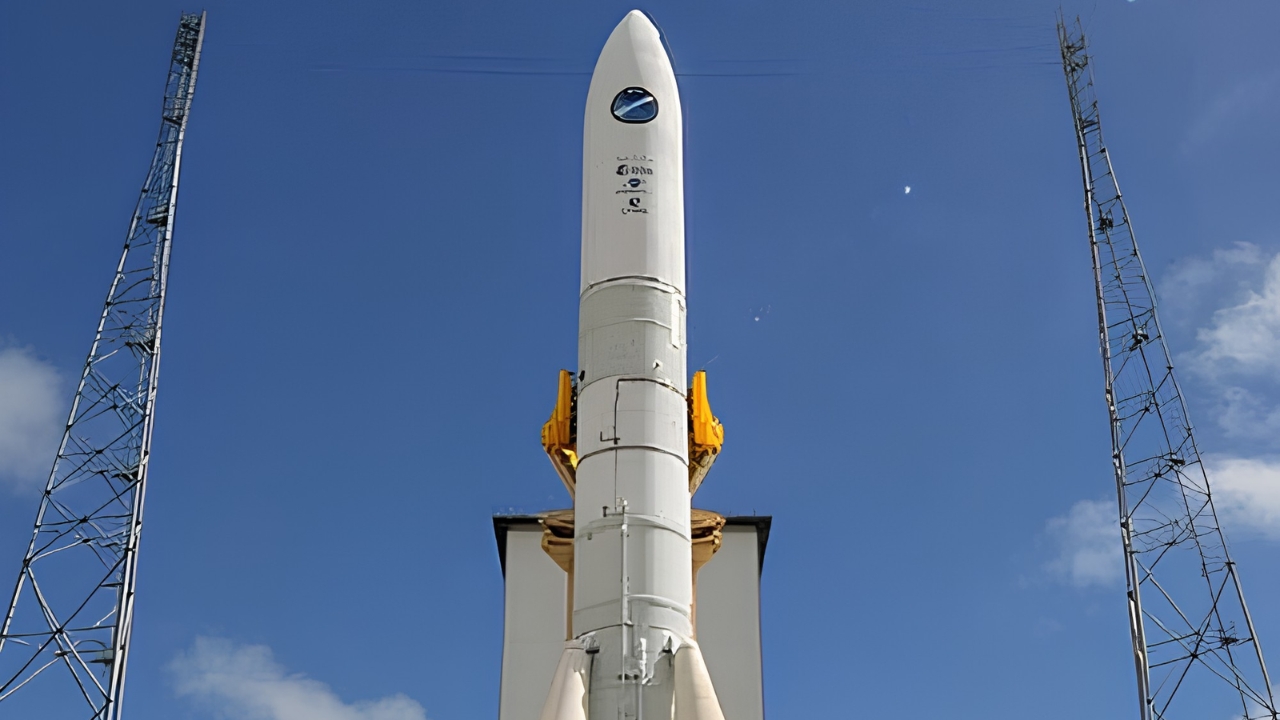
Ariane 6 Faces a Bigger Test Than 32 Amazon Satellites
What does Europe’s new heavy launcher really prove when it lifts another batch of internet satellites? Ariane 6 is due to make its next mission soon, placing 32 Amazon Leo satellites in orbit. This launch, VA268, will be another initial test of Europe’s replacement for Ariane 5 and its reliability as a carrier in the long term. Ariane 5 ended its career in 2023 after 117 flights, with a success rate of 96 percent, making it a crucial strategic tool for Europe just like its commercial competitor.

Now Ariane 6 has to live up to its legacy. VA268 is expected to be the seventh flight for the rocket and its second launch of the 64 version featuring the largest number of solid boosters four. According to Arianespace, the European launch services provider, the launcher will be able to place all spacecraft within low Earth orbit, taking less than two hours, and deploy the last satellite in a tight sequence from its fairing with the height of twenty meters.
The cargo is important, as this mission is going to launch another part of an already existing constellation. Rebranded as Amazon Leo in late 2025 from Project Kuiper, the satellites have grown to 270 spacecraft by April 2026. Still, this is far from Amazon’s licensed 3,236 satellites, and their deployment depends significantly on launch frequency and accuracy, as well as reliability and diversity of launch vehicle families involved. With Ariane 6 successfully flying, the mission adds to Amazon’s transportation options.
There are many reasons for the interest in the launch for Europe. While Amazon benefits from the ability to launch from several sources with regularity and stability, Ariane 6 proves yet again that launching megaconstellation missions is becoming one of the primary uses of European launchers. This allows for maintaining autonomous access to low Earth orbit, which is a key point, since Arianespace itself defines the project as a way for Europe to achieve autonomous, resilient, and cost-effective access to space.
Amazon’s constellation highlights the current state of low Earth orbit and its importance. The satellites in the system should provide access to remote locations unreachable through conventional terrestrial networks, while the orbits they follow are at an altitude of about 590-630 kilometers from Earth. At such altitudes, low latency makes the satellite broadband service applicable to video communications and high-quality streaming.
Therefore, the satellites are another step towards turning launch rockets into bottlenecks in the development of the infrastructure for space internet. As a result, while Ariane 6’s latest mission might seem a relatively usual event in a year of many, it is yet another example of European rocket proving its reliability and availability.