Why Qatar’s 747 Is a Bridge, Not the VC-25B
Boeing’s unveiling of the Boeing 747-8 in presidential service looks, on the surface, like the launch of a fairly routine Air Force One replacement. It is not. A better characterization is that it is an interim executive airlift platform bridging the readiness gap while Boeing completes development of the VC-25B replacement fleet.

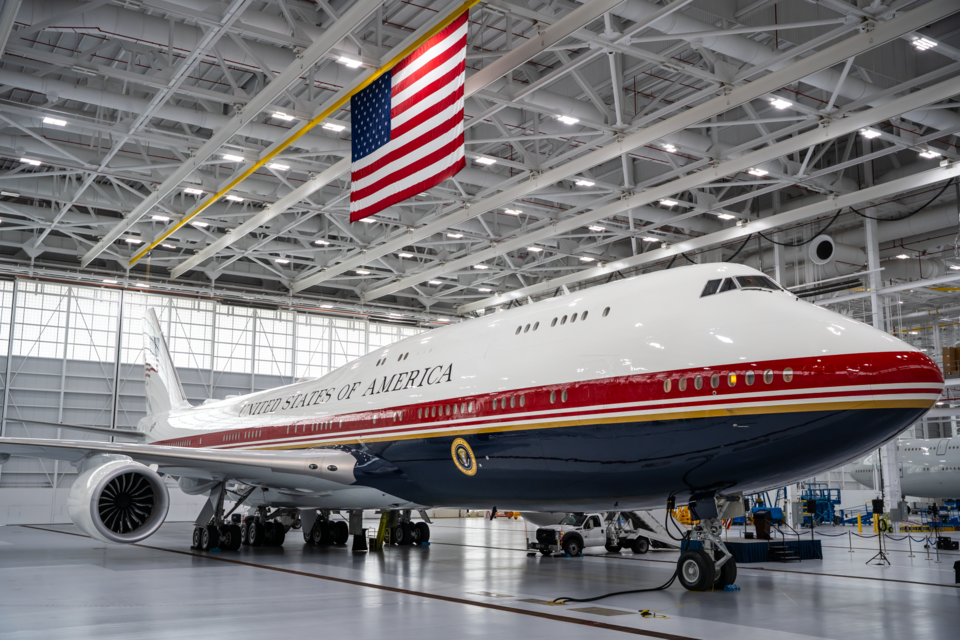
This particular airplane was unveiled at Joint Base Andrews on June 19 after months of debate over how fast the modifications could be made and the actual extent of the modifications. Some of the modifications included in the unveiling include upgrades in security, logistics support, mission communications, and a new red, white, blue, and gold exterior scheme. However, the interior reportedly received little change, which is an important clue into the nature of the conversion process.
It is an important clue because a presidential transport aircraft is not characterized simply by paint job or interior finish or even just secure transport. The engineering effort resides in the mission systems. A presidential purpose-built 747 is supposed to include hardened secure communications capability, command and control capability, medical capabilities, security, and other survivability features. Matthew Burchette, the senior curator of the Museum of Flight, said that the former Qatari aircraft should not be viewed as a “true” Air Force One in the sense of having the complete capability set. Instead he called it a stop-gap airplane until Boeing delivers the new fleet.
That is an important distinction. While any Air Force aircraft carrying the president would have the Air Force One designation, it does not necessarily mean that the airplane will have the full mission capabilities of the purpose-built VC-25B airplane. According to Burchette, a fully modified presidential 747 would get hardened secure communications capability, self-protection systems, electromagnetic pulse protection, specialized command and control capability, medical facilities, aerial refueling capability, and special security upgrades. However, the Qatari aircraft may have some of these capabilities but definitely not all of them.
The very existence of that capability gap explains why this is an interim aircraft rather than just a swap. The current VC-25A fleet entered service in the early 1990s and the replacement effort has run into multiple delays. For example, the delivery target date for the VC-25B aircraft moved from 2024 to 2027 and then to 2029 although one estimate puts the first delivery in mid-2028. From the standpoint of fleet management, an interim aircraft is a means of alleviating the pressure on aging aircraft and giving operators one more tool to rely upon while waiting for Boeing to deliver the next-generation replacement.
The details of basing prove that this is not simply an aircraft swap either. The 747-8 airframe is significantly bigger than the previous presidential airplane and thus required a new hangar to be built at Joint Base Andrews to accommodate the aircraft. That is a good reminder that the introduction of a new airframe has impact beyond the aircraft itself. The ground handling, maintenance, training, supporting equipment and the supporting infrastructure have to change to accommodate the new airframe.
Training and commissioning represent part of that transition process. The newly acquired aircraft will undergo commissioning flights before presidential use. The purpose of such commissioning flights is to ensure that the aircraft is operationally capable according to all necessary mission and procedural requirements. That is a classic systems approach – modification is only one element of operational readiness and the aircraft is operationally effective only when crews, maintainers and supporting procedures are adapted to the hardware.
By contrast, the design of the VC-25B is focused on long-term service as a presidential aircraft. The Air Force Life Cycle Management Center says that the two 747-8-based aircraft are being designed, modified, tested and delivered as replacements for the current VC-25A fleet with upgrades including electrical power improvements, mission communications, medical facility, executive interior modification, and autonomous ground operations capability. This represents a more substantial conversion path compared to the publicly described efforts applied to the interim aircraft.
While the recently unveiled Boeing 747 might have the visual characteristics of presidential transport aircraft and might soon see ceremonial use, the important story is the role of the airplane within the transitional architecture. It preserves executive airlift capacity, provides time for the delayed program and illustrates the difference between appearance of a presidential aircraft and its underlying capabilities in communications hardening, systems integration, certification and support infrastructure. Aviation audience take note: the airplane may be used for presidential mission on an interim basis, but the benchmark is the VC-25B program. Specialized fleets can have their appearances changed quickly enough, but full mission capability usually cannot be.
By Robert McKinney — Editor-in-Chief for AMI’s automotive and mobility coverage, with a mechanical engineering background and a decade reporting on powertrain systems, EV innovation, and global vehicle manufacturing.