GE Aerospace Connects Powder, Machines and Production for Engine AM
Discussions regarding additive manufacturing (AM) metal parts in aerospace tend to focus around the 3D-printing machine as an end product. However, the certification in aerospace propulsion industry takes place within a tightly coupled chain which demands control over powder material, machine capabilities, process engineering, inspections and disciplined manufacturing. Such a process-oriented approach to additive manufacturing is what is developed by Avio Aero and Colibrium Additive within GE Aerospace’s Propulsion & Additive Technologies business unit.

For the sake of the US aerospace audience, the brand is not important. What does matter is the industrial logic. Changes in characteristics of the powder influence the process and its output. Changes in the machine behavior suggest that any qualification efforts cannot be undertaken once and for all. And if inspection fails to cope with the output volumes, then there is no scalability. “Additive Manufacturing is complex because you’re not just 3D printing something, you’re managing certified machines, validated processes, unique materials and rigorous inspections.”
The centerpiece of the network is the Cameri plant of Avio Aero in Italy opened in 2013 and currently functioning as an industrial production facility of aerospace engine parts manufactured through electron beam powder bed fusion (PBF-EB) process. The Cameri plant is one of the flagship centers of GE Aerospace metal additive manufacturing, but it is far from being the only one in the network. Others include Turin Additive Laboratory, the Brindisi facility, AP&C metal powders manufacturing, and Colibrium Additive engineering and machine development teams in Europe, Canada, and the USA.
The reason for which such multi-site setup is relevant is that aerospace additive manufacturing is a controlled manufacturing process which has to be qualified and kept consistent throughout the production process. “Safety, quality, delivery and consistency before productivity and cost” are the priorities in the area stated Dario Mantegazza, Chief Manufacturing Engineer, Additive Business, Avio Aero. The priority is worth noting. Productivity makes sense in propulsion manufacturing only if the process window is stable enough.
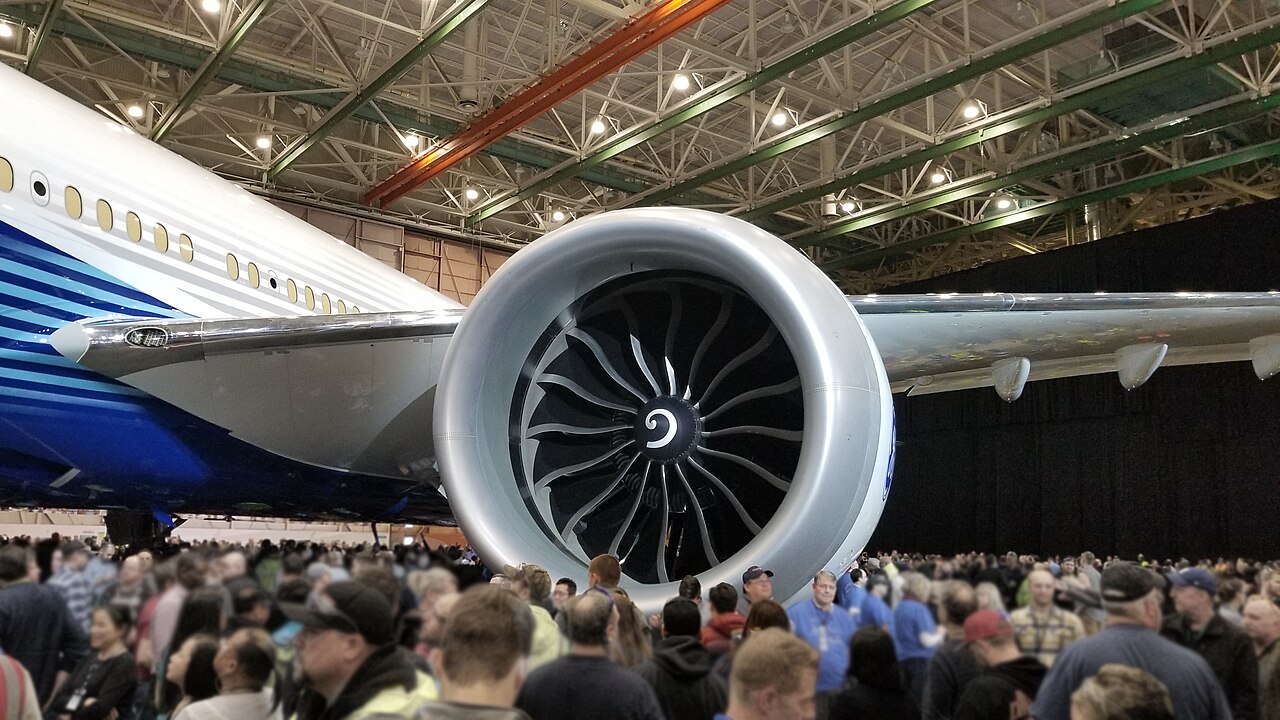
One of the examples of it is the industrialization of titanium aluminide low-pressure turbine blades for the GE9X engine. Such blades are produced on the machines of Colibrium Additive through the use of PBF-EB process and AP&C titanium aluminide powder. According to Avio Aero, the blades are almost twice lighter compared to the traditional blades made from nickel alloy. It leads to the increase of the fuel efficiency compared to the previous generation of the aircraft the GE90-115B engine. It is worth noting that the GE9X engine is already certified by FAA in September 2020 thus making this manufacturing experience relevant for certified commercial propulsion, not just development.
From the mechanical perspective, it is exactly when the value of the integrated model shows up. Titanium aluminide is not just another printable alloy. The process which makes it possible to manufacture the blade is the electron beam technology, the control of powder and precise engineering and it has to be reproduced in batches and over the time. As Dario Mantegazza notes, it “simply would not be possible without close cooperation across our global additive teams”. Not a slogan but a manufacturing requirement for rotating engine hardware.
The Turin Additive Laboratory established in 2017 by Avio Aero and the Polytechnic University of Turin is responsible for transfer of research into industrial production. Dario Mula, Plant Leader at the lab, says that it is the task to support the global additive value chain through improvement of additive processes focusing on productivity, efficiency and reduction of component cost. Just the challenge in aerospace manufacturing – proving that a promising process is locked down, documented and replicated at the industrial scale.
There is one more interesting point in the way how GE Aerospace implements the lean manufacturing principle inside the additive manufacturing. Recently there was a joint project between the specialists of AP&C, Avio Aero, Colibrium Additive and GE Aerospace implementing the company’s Flight Deck operating model. The result was reduction of powder losses and improvement of manufacturing costs and sustainability performance. In case of metal AM, it is a significant achievement. Powder is not a background material, it is a process parameter which influences the process economics and its quality directly.
Automation and AI are also being implemented in the workflow, but very carefully. As Andrea Palumbo, Consulting Engineer Additive Technology at Avio Aero, says, the role of AI increases particularly in the inspection phase where AI can help to accelerate image analysis. At the same time he is very clear about the limitation – the human expert is the ultimate decision-maker and AI helps him to make it. For the certified aerospace production, it is the right approach. Speed is nice, but safety and precision take priority.
What GE Aerospace is demonstrating here is not a story of 3D-printing success in general. This is the manufacturing architecture of certified propulsion parts, where powder material, machine, validation, inspection and factory discipline are taken into account as a united process. This is the threshold of the industrial metal AM. When the powder-to-part chain is treated as a single controlled process, additive manufacturing stops being a prototyping technology and becomes a manufacturing one.
By Edward Collins — Senior editor for AMI’s performance systems and mechanical design coverage, focused on powertrains, drivetrain systems, manufacturing precision, materials, and high-performance engineering.