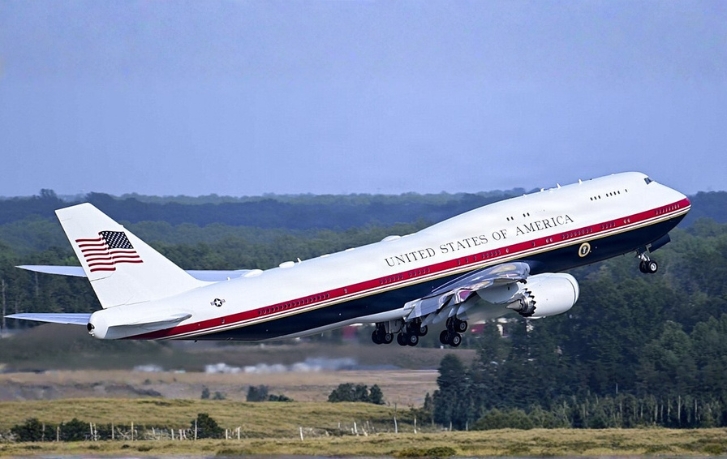
Donated Boeing 747-8 Flies After Conversion Costing Under $400 Million
A Boeing 747-8 donated to the U.S. government after serving Qatar’s royal family made its first reported presidential trip Wednesday, carrying President Donald Trump to North Dakota for an America 250 event connected to the Theodore Roosevelt Library dedication. The Air Force previously put the aircraft’s presidential-use modification cost below $400 million, including secure communications and defensive systems, but officials have not released a complete accounting of classified security upgrades.

That distinction is central to understanding the public cost. The aircraft itself was donated through the Pentagon, according to the administration, but a commercial widebody even one originally fitted for royal travel is not delivered ready for the communications, protection and operational demands of presidential airlift. The acquisition price and the cost of turning an airplane into a secure government platform are separate items.
Asked about the taxpayer expense, Trump did not provide a precise figure. He described it as “very little relative to what it would cost if we did it a different way” and emphasized that the airplane was a gift. The publicly acknowledged figure therefore establishes a ceiling for the Air Force’s reported modification spending, not a complete lifetime-cost figure for operating and supporting the aircraft.
Why a donated airliner still generates a substantial bill
The visible cabin is not the main engineering cost driver. Lie-flat seats, wood paneling, plush carpeting and gold-colored fixtures may distinguish the aircraft from an ordinary passenger jet, but presidential conversion work concerns systems that are less visible and considerably more consequential. Secure communications must function as part of a larger government network, while defensive equipment must be incorporated without compromising aircraft power, data, structural or flight-safety requirements.
Adding mission equipment is a systems-integration problem rather than a simple installation job. New hardware can require electrical distribution changes, cooling, antennas, wiring, structural provisions, operator interfaces, maintenance documentation and testing. Each change can interact with the aircraft’s baseline configuration, and the completed airplane must remain supportable by trained crews and maintainers.
The precise scope applied to this aircraft has not been publicly detailed, and classified features should not be inferred from the broad descriptions available. What can be said is that the Air Force’s sub-$400 million figure covered more than cosmetic refurbishment: secure communications and defensive systems were specifically included in the reported work.
The comparison with Boeing’s replacement program has limits
Trump has cited Boeing’s delays in producing the planned replacement presidential aircraft as a reason for accepting the donated 747-8. The new-aircraft program provides useful context for why presidential conversion can consume years and significant resources, but it is not a direct cost comparison. Boeing’s defense chief said the company still expected additional cost growth as it completed wiring, structures and certification work intended to support a first delivery in 2028, according to Breaking Defense.
Those replacement aircraft and the donated interim airplane do not necessarily have identical configurations, requirements or certification paths. Boeing provided engineering support for the donated aircraft, while L3Harris performed its modification, but Boeing declined to explain publicly how the interim platform differs from the new presidential aircraft under development. It would therefore be misleading to treat the programs’ costs as interchangeable.
What remains outside the public total
The largest unresolved issue is the boundary around the reported Air Force expenditure. Officials have not supplied a complete public breakdown of classified security work. The available figure also does not establish the aircraft’s total future operating burden, including the duration of its service, maintenance demands, crew and maintainer training, logistics support or additional modifications.
Subsequent reporting added another indication that the configuration was still evolving: the White House said the president would temporarily return to an older aircraft while the donated 747-8 received further upgrades over roughly one month, according to The Washington Post. That does not by itself establish the cost or technical scope of the additional work, but it reinforces why the publicly stated conversion figure should not automatically be read as a final all-in total.
Critics have raised legal and ethical objections to accepting a foreign donation, while the administration maintains that the transfer is lawful because the airplane was given to the U.S. government through the Pentagon. No judicial or official finding supplied here establishes that the transfer was unlawful. The narrower engineering-policy conclusion is clearer: eliminating an aircraft’s purchase price does not eliminate the expense of converting, testing, securing and sustaining it for a specialized national mission. Until the government defines which costs are included and which remain outside the sub-$400 million figure, taxpayers have a conversion estimate not a complete cost accounting.
By Thomas Caldwell — AMI’s senior editor for mechanical and mobility engineering, covering vehicle electronics, systems integration, electrification, chassis systems, propulsion, and safety policy.