Navy’s Ford-Class Carrier Redesign Review Raises Billion-Dollar Cost, Delay Risks
The Navy is reportedly evaluating whether to move the command tower on future Gerald R. Ford-class aircraft carriers farther forward, reopening a design question that an earlier review found could add billions of dollars and significantly delay the program. Seven current and former U.S. officials described the evaluation to The Washington Post, although its timing, scope and outcome remain unclear.

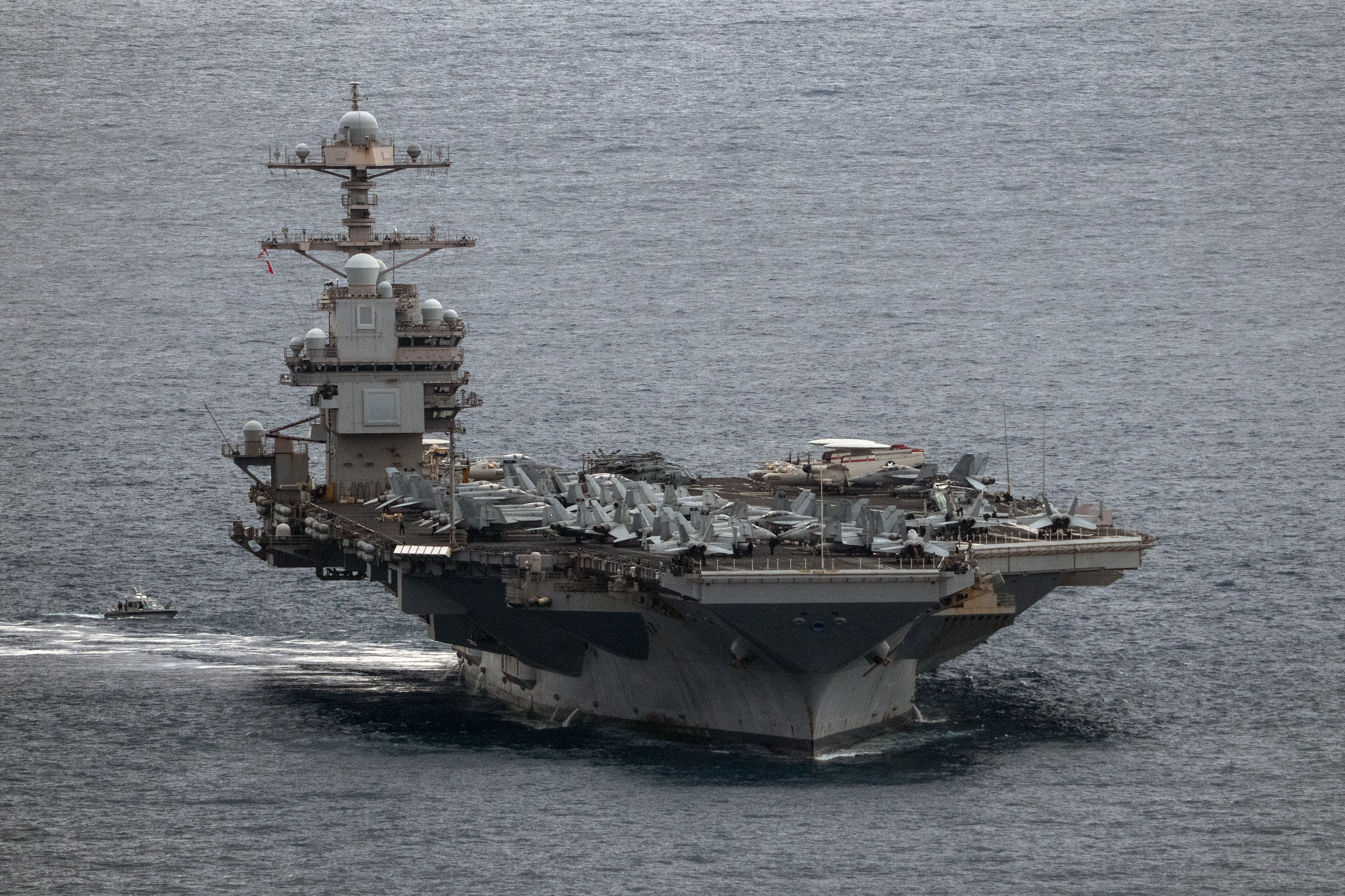
The proposed move responds to a preference for the appearance of older carriers, according to those officials. But the tower known aboard a carrier as the island is not simply an architectural feature that can be repositioned without wider consequences. It carries command functions and contributes to the ship’s weight distribution, while its location shapes how aircraft and air flow move around the flight deck.
The Navy and Pentagon did not independently confirm the island review, referring questions to the White House. A separate national security memorandum does confirm another potential change: It directs the Navy to develop a plan for replacing electromagnetic aircraft-launch systems with steam-powered catapults on future carriers. The memorandum does not address moving the island, so the reported layout study and the confirmed catapult-planning directive remain distinct actions.
A tower move becomes a ship-level redesign
Bryan Clark, a former Navy officer at the Hudson Institute, characterized relocating the island as “a major redesign” that would affect the carrier’s weight and buoyancy. On a ship this large and tightly integrated, changing the position of a substantial structure can force engineers to revisit weight balance, internal arrangements and the relationship between the hull and flight-deck systems.
That scope helps explain why a former senior U.S. official said a study conducted during the first Trump administration produced an unfavorable cost-and-schedule conclusion. “It came back that the cost and time to do so would just be extraordinary,” the former official said. The finding is attributed rather than a publicly released Navy estimate, and no current redesign budget has been confirmed. Still, it identifies the central procurement risk: A visual change at the top of the ship can propagate into expensive engineering and construction work below it.
The current aft position also purchased specific flight-deck benefits. Three current and former officials familiar with the program said placing the island farther back creates more aircraft-parking space near the catapults, supports shorter launch cycles and reduces turbulence encountered by returning aircraft. Moving it forward could therefore trade away some of the operational efficiency and landing-safety benefits attributed to the Ford layout.
That does not establish that a forward island is technically impossible or inherently unsafe. Older carrier arrangements demonstrate that different layouts can work. The relevant question is whether changing an established Ford-class configuration would deliver a benefit sufficient to justify new design work, disrupted construction and potentially reduced deck efficiency. Clark’s assessment was direct: “You could change it, but it’s very disruptive.”
Catapult reversal adds a separate integration problem
The steam-catapult directive would create another system-level challenge. Electromagnetic launch equipment is part of the Ford class’s integrated architecture, while steam catapults depend on a different supporting arrangement. Reversing course on future ships would not amount to substituting one launcher for another at the end of an assembly line; it would require a plan covering design, resources, production and integration.
Officials said that change also could cost billions and worsen shipbuilding delays. The policy case emphasizes “proven, reliable and affordable technologies and ship designs,” but maturity alone does not remove the cost of inserting an older technology into a carrier designed around a newer one. The practical comparison is not merely steam versus electromagnetic launch. It is the full cost and schedule of redesigning an in-production class versus continuing its current configuration.
Those risks land on a program with little schedule margin to spare. USS Gerald R. Ford took 17 years to construct and is now in service. USS John F. Kennedy is undergoing sea trials, while USS Enterprise and USS Doris Miller are under construction. The Navy plans as many as 10 Ford-class carriers over four decades, with future ships projected to cost $22 billion each.
For taxpayers and the fleet, the unresolved boundary is which ships if any would absorb either change. Applying a redesign only to later carriers could limit disruption to ships already well into construction, but it would also create configuration differences across the class, with consequences for engineering, production and long-term support. Applying it earlier would place more existing work at risk. Until the Navy defines the scope, the most consequential fact is that both proposals reach far beyond appearance: They touch the carrier’s basic arrangement, aviation workflow and already demanding construction schedule.
By David Whitaker — Associate editor for AMI’s aerospace and drone systems desk, translating flight systems, aircraft programs, spaceflight, and UAV developments into accessible technical stories.