


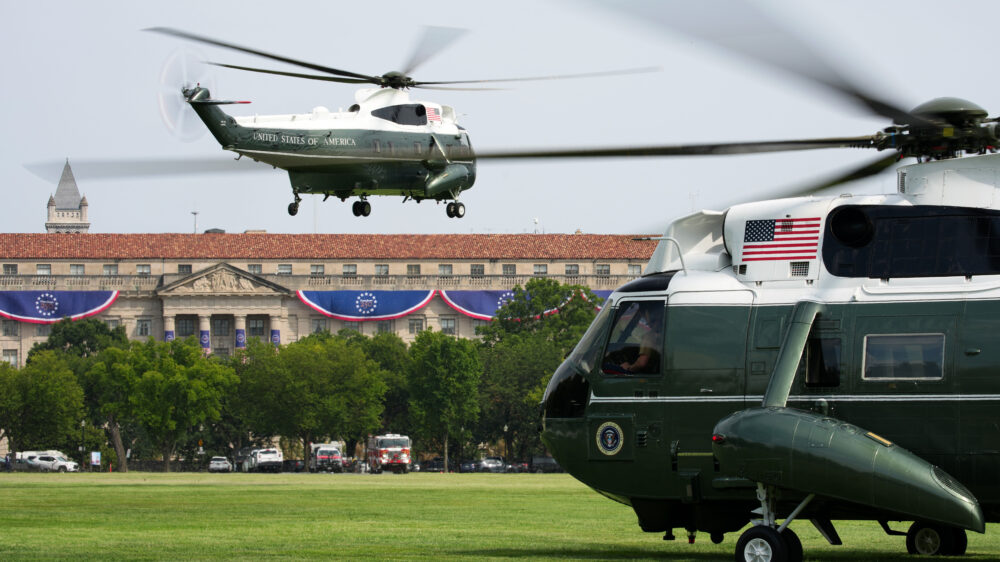
FAA Moves Reagan Receiver After Marine One Warning Fails to Reach Controllers
A radio link can work across an operating area yet fail at one newly introduced location. That coverage boundary is central to the National Transportation Safety Board’s preliminary investigation of an Aug. 4 loss of separation involving Marine One and an Envoy Air passenger jet near Ronald Reagan Washington National Airport.

Marine One transmitted its required three-minute departure warning from the Ellipse, but Reagan controllers did not hear or understand the notification before clearing the jet for takeoff. Investigators said the temporary helicopter departure location lacked adequate line of sight to the radio receiver. The Federal Aviation Administration subsequently moved the receiver from a neighborhood near the airport to the top of the Reagan tower, where later tests showed the radios working well.
A location change altered the communications system
Marine One had been operating from the Ellipse while a new helipad was being built behind the White House. In radio-system terms, that was not merely a change in parking position. Moving a transmitter can alter the path to its receiver, including whether buildings, terrain or other obstructions interfere with the line of sight needed for dependable coverage.
FAA technicians determined after the encounter that the temporary location did not have adequate line of sight to the receiver then in use. Placing the receiving equipment atop the Reagan tower changed its geometry relative to the Ellipse. Successful subsequent testing indicates that the relocation improved this particular communications path, although the continuing investigation has not issued final findings.
The sequence also demonstrates why temporary operating configurations require their own end-to-end validation. A procedure can remain unchanged the pilot still makes the three-minute call while the physical infrastructure supporting it no longer provides the same coverage. In this case, controllers and Marine One pilots had met the previous week because some warning calls had been missing. They agreed on an alternative relay process, but that process also failed to deliver the notification on Aug. 4.
That matters from a systems-safety perspective because the direct radio call and backup relay were intended as separate opportunities to communicate the same time-critical information. Neither gave the controller a usable warning. Awareness that communications had been “spotty” was therefore not equivalent to identifying and correcting the underlying coverage problem.
The missed call affected an airport safety barrier
The warning is operationally consequential because it gives Reagan controllers time to protect Marine One’s route. Under a procedure adopted after the Jan. 29, 2025, collision near the airport, takeoffs and landings are stopped when a helicopter uses a conflicting route. Without a received warning, the controller cleared Envoy Air Flight 3742 for departure as Marine One left the Ellipse.
The NTSB preliminarily estimated that the aircraft came within approximately 0.82 mile laterally and about 700 feet vertically, compared with a required lateral buffer of 1.5 miles. The Envoy crew received a traffic alert from the aircraft’s collision-avoidance system but did not see the helicopter. Marine One’s pilots saw the jet and paused while it climbed away. Neither aircraft was damaged, nobody was injured, and officials said the president was not in danger.
The collision-avoidance alert and the helicopter crew’s visual contact provided later layers of protection, but they did not restore the missed departure coordination. Collision-avoidance equipment is designed to alert crews to nearby traffic; it does not replace the advance notification that allows controllers to keep conflicting operations apart in the first place.
The investigation still has important boundaries
The available findings support a direct connection between the Ellipse operating location and inadequate coverage to the original receiver. They do not establish that construction caused every communication issue involving Marine One. A separate, brief radio problem occurred on a later flight, but its cause was not immediately clear.
Nor does the preliminary information support assigning final fault. The official tower recordings did not capture the required warning, while a separate recording indicated that the Marine One pilot transmitted “three minutes to lift.” The attempted relay through the helicopter facility at Joint Base Anacostia-Bolling was also unsuccessful. Those facts explain why the controller lacked the expected notice, but the NTSB’s broader review remains underway and its information is subject to change.
The receiver relocation is a concrete corrective action, not the end of the safety work. The enduring systems question is whether communications coverage and backup procedures remain reliable whenever a protected operation moves from its normal location. At Reagan, the first hardware change has passed subsequent radio tests; the NTSB’s final findings will determine what additional operational or procedural safeguards the incident warrants.
| More aerospace and engineering stories, right in your MSN feed. Follow AMI on MSN |
By Thomas Caldwell — AMI’s senior editor for mechanical and mobility engineering, covering vehicle electronics, systems integration, electrification, chassis systems, propulsion, and safety policy.



