USS Abraham Lincoln Reaches Thailand After Eight Months Without a Port Call
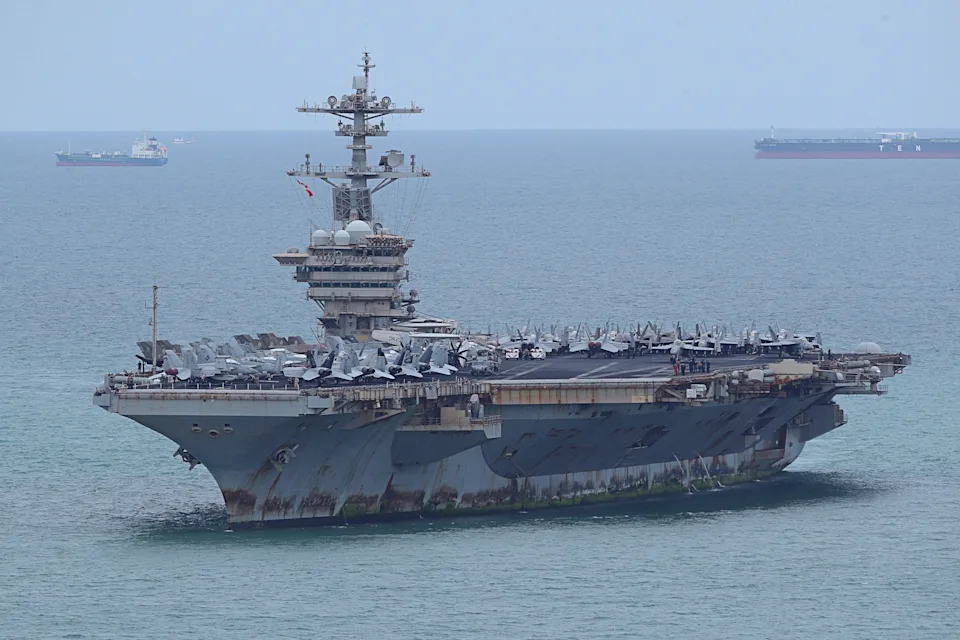
USS Abraham Lincoln sustained an exceptionally long combat deployment, but that availability came with pressure on approximately 5,000 crew members, shipboard support systems and the Navy’s limited carrier force. The 100,000-ton carrier arrived at Laem Chabang, Thailand, on September 2, making its first port call in more than eight months and ending 286 consecutive days at sea.
The stop is more than a break in an unusually long voyage. It demonstrates the operational cost of keeping a carrier continuously available: routine maintenance accumulates, supply chains become harder to manage, basic services carry heavier loads and sailors lose the recovery periods that port visits provide. Lincoln left San Diego last November and is expected to return to Southern California later this year after a deployment on track to rank among the longest in U.S. Navy history.
A carrier is a city that cannot pause
A nuclear-powered carrier can remain underway for long periods without refueling its reactors, but reactor endurance does not eliminate the rest of the ship’s logistical needs. Food, hygiene products, spare parts and mail still have to move through a replenishment network. Water production and plumbing systems must serve thousands of people every day, while aviation and deck crews continue maintaining aircraft and flight-deck equipment in a corrosive saltwater environment.
Port calls create opportunities to replenish supplies, perform work that is more difficult at sea and give crews time away from the ship. Removing those pauses does not necessarily stop operations, but it reduces the margin available to absorb delayed parts, equipment problems and human fatigue. Visible rust on Lincoln and accompanying vessels after months at sea illustrates prolonged exposure, although appearance alone does not establish the ship’s mechanical condition or combat readiness.
Reports about conditions aboard Lincoln remain disputed. Sen. Richard Blumenthal cited alleged shortages of basic supplies, contaminated water, plumbing problems, deck-safety concerns, mail disruption and deteriorating mental health. CNN reported low morale, intermittent shortages and at least one possible suicide attempt. Defense Secretary Pete Hegseth said portrayals of the ship’s conditions were “completely misrepresented,” without specifying which claims he disputed.
The Navy told CNN it had not observed an increase in suicidal ideation or attempts aboard the carrier and said religious, medical and mental-health personnel were available. Those competing accounts do not establish every reported problem as fact. They do show why deployment length is an engineering and readiness issue as much as a scheduling decision: a carrier’s effective endurance depends on its people and support services, not only propulsion, fuel and ammunition.
Relieving Lincoln moved the strain elsewhere
The Navy preserved its two-carrier presence in the Middle East by sending the Japan-based USS George Washington to join USS George H.W. Bush and replace Lincoln. That rotation enabled Lincoln to begin moving home, but it also reduced carrier availability in East Asia. A ship can be reassigned more quickly than another carrier can be produced, overhauled or brought through training, so meeting an urgent requirement in one region can create a visible gap in another.
The United States operates 11 aircraft carriers, but that figure is not the same as 11 deployable ships. Maintenance periods, reactor refueling, training and certification keep part of the fleet unavailable at any given time. Delays affecting newer Ford-class ships further limit how quickly the Navy can expand usable capacity. Under those constraints, extending a deployment may preserve immediate coverage while shifting maintenance work, crew recovery and scheduling pressure into the future.
Chief of Naval Operations Adm. Daryle Caudle has said he prefers deployments of about seven months and generally opposes extensions, while acknowledging that combat requirements can overturn preferred schedules. Lincoln’s port call came well beyond that benchmark. Its commanding officer, Capt. Dan Keeler, said the crew was excited to make Thailand the first port visit of the deployment.
Lincoln is still expected to complete the journey to Southern California later this year. Before the carrier can settle back into a normal cycle, its condition, deferred work and crew recovery will have to be reconciled with the fleet’s next demands. The ship’s 286 days without a port call kept one carrier on station, but replacing it required the Navy to pull another carrier away from East Asia the clearest measure of how little spare capacity was available.
| More aerospace and engineering stories, right in your MSN feed. Follow AMI on MSN |
By David Whitaker — Associate editor for AMI’s aerospace and drone systems desk, translating flight systems, aircraft programs, spaceflight, and UAV developments into accessible technical stories.