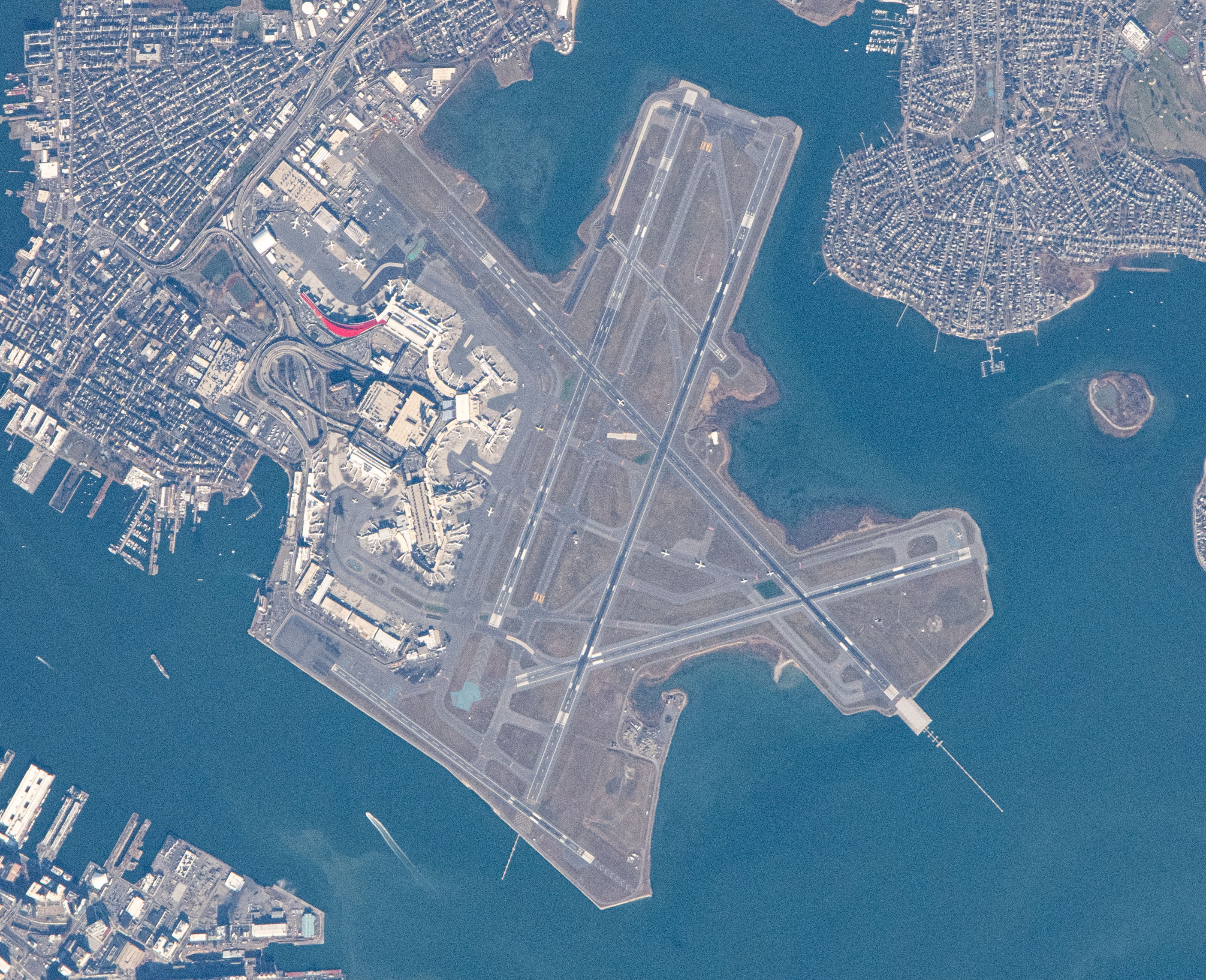
Boston Logan Closes Runway for 75-Day Safety Upgrade, Delays Expected Through Mid-November
Boston Logan International Airport is accepting a short-term loss of runway capacity to add long-term aircraft-overrun protection. Runway 9-27 closed on September 2 for a planned 75-day safety-system installation, and Massport expects the reduced operating capacity to contribute to delays particularly during afternoons and evenings through mid-November.

The project adds an Engineered Materials Arresting System, commonly called EMAS, beyond the runway end. The Federal Aviation Administration describes EMAS as an energy-absorbing bed made from material that crushes beneath an aircraft’s wheels. If an aircraft overruns the pavement, its tires sink into the material, increasing resistance and rapidly reducing speed.
Why a runway must close for passive protection
EMAS performs a specialized function without requiring a mechanical command, pilot activation or powered control system. It remains passive until an aircraft enters the bed. That simplicity eliminates the need to detect an overrun and trigger equipment in real time, but the protection must be engineered around the runway geometry and the aircraft expected to use it.
The FAA says a standard installation is designed to stop most overrunning aircraft entering at 70 knots or less. Bed length, width and distance from the runway end depend on airport configuration and fleet mix, and the FAA reviews and accepts each proposal before installation. Those design dependencies help explain why this is more than placing generic crushable blocks behind the pavement.
Runway safety areas traditionally provide clear, graded ground beyond and alongside a runway so an aircraft has more room to stop after an excursion. At airports where sufficient land is unavailable or a full-size safety area is impracticable, EMAS can absorb an aircraft’s kinetic energy in less distance. The technology effectively purchases stopping capability with engineered material rather than additional open land.
The construction cost visible to travelers is operating capacity. With runway 9-27 unavailable, Logan has fewer options for sequencing arrivals and departures. A runway closure does not mean every flight will be delayed, but it reduces the airport’s flexibility during busy periods. Massport has specifically warned: “We do expect delays, particularly in the afternoons and evenings until mid-November, due to an ongoing runway construction project.”
Delay totals do not establish a reliable daily forecast
Several large daily delay and cancellation counts have circulated for the first week of construction, including reported totals for September 4, 6 and 7. Those figures have not been confirmed here against FAA or flight-tracking records, so they should not be treated as verified measurements of the project’s impact.
There is also no confirmed basis for promising that an average Logan delay will fall within a particular range. A forecast of 60 to 75 minutes was attributed to an unidentified person claiming to be a former airport employee, not to Massport. The airport authority’s narrower statement elevated delays are expected especially during afternoons and evenings through mid-November is the defensible planning boundary.
This distinction matters because delay duration is a system outcome, not a fixed property of the construction project. The operational effect can vary with traffic demand, runway assignments and other conditions. Closing one runway creates a capacity constraint, but that fact alone cannot establish the delay for an individual flight.
A proven system with a destructive operating principle
EMAS is designed to be sacrificed during an overrun. Its lightweight material deforms under wheel loads, converting aircraft motion into crushing work and drag. Sections entered by an aircraft would therefore require assessment and repair, but that controlled material damage is the point: the bed is intended to dissipate energy before the aircraft reaches hazards beyond the protected area.
The FAA reported in August 2026 that EMAS had safely stopped 26 overrunning aircraft carrying a combined 497 passengers and crew. That record includes aircraft ranging from business jets and regional aircraft to Boeing 737 and 747 models. It demonstrates the system’s practical role while not eliminating its operating limits; performance still depends on entry speed, aircraft characteristics and the accepted design for that runway end.
The current work has been described as the first of two planned 75-day closures. However, conflicting dates have been given for the second phase, including references to periods after July 1, 2026 and after July 1, 2027. Until Massport publishes or confirms a consistent project schedule, the timing of that later closure remains unresolved. For now, the firm operating consequence is the present one: runway 9-27 remains unavailable while Logan installs a passive safety bed, with disruption expected through mid-November.
| More aerospace and engineering stories, right in your MSN feed. Follow AMI on MSN |
By Thomas Caldwell — AMI’s senior editor for mechanical and mobility engineering, covering vehicle electronics, systems integration, electrification, chassis systems, propulsion, and safety policy.