


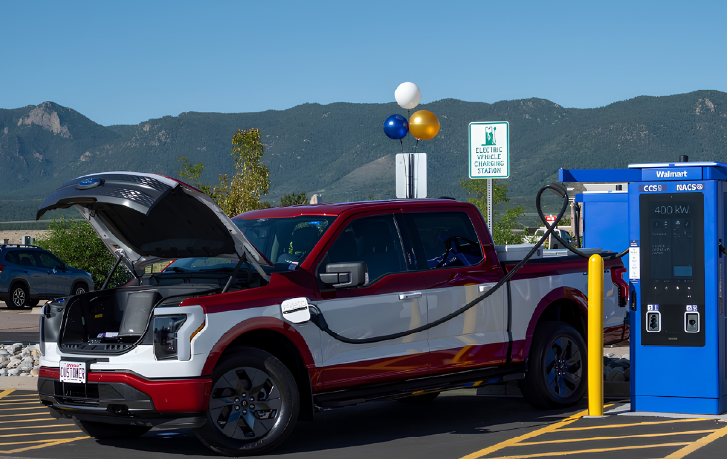
Walmart Reaches 100 EV Charging Sites, Plans Thousands Despite Funding Constraints
Walmart’s electric-vehicle charging network is expanding at a moment when two conventional supports for new infrastructure have weakened: federal funding was disrupted, and U.S. new-EV sales flattened in 2025. The retailer has now reached 100 charging locations and plans to put chargers at thousands of its stores by 2030, using parking lots, a familiar consumer brand and direct control of the charging experience to build capacity.
The 100th location opened at a Walmart store in Monument, Colorado. EV research firm Paren is tracking more than 200 additional Walmart locations in the pipeline. Some sites have banks of as many as 16 chargers, with sessions initiated through Walmart’s app and charging discounts available to Walmart+ members.
This is more than a matter of installing dispensers beside stores. A fast-charging site requires electrical service, utility coordination, permitting, payment systems, communications, maintenance support and enough physical space for vehicles to circulate safely. It also needs an operating model that can absorb installation costs before utilization becomes predictable.
Retail property changes the deployment equation
Large retailers begin with an advantage that charging-only operators must often acquire separately: property with existing traffic, lighting, parking, security and customer amenities. A charging stop can overlap with shopping rather than becoming a separate trip. The fastest commercially available chargers can replenish a vehicle in approximately 20 to 60 minutes, making the retail visit and the charging dwell time potentially compatible.
Ownership also determines who controls the customer interface. Walmart’s app-based system can connect charging with its existing loyalty program, while a branded network gives the retailer direct access to charging-related customer data. Industry participants describe that information as valuable for understanding visits and repeat use, although the available figures do not establish that every retail charging site is profitable.
White-label arrangements offer another path. Under these models, an outside provider can manage permitting, setup and maintenance while the retailer retains its own branding. Financing structures can also spread installation costs over time. Those approaches reduce the organizational burden of becoming a charging operator, but they do not eliminate the underlying engineering requirements or the need for dependable maintenance.
That distinction matters because a charger’s rated output is only one part of the service. Drivers encounter the entire system: parking access, connector availability, payment authorization, communications and equipment uptime. A bank with numerous ports can serve more vehicles and provide redundancy when one unit is unavailable, but it also creates a larger electrical load that must be incorporated into the site and local distribution network.
Private construction is adding measurable capacity
Paren reported that U.S. operators added 4,382 fast-charging ports across 806 stations during the second quarter of 2026. That brought the national fast-charging inventory to just under 78,000 ports. Charging activity reached 3.5 million sessions in June, up 29%, indicating that use was rising even as new-EV sales remained around 1.2 million in 2025. Used-EV sales, meanwhile, increased 10.1% year over year in July, and the total population of EVs on the road continued to grow.
The broader count exceeds 250,000 chargers of all types at roughly 81,000 U.S. locations, compared with 228,000 ports at the end of 2025. The Department of Energy’s charging-infrastructure trend reports provide additional context for how public and private nonresidential ports have expanded by charging level and region.
Walmart is not alone. Buc-ee’s, Circle K, Sheetz and Wawa are also adding chargers, while Tesla’s Superchargers for Business program added 58 stations containing 355 ports over 10 months, according to Paren. Electric Era estimates that convenience stores host roughly 1,365 chargers and big-box retailers about 600, leaving considerable room between early deployments and a mature retail network.
Retail sites cannot fill every geographic gap
The $5 billion National Electric Vehicle Infrastructure program was frozen in early 2025, stalling planned projects. A judge subsequently reversed the freeze and released some funding. Retail construction continued through that disruption, but private sites and public corridor programs do not perform identical jobs.
Retailers naturally have the strongest case where customer traffic can support a site. Public programs can target lower-traffic corridors and rural gaps that may be important to network coverage but harder to justify commercially. Colorado illustrates the distinction: the state reports that 17 federally supported fast-charging locations are open and 33 more have been awarded and are under development, contributing to coverage across mountainous and rural routes.
Walmart’s next 200-plus tracked locations will test how readily a standardized retail model can be repeated across different utilities, permitting jurisdictions and site layouts. Reaching thousands by 2030 will depend not just on installing chargers, but on integrating power, payments and maintenance consistently enough that a parking-lot charger becomes as routine to drivers as the store itself.
| More aerospace and engineering stories, right in your MSN feed. Follow AMI on MSN |
By Thomas Caldwell — AMI’s senior editor for mechanical and mobility engineering, covering vehicle electronics, systems integration, electrification, chassis systems, propulsion, and safety policy.



