Gloyd Starts U.S. Machine That Shreds Battery-Filled Earbuds and Vapes Whole
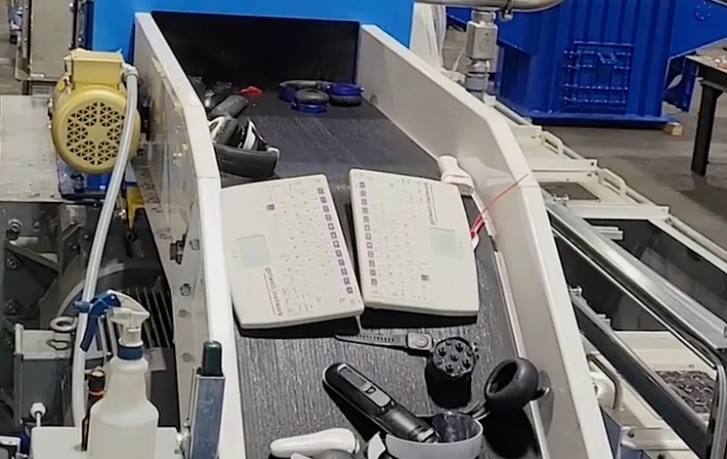
Water is central to Gloyd Recycling Solutions’ approach to a difficult industrial problem: shredding small electronics that still contain lithium batteries. Rather than requiring workers to open each vape, earbud case or other compact device first, the equipment feeds the complete product through a wet shredder designed to reduce the risk of fire or explosion during processing.
That system is now operating in the United States. Houston-based Gloyd has commissioned its first domestic Battery-In-Device Shredding installation for an unnamed customer in the Southeast, according to Resource Recycling’s account of the deployment. Two additional U.S. installations are expected to begin operating, although their locations and startup dates have not been disclosed.
Wet shredding replaces a manual disassembly step
The machine accepts loose batteries along with battery-containing electronics as large as a laptop. After wet shredding, the mixed material moves into a density-separation tank. The system produces four output streams: plastic, ferrous metal, nonferrous metal and black mass, the concentrated battery material that can be directed to downstream recovery operations.
Mechanically, the important change is not simply that the equipment shreds devices. Conventional handling can require employees to find and remove embedded batteries before the surrounding product is processed. Gloyd’s system is intended to eliminate that disassembly step for accepted items, reducing direct handling while preparing several material categories for reuse or sale.
The wet process should not be interpreted as eliminating battery hazards. Lithium-ion cells can retain charge, and damaged cells may enter thermal runaway if their casings are breached. Michigan environmental regulators, for example, warn that damaged batteries can ignite and create hazards during transport, storage and processing. Gloyd describes its shredder as reducing fire and explosion risk; no independent U.S. performance data were provided to quantify that reduction.
A smaller footprint targets smaller recycling operations
Gloyd says one machine can process approximately 4 million to 8 million pounds annually. A complete unit occupies roughly 750 square feet and requires water and an electrical connection. Those figures position it as warehouse-scale equipment rather than infrastructure reserved for a major centralized battery-processing complex.
That distinction matters because aggregation can itself become an operational constraint. Founder Jeff Gloyd said major battery processors often seek incoming loads of 30,000 to 40,000 pounds. Smaller electronics recyclers may generate battery-containing material gradually, leaving them to store it until they accumulate enough for another processor. Storage extends the time that charged, damaged or poorly identified cells remain inside a facility.
A compact processing line potentially changes that workflow by allowing material to be handled closer to where it is collected. However, annual nameplate throughput does not establish actual utilization, recovery efficiency or operating cost. Those outcomes will depend on the incoming device mix, uptime, maintenance requirements, water management and the availability of buyers or processors for all four output streams.
Recovery claims have not yet been demonstrated at the U.S. site
An overseas installation provides an early reference point but not a verified result for the new American machine. Australian company EcoBatt began using the system in September 2025 at a dedicated battery-in-device shredding facility. EcoBatt said it recovered more than 90% of the minerals contained in the devices it processed.
That figure is an attributed claim from the Australian operator. It should not be applied automatically to the U.S. installation, where no recovery percentage, contamination measurement, fire-performance record or sustained throughput result has been released. Differences in feedstock can materially affect separation: an earbud, a disposable vape and a loose cell combine plastics, metals and battery chemistries in different proportions.
The first domestic deployment therefore establishes that Gloyd has moved from an overseas reference installation to an operating U.S. system. It does not yet establish how consistently the equipment meets its stated capacity or how effectively its outputs fit existing downstream markets. The two planned U.S. startups could broaden that operating record, but Gloyd has not provided a schedule or locations. For recyclers deciding whether wet shredding can safely and economically replace manual battery removal, measured results from those installations will be the next consequential milestone.
| More aerospace and engineering stories, right in your MSN feed. Follow AMI on MSN |
By Thomas Caldwell — AMI’s senior editor for mechanical and mobility engineering, covering vehicle electronics, systems integration, electrification, chassis systems, propulsion, and safety policy.