


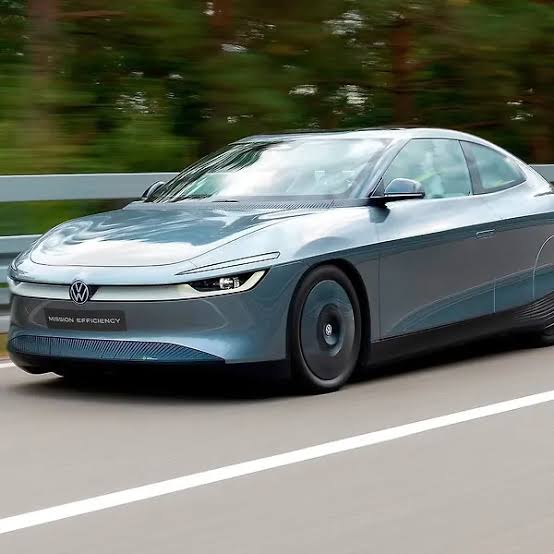
Volkswagen Concept Averages 13.14 Miles per kWh Across Nearly 800 Miles
Volkswagen says its Mission Efficiency electric concept averaged 13.14 miles per kilowatt-hour during a nearly 800-mile road trip from Wolfsburg, Germany, to Vienna. The result exceeded the development team’s initial target of 10 miles per kilowatt-hour and illustrates how reducing aerodynamic and rolling losses can extend range without installing an exceptionally large battery.
The car averaged 42 mph, reached 86 mph on the autobahn and stopped once to recharge. That last point is important: the nearly 800-mile journey was not completed on one battery charge. Volkswagen’s separate 721-mile range figure is a theoretical calculation obtained by applying the reported efficiency to the concept’s 54.9-kilowatt-hour battery capacity.
Low drag does much of the work
The Mission Efficiency records a claimed drag coefficient of 0.158 and presents only 22.39 square feet of frontal area to the airflow. Those two measurements work together: a low drag coefficient has less practical value if it is paired with a large frontal area, while a small vehicle still wastes energy if its shape creates substantial turbulence and separation.
Volkswagen’s purpose-built body tapers tightly toward the rear, where covered wheels and a narrow tail manage the wake behind the car. Wheel-airflow deflectors limit turbulence around the rotating wheels, while a variable front intake admits cooling air only when the vehicle needs it. Closing unnecessary openings reduces the pressure and airflow penalties associated with sending air through the cooling system.
These measures become increasingly valuable as speed rises because aerodynamic resistance grows rapidly with vehicle speed. Volkswagen says the concept can travel at 87.5 mph using the same energy the ID. Polo consumes at 62.5 mph. At 50 mph, the Mission Efficiency reportedly uses more than 30% less energy than the Polo.
The tires address another persistent loss. A special version of Continental’s EcoContact 7 reportedly reduces rolling resistance by 25% compared with the threshold for the European Union’s class A efficiency label. Unlike aerodynamic drag, rolling resistance matters even at relatively modest speeds, making tire construction, pressure, loading and alignment consequential to total consumption.
Production-derived hardware, specialized body
Underneath the unusual body is technology linked to a mass-market Volkswagen program. The concept uses the MEB+ platform and a 133-horsepower APP290 electric drivetrain associated with the ID. Polo. Volkswagen describes the ID. Polo as the first production model based on its MEB+ platform, with a compact front-wheel-drive system intended to improve packaging and cost.
“These are parts, modules, and concepts that we already have in production,” said Alex Heinrich, Volkswagen’s senior vice president for system architecture, concepts and innovation. That makes the experiment more relevant than a vehicle dependent entirely on laboratory-only propulsion hardware. Its exceptional efficiency, however, still depends on a highly specialized body and tightly managed sources of resistance.
The 54.9-kilowatt-hour nickel-manganese-cobalt battery is modest beside the much larger packs commonly used to secure long advertised ranges. At the reported 13.14 miles per kilowatt-hour, it yields the calculated 721-mile figure. Real range would still vary with speed, gradients, weather, cabin heating or cooling, tire condition and other auxiliary loads.
A 370-watt solar panel mounted on the roof could contribute as much as 18 miles of range per day under favorable conditions, according to Volkswagen. That is an environmental upper-bound claim rather than a dependable daily addition; season, location, parking exposure and weather would determine the actual contribution.
The efficiency comes with packaging boundaries
The long, tapered body retains cargo space and a rear seat, but Volkswagen describes that seat as snug. This reflects a central integration compromise: narrowing the rear improves airflow, yet reduces the volume available for occupants and cargo. A production vehicle would also have to balance aerodynamic performance against crash requirements, visibility, access, manufacturing cost, repairability and customer expectations.
Volkswagen has not approved the Mission Efficiency for production. Technical development board member Kai Grunitz said the company is considering what a production version might look like, but that is not a launch commitment. For now, the concept’s most concrete contribution is its demonstration that familiar electric-drive hardware can go substantially farther when the vehicle around it demands less energy.
| More aerospace and engineering stories, right in your MSN feed. Follow AMI on MSN |
By Thomas Caldwell — AMI’s senior editor for mechanical and mobility engineering, covering vehicle electronics, systems integration, electrification, chassis systems, propulsion, and safety policy.


