Airbus Spends £150 Million Turning Its A380 Factory Into an A321 Wing Line
A factory built to make wings for the world’s largest passenger aircraft is being reassigned to a much smaller jet produced in far greater numbers. Airbus is spending £150 million to convert its former A380 wing facility in Broughton, North Wales, into a dedicated A321 wing-production line, according to the company’s September 21 announcement.
The contrast reflects a fundamental change in Airbus’s production needs. Broughton’s West Factory opened in 2003 to support the four-engine, double-deck A380. Its next assignment is the A321, the largest member of Airbus’s single-aisle family and the dominant aircraft in the company’s narrow-body backlog.
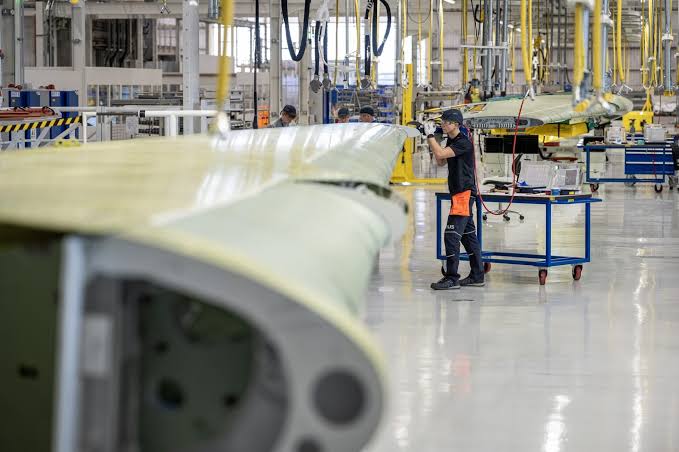
The first wing is already in production. Airbus plans to install six wing-production jigs, a dedicated equipping line and a paint shop, with all six jigs expected to be operating by the end of 2026. Around 250 jobs are associated with the refurbished factory, forming part of approximately 480 new positions planned across Broughton during 2026.
One large factory, a very different production problem
The West Factory was sized for a giant aircraft. It covers 83,500 square metres, extends more than 400 metres in length and exceeds 200 metres in width. The building cost £350 million and was designed to employ around 1,200 people at peak A380 output. Since 2020, following the end of A380 production, it has been used primarily as a warehouse.
A321 production places a different demand on that infrastructure. The A380 required exceptionally large wings but was built at comparatively low volume. The converted line must instead support a faster and more repetitive flow of A321 wings, making the number and arrangement of production stations central to capacity.
The six jigs are fixtures that hold major wing structures in alignment during assembly. After structural work, the equipping line supports installation of the systems that turn the wing from an airframe structure into an operational assembly. Painting adds another production stage within the converted facility. Together, those resources create an end-to-end industrial flow rather than simply using the old hall as extra floor space.
Airbus says operators contributed to the new environment’s ergonomics and technology integration. That involvement matters during a production ramp because workstation access, material movement and task sequencing affect whether nominal equipment capacity translates into repeatable output. A large building alone does not produce more wings; the industrial system inside it must control quality while maintaining pace.
The backlog explains why Airbus needs the line
At the end of August 2026, Airbus had 7,577 A320-family aircraft in its backlog. Of those, 5,691 were A321neos roughly three-quarters of the total. The converted A380 facility is therefore being configured around the model representing most of the outstanding single-aisle demand, rather than being divided broadly among unrelated aircraft programs.
Airbus is targeting production of between 70 and 75 A320-family aircraft per month by the end of 2027, followed by stabilization at 75 per month. Wing output at Broughton must rise alongside final assembly and delivery capacity, because increasing aircraft assembly without a corresponding supply of completed wings would leave the wider production system unbalanced.
The manufacturer has added final-assembly capacity in Toulouse and also operates A320-family lines in Hamburg, Mobile and Tianjin. In September, Airbus opened a new 35,000-square-metre delivery center in Toulouse with 16 aircraft positions and a hall for technical adjustments and finishing. That facility addresses the downstream end of the process; the Broughton conversion expands capacity farther upstream.
This distinction is important. Aircraft output depends on synchronized structures, systems, engines, final assembly, testing and delivery not merely on opening another final-assembly line. Converting the West Factory gives Airbus an existing large industrial space at a site already responsible for wing production, but the success of the ramp will still depend on coordination across that wider network.
The Broughton project also creates potential demand for tooling, automation, machining, inspection, metrology and engineering services. Such work is not guaranteed to local suppliers: aerospace contracts require certified quality systems, cost control and reliable performance at the required production rate.
By the end of 2026, the clearest measure of progress will be concrete rather than symbolic: all six jigs are expected to be operating inside a hall once dedicated to the discontinued superjumbo. The factory’s second life will be judged by whether it can supply wings at the cadence required for Airbus’s planned 75-aircraft monthly rate.
| More aerospace and engineering stories, right in your MSN feed. Follow AMI on MSN |
By Thomas Caldwell — AMI’s senior editor for mechanical and mobility engineering, covering vehicle electronics, systems integration, electrification, chassis systems, propulsion, and safety policy.