Air New Zealand Engine Crack Escaped Overhaul, Blade Failed Four Hours Later
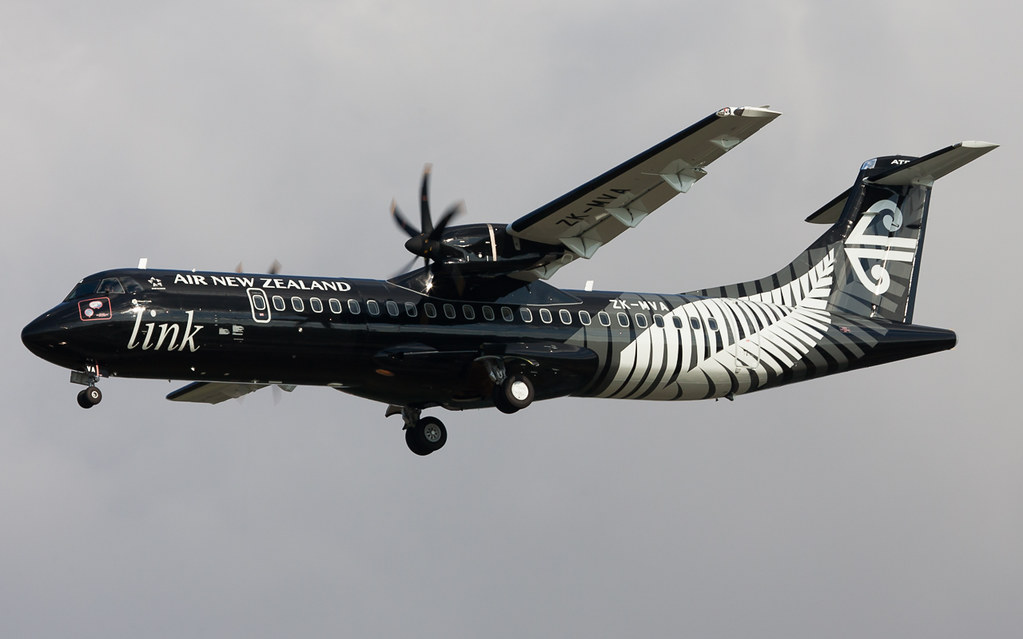
An Air New Zealand engine returned from a manufacturer-controlled overhaul with a fatigue crack still present. Less than four flying hours later, the cracked turbine blade failed and the engine caught fire as an ATR 72 approached Wellington. The Transport Accident Investigation Commission’s final report places the missed inspection within Pratt & Whitney Canada’s overhaul process not the airline’s maintenance or operation.

That division of responsibility is central to the incident. A supplier controlled the inspection intended to identify defects before the engine returned to service, but Air New Zealand’s crew and passengers faced the immediate operational consequences when it did not. The aircraft landed safely, yet its evacuation took 2 minutes 51 seconds, well beyond the 90-second certification benchmark cited by TAIC.
The ATR 72-600 was carrying 70 passengers and four crew from Christchurch on September 1, 2024. On approach to Wellington, a low-pressure turbine blade in the left engine failed through fatigue cracking. The failure produced vibration and damaged internal air seals, allowing oil to enter the engine. Smoke and flames followed, triggering a fire warning.
The crew declared an emergency, landed and discharged fire suppressant after stopping on the runway. Although the fire was extinguished, the warning remained illuminated, so the captain ordered an evacuation. Some passengers received minor injuries while leaving the aircraft, and several people using the forward-left exit passed close to the engine that had been on fire.
A quality-control problem with consequences beyond the overhaul shop
The engine had been overhauled by Pratt & Whitney Canada the previous day, but the fatigue crack escaped its quality checks. Investigators also found fatigue indications on a second blade from the same engine. TAIC recommended that the manufacturer strengthen its overhaul quality-assurance procedures so pre-existing fatigue can be identified before affected components return to service.
The finding illustrates a basic systems-integration problem in commercial aviation: operational responsibility and process control can sit in different organizations. An airline remains responsible for conducting a safe flight, responding to warnings and managing an emergency, but it cannot independently repeat every specialized inspection performed within a manufacturer’s overhaul system.
That makes supplier quality assurance part of the operator’s safety boundary even when the operator did not perform the defective work. Inspection criteria, execution, records and verification must collectively prevent a critical component with an existing crack from being released. Here, the short interval before failure is particularly significant: the engine had accumulated less than four flying hours after overhaul, leaving little operating time between its return to service and the emergency.
Air New Zealand chief safety and risk officer Nathan McGraw said the investigation “found no evidence of Air NZ maintenance or operation contributing” to the blade failure. That does not remove the airline from the broader safety response. It distinguishes the confirmed mechanical origin from the separate questions raised by the evacuation.
Baggage retrieval turned evacuation instructions into a human-factors problem
The 90-second figure is a certification benchmark, not a guarantee that every real emergency will reproduce controlled test conditions. Even so, TAIC treated the 2-minute-51-second evacuation as a safety issue because exposure to fire, propellers, wreckage and other hazards continues while people remain aboard or move around the aircraft.
Baggage retrieval was one documented source of delay. Ten of the 12 passengers using the forward-right exit took baggage, as did eight of 15 at the forward-left exit and an estimated 17 of 42 at the rear-left exit. TAIC identified several reasons: some passengers did not hear or remember instructions, some copied others, some perceived less urgency because they could not see flames, and some disregarded commands.
Those findings matter because an evacuation system includes more than doors and escape paths. It also depends on briefings being noticed, commands being standardized and passengers recognizing that familiar possessions can become obstructions when movement must be rapid. The figures establish that baggage was widespread during this evacuation, although they do not quantify precisely how many seconds each bag added.
Communication outside the cabin also presented a coordination issue. The flight crew did not transmit an evacuation radio call, leaving airport fire crews to shift from firefighting to passenger management without notification. Meanwhile, people leaving through the forward-left exit moved close to the affected engine, showing why commands must cover both leaving the cabin and moving to a safer area afterward.
Air New Zealand plans to develop a cabin evacuation trainer, strengthen training for the ATR’s rear service door, revise passenger briefing material and standardize commands explicitly directing passengers to leave baggage behind. TAIC said that work was not yet fully implemented and issued a recommendation addressing evacuation and post-evacuation passenger management.
The remaining test is therefore split across two organizations: Pratt & Whitney Canada must improve assurance that fatigue damage is detected before an overhauled engine is released, while Air New Zealand must turn a difficult real-world evacuation into more consistent crew commands and passenger behavior. The incident joined those separate safety layers less than four flying hours after the engine left overhaul.
| More aerospace and engineering stories, right in your MSN feed. Follow AMI on MSN |
By Thomas Caldwell — AMI’s senior editor for mechanical and mobility engineering, covering vehicle electronics, systems integration, electrification, chassis systems, propulsion, and safety policy.