Finland and Sweden Conduct First Joint Russian Aircraft Intercept in International Airspace
Finland and Sweden have completed their first joint fighter mission to intercept and identify Russian military aircraft, demonstrating that their separate alert forces can now execute a combined operational response. The Finnish Air Force said the September 24 mission took place over the Gulf of Finland, where the Russian formation remained in international airspace.
The distinction matters: this was an identification mission, not combat, and officials did not report a violation of Finnish or Swedish airspace. Its significance lies instead in the ability of two national air forces to launch, coordinate and complete a real-world fighter-alert assignment together rather than simply train for one.
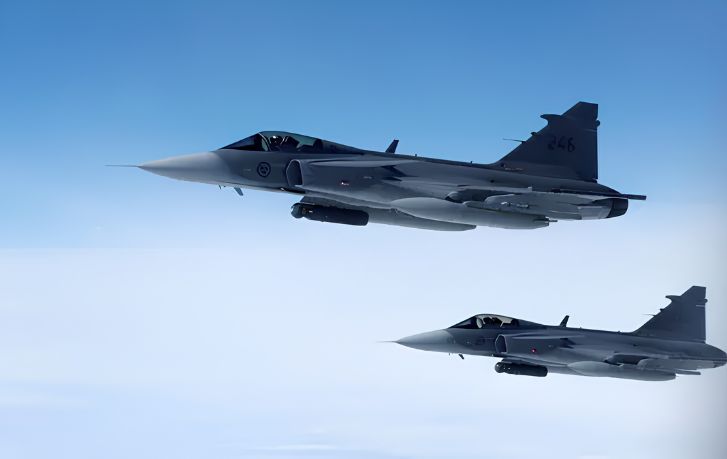
Finnish F/A-18 Hornets and Swedish JAS 39 Gripens located and identified a Russian detachment consisting of a Tu-134 transport aircraft, MiG-31 fighters and Su-30 fighters. The Finnish Air Force’s Air Operations Centre led the mission, providing one of the clearest public indications yet of how the two countries divided command responsibility during the operation.
From recurring training to an operational intercept
Finland and Sweden did not build this capability in a single launch. Their fighters have conducted cross-border training almost weekly for several years, allowing aircrews and ground organizations to practice operating across national boundaries. The September mission moved that relationship into an operational setting against aircraft requiring identification.
Both countries maintain Quick Reaction Alert forces fighter aircraft and crews held ready to respond when directed by an air operations center. Alert locations and response times are adjusted to current requirements, according to the Finnish Air Force. The aircraft normally stand duty at bases in their own countries, but the expanded arrangement permits Finnish and Swedish fighters to operate from each other’s bases when necessary.
That basing provision is consequential even though officials have not said whether it was used during this mission. Access to another country’s airfields can give planners more options for positioning aircraft, supporting sorties and maintaining coverage. It also adds practical demands involving maintenance, fuel, communications, ground support and national command authority. None of those details was disclosed for the September 24 operation.
Swedish Prime Minister Ulf Kristersson called the mission “a concrete expression of the readiness and trust we have built together,” linking it to wider Nordic and NATO cooperation. That is an official assessment of the mission’s importance, not an independent measure of comprehensive alliance readiness.
A completed mission with important unanswered questions
The operation confirms a narrow but meaningful capability: Finnish and Swedish fighters progressed from an alert launch to locating and identifying a mixed formation of foreign military aircraft under Finnish operational direction. It does not establish how the forces would perform across a prolonged campaign, under different command arrangements or while sustaining repeated launches.
Officials also did not disclose how the Russian formation was initially detected, how tasks were distributed between the Hornets and Gripens, how many Finnish or Swedish aircraft participated, or whether other NATO surveillance assets contributed. Response times and detailed communications procedures likewise remain undisclosed. Those omissions limit what can be concluded from one mission and appropriately keep the public account at a high operational level.
The encounter occurred amid increased concern about security and critical infrastructure around the Baltic Sea following pipeline outages, drone sightings and reported airspace violations since Russia began its full-scale invasion of Ukraine in 2022. Finland joined NATO in 2023 and Sweden followed in 2024, ending their longstanding policies of military non-alignment. Russian embassies in Helsinki and Stockholm did not immediately respond to requests for comment reported by Reuters.
The joint response also fits a broader Nordic framework involving Finland, Sweden, Norway and Denmark, whose air forces are developing closer interoperability. In the Baltic region, Finnish and Swedish forces coordinate with NATO’s Baltic Air Policing detachments as well. Those relationships create a larger surveillance network, but the September mission by itself does not prove that every command, maintenance or sustainment layer is fully integrated.
What it does prove is more concrete: Finnish Hornets and Swedish Gripens were jointly tasked under a Finnish operations center and successfully identified a Russian transport-and-fighter formation in international airspace. The next meaningful measure will be whether this becomes a routine, repeatable part of Nordic air surveillance and what officials eventually disclose about the command and support structure that makes repetition possible.
| More aerospace and engineering stories, right in your MSN feed. Follow AMI on MSN |
By David Whitaker — Associate editor for AMI’s aerospace and drone systems desk, translating flight systems, aircraft programs, spaceflight, and UAV developments into accessible technical stories.