Iran Attacks Bahrain Twice in Three Days, Constraining Gulf Airline Recovery
Gulf airports are open again, but the region’s airline network remains far from restored. Iran attacked Bahrain twice in three days through November 15, renewing the security pressure just as carriers were cautiously returning aircraft and routes after eight months of disruption.
Bahrain’s Interior Ministry issued two safety alerts on Sunday, its first since September, telling residents to move to the nearest safe location. The Bahrain Defence Force said it intercepted and destroyed incoming Iranian munitions. Two days earlier, U.S. Central Command said it had intercepted two Iranian attack drones heading toward Bahrain. Those outcomes are official claims, but the alerts alone show why an airport reopening cannot guarantee a rapid return to normal airline schedules.
Airports can reopen before airline networks recover
An airport and its surrounding airspace may be available while individual airlines still decline to fly, limit frequencies or avoid nearby airspace. Governments issue closures and advisories, but every carrier must also decide whether a route can be operated with acceptable exposure to diversion, cancellation and schedule disruption.
The International Civil Aviation Organization says governments, aircraft operators and air-navigation providers must exchange current conflict-zone risk information. Airlines also conduct proprietary assessments, often using third-party security monitoring, before selecting routes and operating schedules. ICAO publishes additional conflict-zone risk guidance for states and operators.
Those assessments extend beyond whether a runway is open. An airline must consider the usable airspace along the journey, the availability of diversion airports, insurance conditions, crew planning and whether an aircraft can reliably complete its next scheduled flight. A route that is technically possible can still be commercially and operationally fragile if fresh alerts repeatedly force changes.
European aviation guidance continues to advise operators against flying in Iranian and Iraqi airspace. It also advises avoiding specified Persian Gulf waters within affected Gulf flight-information regions, except when arriving at or departing from airports there. That permits access to Gulf hubs while still narrowing the operating environment around them.
Dubai’s passenger numbers show the scale of the gap
Dubai International Airport handled 31.5 million passengers during the first half of 2026, down 31.3% from the same period a year earlier. The airport expects approximately 70 million passengers for the full year, compared with 95.2 million in 2025.
The reduction is visible in airline participation as well as passenger totals. Fifty-six airlines served Dubai in August, down from roughly 90 before the war. For passengers, that means fewer nonstop choices and less redundancy when a carrier suspends a route. A large hub can remain operational while offering a substantially thinner network.
The initial disruption was severe. After the United States and Israel struck targets in Iran on February 28 and Iran responded with missiles and drones across the Gulf, aviation-data company Cirium counted more than 29,000 cancellations among over 51,000 scheduled regional flights between February 28 and March 6.
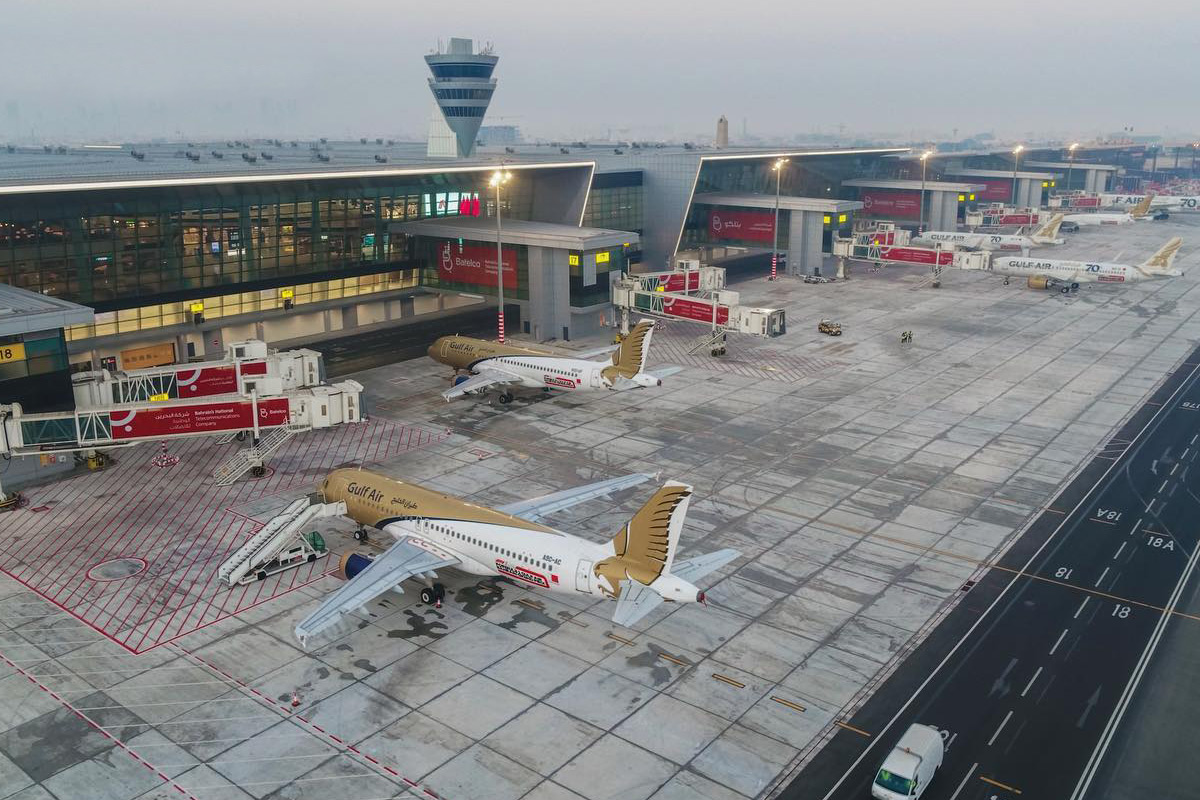
Bahrain International Airport was struck by a drone on March 1, causing what a senior civil aviation official described as “minor material damage.” Bahrain’s airspace remained closed for more than a month, and Gulf Air temporarily operated from Dammam. The country reopened its airspace in early April after a 14-day ceasefire was announced, but lower-intensity strikes have continued.
Route restoration remains uneven
British Airways illustrates how airlines can return to neighboring Gulf destinations on very different schedules. It resumed one daily Heathrow Dubai flight on November 3 after an eight-month suspension. Its Doha service returned in September at one flight per day rather than the previous two.
The carrier’s Bahrain flights remain suspended until the end of March, while Abu Dhabi service is not scheduled to return until winter 2027/28. These differences leave passengers with reduced frequency and route choice even where airports themselves have reopened.
The financial outlook reflects that incomplete recovery. The International Air Transport Association expects Middle Eastern airlines to lose $4.3 billion in 2026, making the region the only one forecast to post a loss. Arab airline leaders meeting in Doha have forecast a 10.3% decline in regional demand for the year.
Each restored flight adds capacity, but a hub-and-spoke network depends on many carriers arriving within coordinated schedule banks. With only 56 airlines serving Dubai in August and renewed alerts in Bahrain, rebuilding that network remains governed by the most cautious carrier assessments not simply by whether airport doors and runways are open.
| More aerospace and engineering stories, right in your MSN feed. Follow AMI on MSN |
By Stephen Wallace — Editor for AMI’s aerospace integration and unmanned mobility coverage, focused on drone manufacturing, VTOL systems, autonomous networks, and air-ground mobility links.