HMCS Spitfire Found Exactly 128 Years After Sinking, Location Kept Secret
The first clue was an acoustic anomaly in the seabed off Far North Queensland. After a month of searching, a Royal Australian Navy mine hunter, its dive team and remotely operated vehicles established what lay beneath the sand: HMCS Spitfire, described by officials as the first warship built in Australia for Australian service.
The identification came on Aug. 21, 2026 exactly 128 years after Spitfire sank off Queensland on Aug. 21, 1898. The search team exposed 16 meters of the largely buried wreck, giving maritime archaeologists enough physical material to connect the site with the vessel’s known dimensions and archival loss position. The Australian Department of Defence announced the discovery after agencies completed reporting required under shipwreck-protection laws.
“It is remarkable luck that Spitfire was discovered on the 128th anniversary of its sinking,” Queensland heritage officer Celeste Jordan said in the joint agency statement. The timing supplies the extraordinary coincidence, but the identification itself rested on a combination of historical research, sonar detection and close underwater documentation.
A small timber warship built for colonial waters
Spitfire was a 19-meter, two-masted schooner launched in Sydney in 1855. It was commissioned amid concern that Russia’s Pacific Fleet might threaten the British colonies during the Crimean War, making the vessel an early attempt to create a locally built maritime-defense capability rather than depend entirely on ships arriving from Britain.
Its structure reflected the materials and shipbuilding methods available in colonial Australia. An ironbark keel formed the main longitudinal backbone, blackbutt was used for the frames and kauri for the planking. Copper sheathing below the waterline protected the immersed timber hull. That combination also helps explain why the wreck matters mechanically: it is physical evidence of how local builders selected and assembled native and regional timbers for a working government vessel in the mid-19th century.
The schooner’s fighting power was modest. It carried one cannon firing 32-pound iron balls. Australian National Maritime Museum archaeologist James Hunter contrasted that weapon with the larger iron-hulled, steam-powered Russian warships of the period, asking whether a cannonball would have bounced off one of them: “Probably.” Spitfire was a patrol and defensive asset suited to its local setting, not an equal counterpart to a major fleet combatant.
It never entered battle. The Crimean War ended in 1856, and Spitfire was reassigned as a pilot vessel at Moreton Bay in 1857. Its later working life also included service as a buoy tender. The Queensland government sold it into private ownership in 1885, after which it operated as a fishing boat.
How the search converted a signal into an identification
Archival records gave researchers an estimated loss area near Piper Island, where Spitfire had developed a leak and foundered during a voyage. There was no loss of life. During the 2026 expedition, HMAS Diamantina, a Royal Australian Navy mine hunter, supplied the sensing, underwater access and documentation capability needed to narrow that historical estimate.
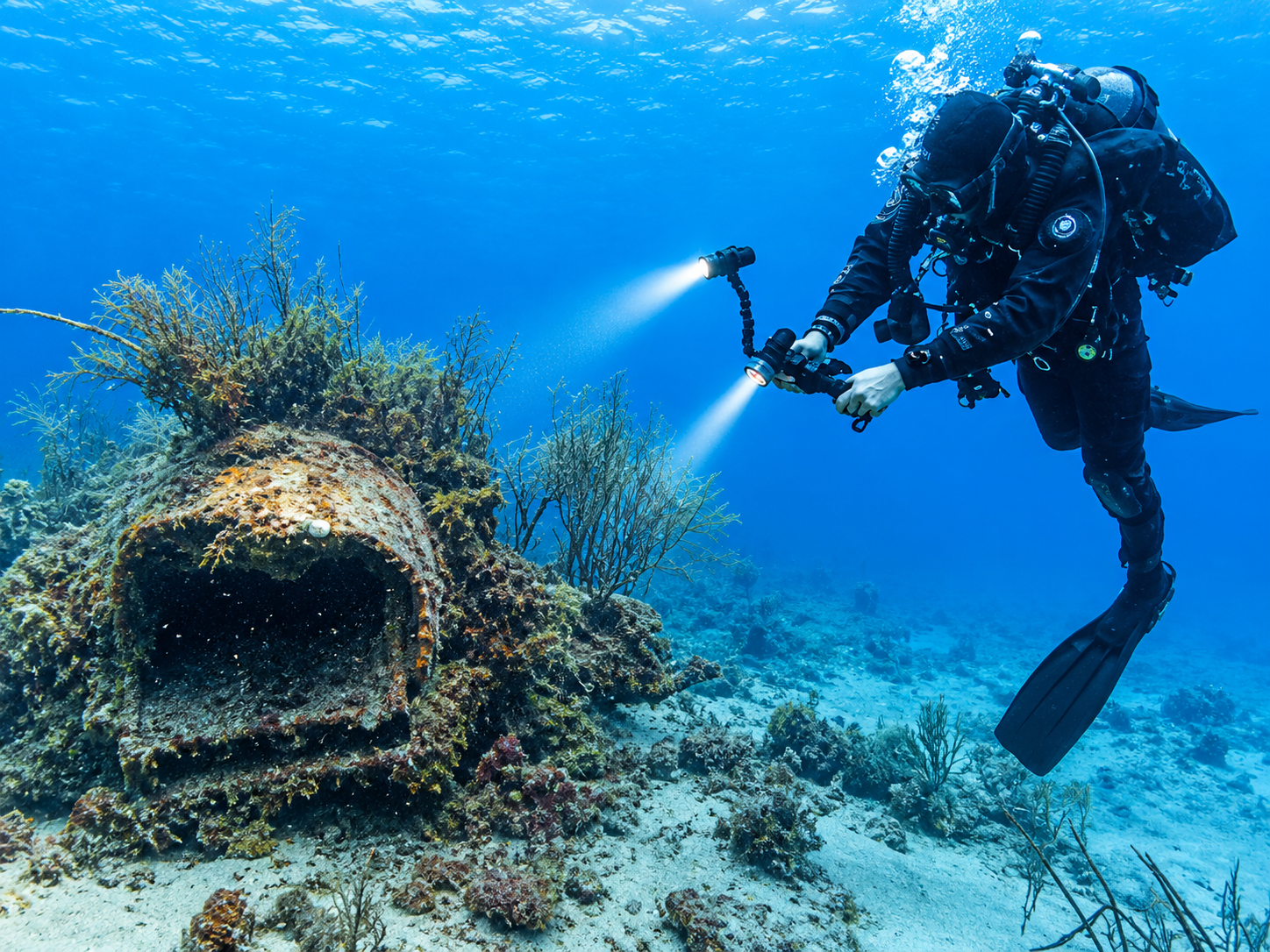
The ship’s sonar team detected the anomaly created by the buried remains. Clearance divers and remotely operated vehicles then examined and documented the material visible above the seabed. This sequence historical positioning, broad-area acoustic sensing and close inspection allowed investigators to identify a wreck that was mostly concealed rather than sitting intact and obvious on the bottom.
The sand that complicated detection may now serve as part of the site’s protection. Authorities have no plans to raise Spitfire, and its precise coordinates remain undisclosed because recreational scuba divers can reach the wreck. Federal and state protections apply, including Australia’s Underwater Cultural Heritage Act 2018, which protects underwater heritage sites and associated artifacts.
Leaving the timber remains in place avoids the difficult conservation burden that begins when waterlogged material is removed from its long-term environment. The accessible depth, however, creates a competing risk: a site reachable by divers can be disturbed or stripped if its position becomes widely known. For now, documentation rather than salvage provides public knowledge while the sand and undisclosed location provide physical protection.
Vice Admiral Matthew Buckley called Spitfire “the beginning of a story that continues in the Royal Australian Navy.” That beginning is now tangible again but it will remain largely buried, legally protected and absent from published charts marking its exact resting place.
| More aerospace and engineering stories, right in your MSN feed. Follow AMI on MSN |
By Jonathan Barrett — Editor for AMI’s future mobility and autonomous systems section, with two decades covering robotics, e-mobility, drone-vehicle convergence, and transport mechanical systems.