Hacksmith’s Six-Excavator Machine Lifted Five Feet Before Emergency Stop
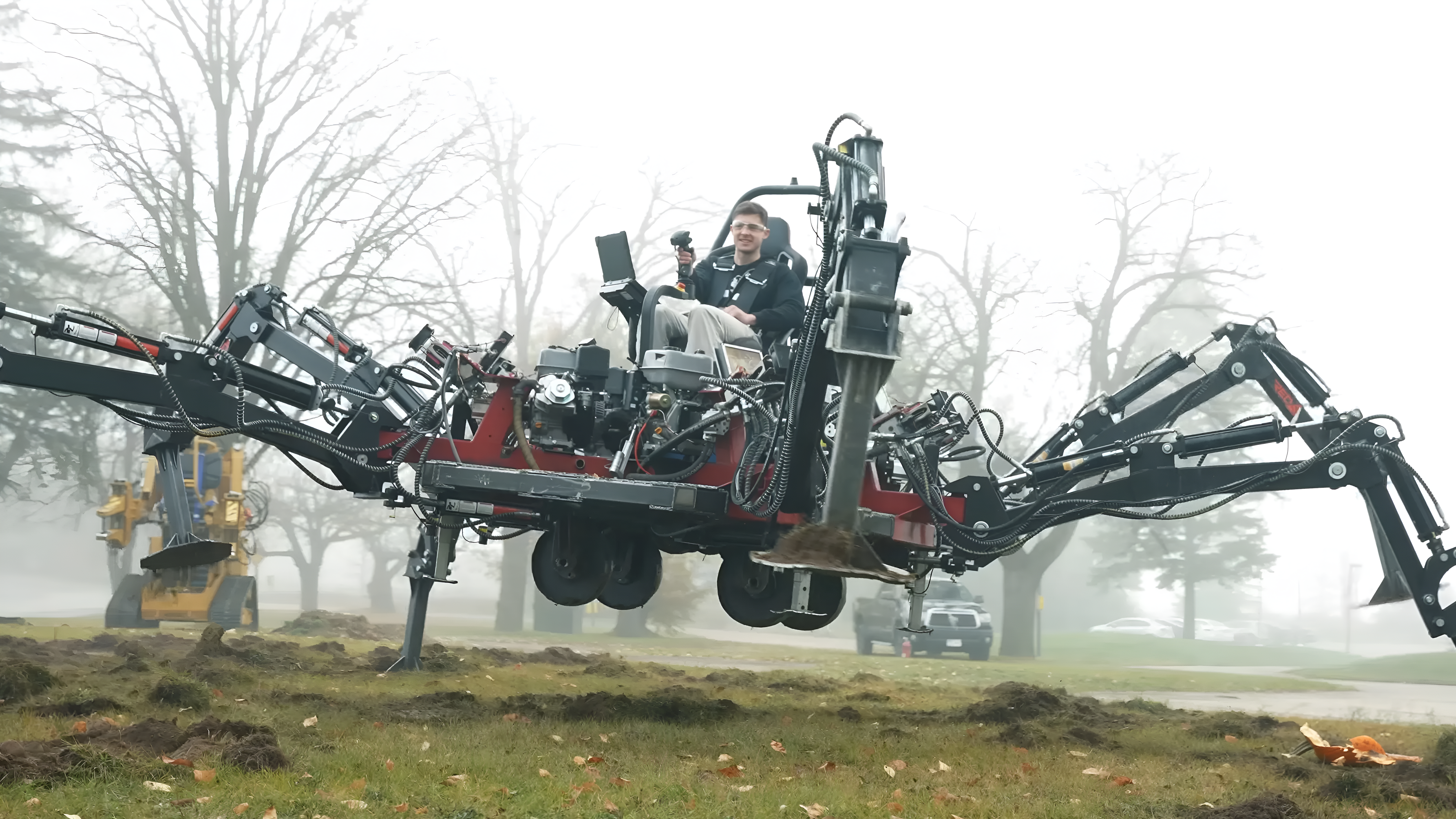
Hacksmith Industries built a six-legged hydraulic machine from six excavator mechanisms, but its most ambitious computerized lifting test ended with an emergency stop. The machine rose approximately five feet before its legs began curling inward, demonstrating both the available hydraulic force and the unfinished state of the control system.
The test came five months into a project initially estimated to take three. Hacksmith had already shown that the assembled machine could lift its platform and occupants under manual control, using four individual pilots. The next objective was much harder: coordinate the entire machine through one pilot and a computer capable of managing every leg as part of a single mechanism.
A frame change reshaped the control problem
The original concept appeared comparatively straightforward: weld together six excavators, connect their engines and program identical leg movements with timing offsets. That plan assumed a rectangular central frame. The builders abandoned it because the resulting machine would not fit through the available door, its legs were too close together and the layout offered less stability.
A hexagonal frame solved those packaging problems, but it eliminated the assumption that all six legs could follow one common trajectory. Their positions and orientations around the body meant, as the project narrator put it, Every leg had to have a specific motion profile.
Physical tolerances added another complication. The mass-produced excavator frames did not match their idealized computer-aided design geometry closely enough for straightforward assembly. Structural sections had to be cut, aligned and rewelded. Work expected to take roughly two days of welding expanded beyond a week. On a coordinated robot, these variations are more than fabrication inconvenience: they change the relationship between a commanded joint movement and the foot position the controller actually produces.
The team also replaced the excavator buckets with purpose-built feet offering greater ground contact and useful cylinder travel. This helped turn mechanisms designed for digging into load-bearing legs, but it did not provide the feedback needed to keep the body level.
Hydraulic power needed a feedback loop
For computerized operation, a Linux computer calculated leg movements from pilot input. A Revolution Pi controller handled commands, while rope potentiometers measured individual joint positions. Servos then moved the hydraulic valves toward the requested positions.
Even the electrical interface required custom hardware. The controller produced 24-volt outputs, while the servos expected 5-volt inputs, so the team designed a translating circuit board. SolidWorks geometry and hexapod calculations were incorporated into a simulation that compared commanded and measured leg positions before and during hardware development.
This closed-loop arrangement is essential because hydraulic force alone cannot establish a stable pose. The controller must continuously compare requested and actual joint positions, correct errors and keep those corrections from destabilizing the structure. Raising control gain made a test leg respond more forcefully, but excessive gain risked growing oscillations a serious constraint when several powerful hydraulic joints support one platform.
Research on purpose-designed hydraulic hexapods similarly treats structure, gait, hydraulic flow and stability as a coupled optimization problem. One hydraulic-robot design study reported a 44.6% modeled reduction in power after optimizing mechanical dimensions and gait together. Hacksmith’s prototype was assembled from mechanisms intended for another task, leaving its controller to accommodate geometry and tolerances that were not optimized for walking.
Heat and safety became system-level constraints
Testing also exposed an actuator problem. One servo exceeded 100 degrees Celsius, compared with about 60 degrees for other units, and a winding had burned. The builders installed replacement servos, lighter springs and computer cooling fans. The episode showed how a small electromechanical component could limit a machine whose primary actuators were far larger hydraulic cylinders.
The original engines and pumps were replaced with more powerful, remotely started units and larger pumps intended to increase hydraulic flow, movement speed and joint power. Engine start and stop circuits were connected to an expanded emergency-stop system. Routed exhausts and baffles were added to reduce noise and direct fumes away from the operator. Emergency-stop design is a distinct machinery-safety function covered by ISO 13850, rather than a substitute for stable motion control.
By the five-month point, the initial sponsor budget had been spent and additional costs were coming from the builders’ own pockets. More importantly, the machine had not completed a proper computerized stand-up test. Its five-foot rise confirmed that six excavator mechanisms could lift the combined load, but the inward-curling legs forced operators to stop the attempt. The remaining milestone is therefore not greater hydraulic power; it is a controlled, repeatable stand-up in which sensing, software, valves and imperfect structure remain coordinated under load.
| More aerospace and engineering stories, right in your MSN feed. Follow AMI on MSN |
By Jonathan Barrett — Editor for AMI’s future mobility and autonomous systems section, with two decades covering robotics, e-mobility, drone-vehicle convergence, and transport mechanical systems.