StarGate’s 30-Kilometer Airlift Prompts Dedicated Ukrainian Drone Rescue Platoons
Ukraine’s 475th Separate Assault Regiment is forming dedicated drone-airlift platoons after a StarGate evacuation drone carried a wounded person for 30 kilometers during one mission. The move, reported by Reuters on November 12, is intended to turn a small number of human-carrying flights into a more routine medical-logistics capability.
The aircraft traveled 60 kilometers in total on that mission, according to Ukraine’s Defence Ministry, with half the distance flown while carrying the evacuee. That result demonstrates useful range under operational conditions, but the regiment’s experience also shows why the aircraft alone cannot make aerial evacuation routine. Each flight depends on pilots, medical personnel, electronic-warfare teams and other supporting assets coordinating around a patient who may already have spent an extended period beyond the reach of conventional evacuation.
Seven days of preparation fell to 12 hours
The unit’s first StarGate operation led by a 33-year-old pilot using the call sign KVN took seven days to prepare. Two weeks later, a similar mission was organized in 12 hours. KVN had completed four evacuation missions when interviewed, and his latest flight lasted 90 minutes.
That reduction in preparation time is the clearest sign of operational learning. It does not mean the underlying risks have disappeared. Rather, the regiment has shortened the organizational cycle by establishing contacts and procedures among the groups needed to support a launch, flight, recovery and medical handoff. KVN said he could organize the necessary support with four or five calls by the time of the later operations.
The 475th is now creating platoons specifically for drone airlifts while improving coordination between pilots and medics. Dedicated staffing can preserve experience that would otherwise be scattered among units performing other jobs. It also gives medical personnel a clearer role in deciding when an aerial pickup is appropriate and preparing for the transfer of a wounded person to further care.
Ukraine’s 92nd Brigade conducted the first known drone airlift late in the month before the report, according to Reuters. The 475th completed its first two rescues shortly afterward. These remain early operations rather than evidence of a mature evacuation network, but the progression from isolated flights to assigned platoons is a concrete institutional change.
Speed has medical value, but the aircraft is not a hospital
The 475th’s medical chief said aerial evacuation drones are faster and more evasive than unmanned ground vehicles, which Ukraine has also used to retrieve wounded personnel while limiting rescuers’ exposure. Ground vehicles remain useful, but their speed can become a constraint when terrain or continued exposure delays access to care.
Eduard Khoroshun, head of a major military hospital in the Kharkiv region, said quicker evacuation could result in fewer complications and disabilities. Previous medical research on evacuation time has found that the benefit of faster transport varies by injury type, with shorter transport associated with lower mortality for some severe combined injuries. StarGate’s practical medical value will therefore depend on more than flight time: patient selection, stabilization, safe loading and the handoff into a treatment system remain part of the evacuation chain.
Autonomy and production define the next stage
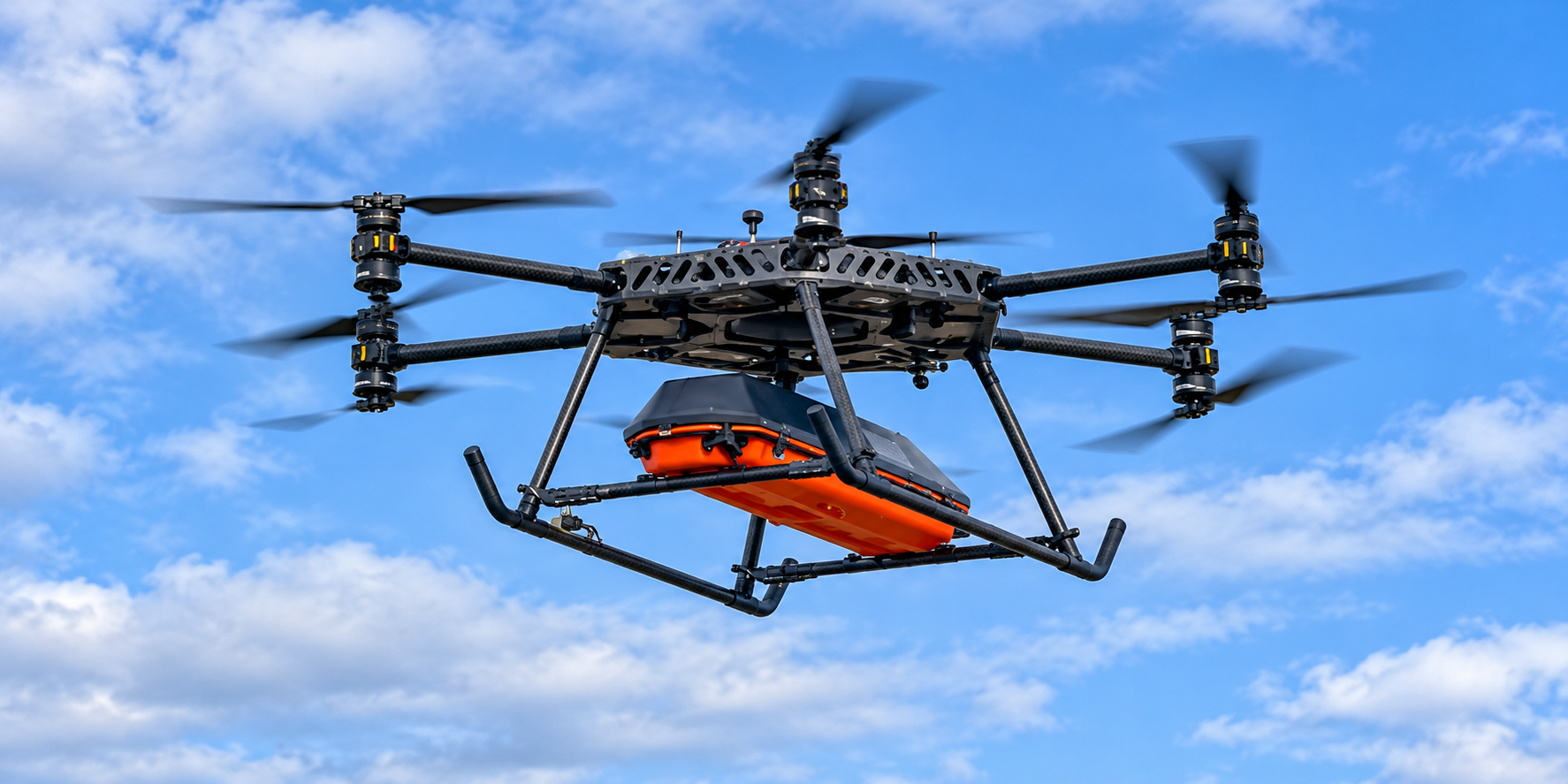
StarGate is a Ukrainian-made hexacopter built by SkyFall specifically for evacuation. The manufacturer describes it as an artificial-intelligence-assisted aircraft capable of hovering and landing autonomously during electronic-warfare jamming attempts. Ukraine’s Defence Ministry also identifies AI-based navigation as a central feature of the country’s emerging heavy-drone evacuation program.
Those automated functions address a demanding control problem: a heavy aircraft carrying a person must maintain stable flight and complete a safe landing even when communications or navigation are degraded. SkyFall’s claims establish the design intent, while continued missions will determine how consistently those functions perform across changing conditions.
Manufacturing is the other constraint. SkyFall expects to reach production of about 1,000 StarGate aircraft per month by the end of 2026 and says other Ukrainian units and brigades are requesting the system. Reaching that target would expand the available fleet, but aircraft volume alone cannot supply trained crews, medical integration or the coordination capacity demonstrated by the 475th.
SkyFall cautions that aerial evacuation is not a universal solution and that every mission carries risk. The regiment’s next milestone is therefore broader than adding aircraft: it must reproduce the shift from a seven-day preparation cycle to a 12-hour one without treating a high-risk, human-carrying flight as routine before the organization supporting it is ready.
| More aerospace and engineering stories, right in your MSN feed. Follow AMI on MSN |
By Stephen Wallace — Editor for AMI’s aerospace integration and unmanned mobility coverage, focused on drone manufacturing, VTOL systems, autonomous networks, and air-ground mobility links.