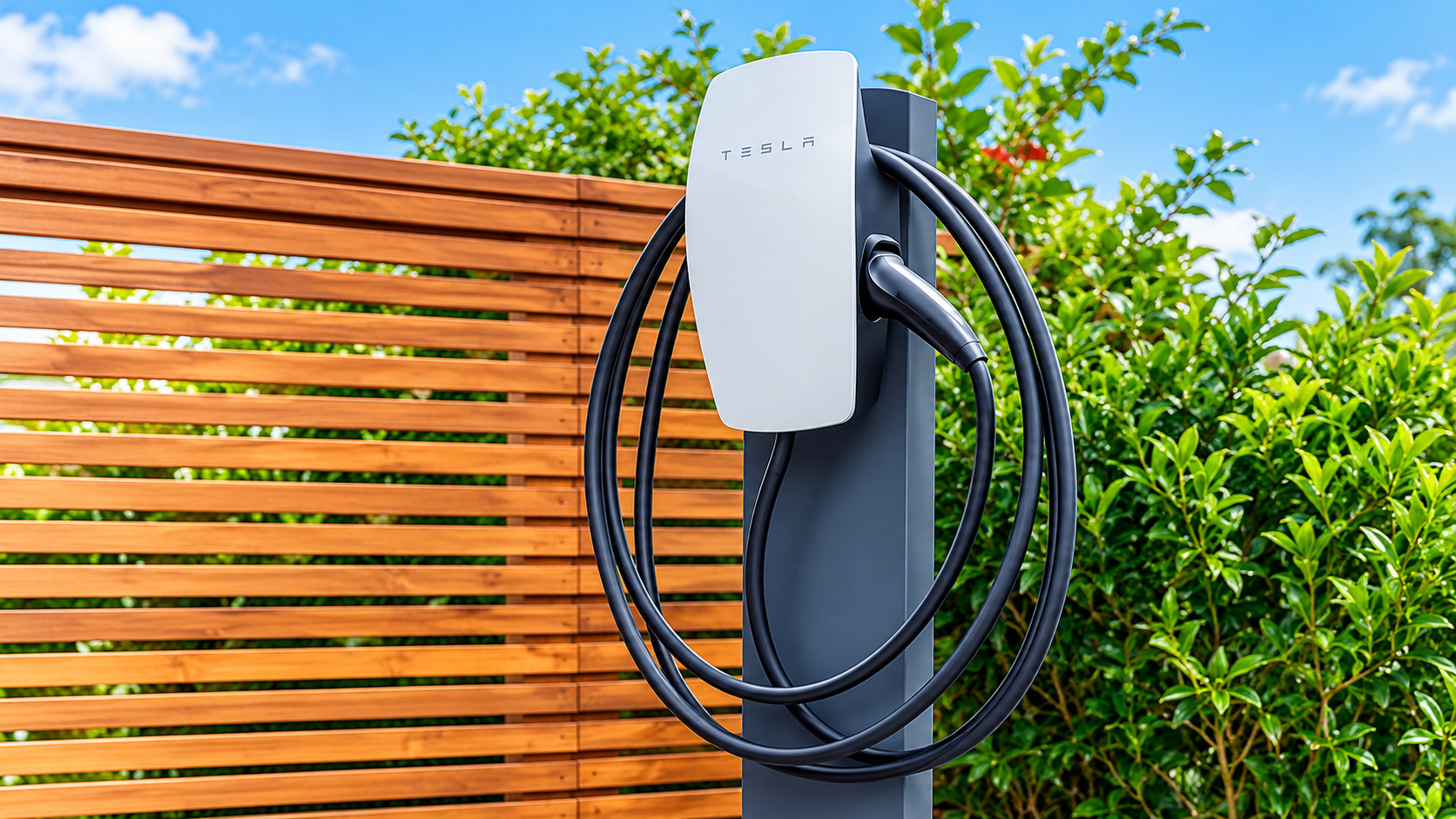
Tesla Raises Wall Connector to $635 After Fourth Increase This Year
$635 is the new U.S. price of Tesla’s standard Wall Connector. The November increase, from $585, is the home charger’s fourth price step of 2026 and takes it $185 or about 41% above its $450 price at the beginning of the year.
The progression shows how quickly the hardware cost has changed. Tesla raised the standard unit from $450 to $485 in the spring, then to $535 in July and $585 in September before the latest move to $635. For an owner planning a home-charging installation, the charger alone now carries a substantially higher entry cost than it did less than a year ago.
Tesla also raised the Universal Wall Connector from $660 to $720. That model, which incorporates a J1772 adapter for non-Tesla electric vehicles, has increased by $120 since the start of 2026. Its broader vehicle compatibility helps distinguish it from the standard model, but the latest change leaves a $85 gap between the two units.
Limited supply adds an ownership restriction
Price is only one part of the current access issue. Tesla’s online store requires customers to sign in with a Tesla account associated with a registered vehicle before purchasing either Wall Connector while supplies are limited. The notice states: “Tesla ownership is required while supplies are limited.”
That restriction narrows direct access to hardware that would otherwise have potential beyond Tesla vehicles, particularly in the case of the Universal Wall Connector. Connector compatibility is becoming more important as North America transitions between established J1772 equipment and the connector commonly associated with Tesla, standardized as SAE J3400. Canadian transportation guidance notes that many home-charging providers now offer a choice between the two connector families and emphasizes maintaining interoperability with existing vehicles and charging infrastructure.
The purchase restriction is therefore a commercial availability constraint rather than a technical description of every vehicle the Universal unit can serve. Tesla has not provided a broader sales timetable in the available information. Financing for the hardware starts at $58 per month, although financing changes the payment structure rather than the underlying $635 or $720 price.
What the higher hardware price provides
The Wall Connector is rated to add up to 44 miles of range per hour while delivering 11.5 kilowatts. Actual range gained will depend on the vehicle and operating conditions, but the rating places the unit in the role of overnight residential charging rather than roadside fast charging.
Its connected functions extend beyond power delivery. Wi-Fi supports over the air software updates and remote diagnostics, while the Tesla app provides charging access controls. Firmware version 26.34 also added smart charging for owners with a Powerwall home battery. Depending on the selected Powerwall mode, the system can schedule vehicle charging when electricity is cheapest or use excess solar generation.
Tesla has also included the Wall Connector in its recently introduced Powershare home-backup configuration for the Model 3 and Model Y. Those energy-management functions can make the charger one component in a wider home electrical system, but they do not erase the immediate cost change for buyers who primarily need routine vehicle charging.
The hardware price is also not necessarily the complete project price. The U.S. Department of Energy explains that the full cost of installing electric-vehicle charging equipment can include construction, permitting, inspections, utility work and other non-equipment expenses. Conditions vary by property and jurisdiction, making the Wall Connector’s 41% increase only one part of a potentially larger installation budget.
The increase extends outside the United States as well. Tesla’s standard Wall Connector now costs $885 Canadian, up from $815, and $890 Australian. In the U.S., however, the sharpest comparison remains the year’s five price points: $450, $485, $535, $585 and now $635 with direct purchases still limited to qualifying Tesla owners while supply remains constrained.
| More aerospace and engineering stories, right in your MSN feed. Follow AMI on MSN |
By Thomas Caldwell — AMI’s senior editor for mechanical and mobility engineering, covering vehicle electronics, systems integration, electrification, chassis systems, propulsion, and safety policy.