Tesla Cybertruck Registrations Reach Just 7,133 After Sales Fell Nearly 50%
Only 7,133 new Tesla Cybertrucks were reportedly registered in the United States through May 2026. That figure follows an estimated 20,237 sales in 2025, nearly 50% below the 38,965 recorded in 2024, according to figures attributed to Cox Automotive.

Registrations and sales are different measures, and the partial-year registration count cannot be compared directly with either full-year sales total. Together, however, the figures describe a sustained reduction in demand after the Cybertruck’s first full production year. They also sharpen the contrast between the vehicle’s market performance and the expectations created by its 2019 unveiling.
Reservations set a much higher expectation
Within days of the Cybertruck’s debut, Elon Musk said Tesla had received more than 250,000 orders. Those early commitments helped establish the impression that the unconventional electric pickup could become a high-volume product.
But a reservation particularly one made years before production does not carry the same weight as a completed retail sale. Pricing, specifications, delivery timing and buyer circumstances can all change before a reserved vehicle reaches the market. The decline from 38,965 sales in 2024 to 20,237 in 2025 suggests that launch-era interest did not convert into a similarly durable annual sales rate.
The 2025 total reportedly included 1,279 Cybertrucks purchased by SpaceX. Those purchases count as demand, and no motive for them has been established. They nevertheless show why fleet and affiliated-company transactions can affect the composition of a relatively small annual total.
The price moved far beyond the original entry point
Tesla initially promoted a $39,900 starting price in 2019. Following delays, the first available trucks were priced at roughly $100,000, placing the product in a substantially different consumer category from the entry-level pickup described at the reveal.
Tesla continued revising the lineup and announced a $60,000 all-wheel-drive version in 2026. Many preorders for that configuration were reportedly canceled after Tesla excluded it from transfers of the company’s Full Self-Driving driver-assistance package. That episode does not establish why overall Cybertruck demand declined, but it illustrates how configuration and software eligibility can influence the effective value of a modern vehicle.
More recent pricing also remains well above the original $39,900 target. Edmunds lists the 2026 dual-motor model at $69,990 before destination charges, with higher trims reaching approximately $100,000. At those prices, the Cybertruck competes not only on electric propulsion and styling but also on towing, cabin usability, charging performance and range.
Range depends on configuration and test conditions
The 2019 presentation described a base truck with more than 250 miles of range and a tri-motor version capable of exceeding 500 miles. Reported real-world results have generally landed much closer to the lower end of that span than to the top launch-era promise.
The broad real-world estimate cited for Cybertrucks is approximately 250 to 300 miles, although independent testing demonstrates why a single number cannot characterize every version. Edmunds recorded 334 miles from two dual-motor trucks in its standardized range test, slightly exceeding their 325-mile official estimate. It also measured energy consumption of 42 kilowatt-hours per 100 miles and found that adding 100 miles of range took more than 20 minutes in its charging test.
Those results show a capable electric pickup, but not the 500-plus-mile flagship envisioned at the reveal. Range is especially consequential for trucks because towing, payload, speed, weather and terrain can materially change energy consumption. Battery capacity sufficient for a very long unloaded range also adds cost and mass, creating a systems tradeoff rather than a specification that can be increased without penalty.
Electric pickups remain a limited market
The Cybertruck’s decline is occurring within a category that remains small compared with conventional pickups. A Car and Driver comparison counted 232,809 sales across six electric-pickup models over 2024, 2025 and the first three quarters of 2026. Ford sold 801,525 F-Series pickups in 2025 alone.
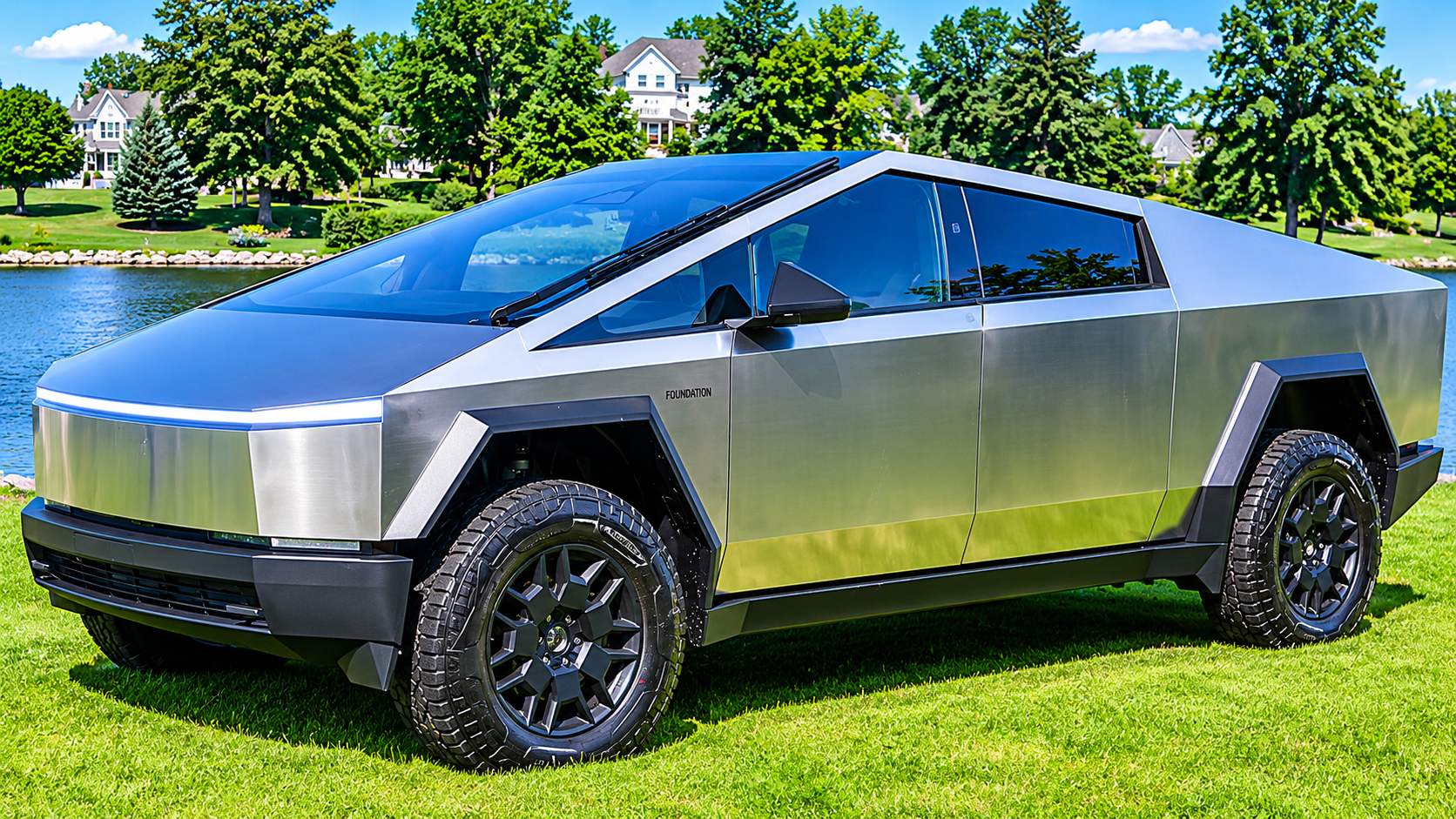
That market context does not erase the Cybertruck’s expectation gap. Its stainless-steel body, steer by wire controls and 48-volt electrical architecture introduced notable engineering choices, but technical novelty has not translated into growing sales. Experts cited by Bloomberg reportedly expect Tesla to retain the Cybertruck for now, potentially through a redesign or alongside another model. The next consequential measure will be whether such changes can broaden demand beyond the buyers attracted by the original design.
| More aerospace and engineering stories, right in your MSN feed. Follow AMI on MSN |
By Thomas Caldwell — AMI’s senior editor for mechanical and mobility engineering, covering vehicle electronics, systems integration, electrification, chassis systems, propulsion, and safety policy.