Turned Engine Vanes Left a Thunderbird F-16 Unable to Stay Airborne
Deep in the high-pressure compressor of a Thunderbird F-16’s engine, vanes in the fourth and fifth stages had turned out of alignment. That condition initiated internal damage that ultimately left the aircraft without enough thrust to remain airborne, according to a U.S. Air Force Aircraft Accident Investigation Board finding released on Sept. 21, 2026.

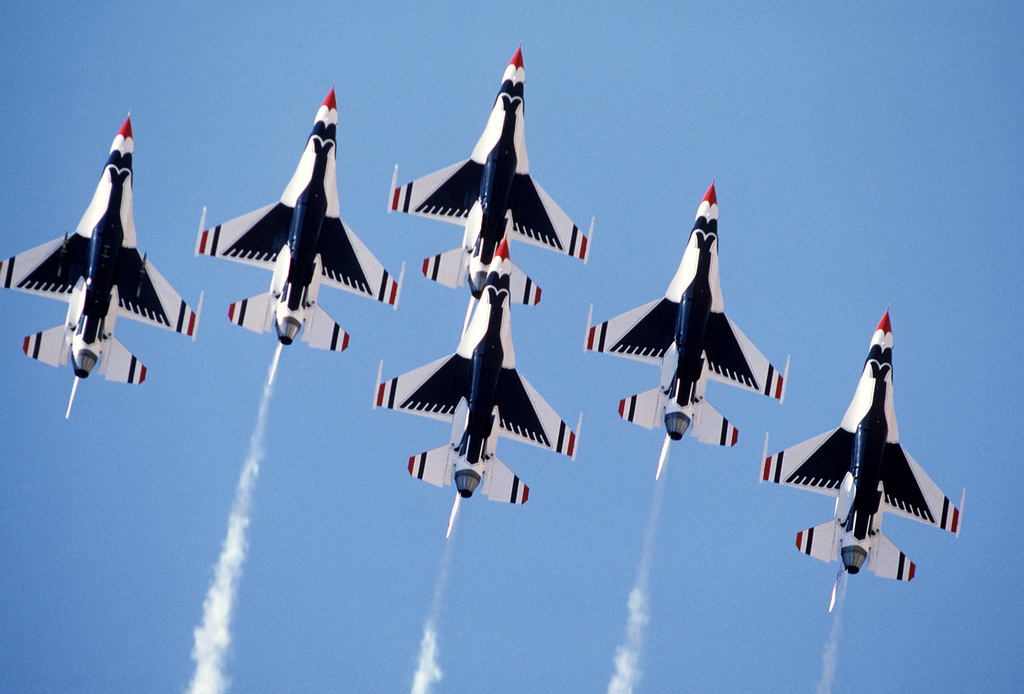
The pilot ejected with minor injuries near Trona, California, on Dec. 3, 2025, after trying for 4 minutes and 21 seconds to recover usable power. The F-16CM, assigned to the Air Force Air Demonstration Squadron at Nellis Air Force Base, was destroyed. The aircraft was valued at $33.46 million.
The damage began inside the compressor
The F-16 was powered by a Pratt & Whitney F100-PW-220 turbofan. Engineering analysis found turned vanes in the fourth and fifth stages of its high-pressure compressor, followed by individual blade separations in the fifth and sixth stages. Damage then extended through the seventh stage.
Compressor vanes manage airflow between rotating blade rows. When vanes are out of their intended position, they can disturb that airflow and impose abnormal aerodynamic loading on downstream components. In this engine, the documented result was cascading internal damage and a loss of flight-sustaining thrust.
That distinction matters. The engine did not simply stop and remain off. It entered a condition in which the pilot could not command the power needed to maintain level-flight airspeed. The aircraft was rejoining six other F-16CMs during formation training when it experienced what investigators classified as a non-recoverable engine stall.
The pilot then selected Secondary Engine Control. That substantially increased fuel flow, causing the engine to flame out and spool down. After the pilot returned the system to primary control, the engine restarted and operated at idle. It did not respond to throttle commands above idle, however, leaving the aircraft descending as its airspeed and altitude declined.
Idle operation can keep an engine turning without producing enough thrust to sustain the airplane. For the pilot, the distinction between a restart and a recovery was therefore decisive: the engine was running again, but the F-16 still could not maintain flight. The board found that the pilot’s actions followed applicable emergency procedures and that ejection became necessary.
An inspection-access limitation
The investigation also identified a maintenance constraint rather than a missed ordinary inspection. Examining the affected compressor area required removing the engine from the aircraft and opening its rear compressor case. Installed-engine inspections did not provide comprehensive access to the core sections where the critical condition developed.
The board wrote that post-foreign-object-damage guidance had an “inherent inability to inspect these specific sections of the engine core.” Because those areas were not opened until scheduled maintenance tied to a core component’s overhaul threshold, possible damage could progress between overhauls without being detected.
This was not a finding that maintainers ignored a visible defect. The engine’s 50-hour inspection on Oct. 1, 2025, recorded no defects, and the report found that maintenance personnel followed the applicable inspection procedures. The aircraft had accumulated 7,732 flight hours, while the engine had recorded 4,128 total accumulated cycles.
The access issue is consequential because maintenance effectiveness depends not only on inspection frequency but also on what an installed engine physically allows technicians to examine. A compliant inspection cannot identify a condition in an inaccessible section unless the maintenance program requires the additional removal and disassembly needed to reach it.
A separate published account of the finding notes that another F-16 powered by the F100-PW-220 crashed near Holloman Air Force Base in April 2024 after investigators identified a similar turned-vane failure. That comparison does not establish a common initiating cause, but it gives the inspection-access question broader significance than a single destroyed aircraft.
The initiating cause remains unresolved
The Air Force established the mechanical chain with considerable specificity: turned fourth- and fifth-stage vanes, separated fifth- and sixth-stage blades, downstream compressor damage, an engine stall and insufficient usable thrust. It did not establish why the vanes turned in the first place.
The board called that question “impossible to conclusively determine.” Its report therefore supports two findings that must remain separate. Misaligned vanes caused the destructive engine sequence, and limited access substantially contributed by preventing inspection of the affected area. Neither finding proves what initially moved the vanes out of alignment or assigns fault to maintenance personnel.
That unresolved origin is now the central engineering question. Investigators have explained why the Thunderbird F-16 could no longer stay airborne; preventing another occurrence depends on determining how to address a damaging condition in compressor stages that ordinary installed-engine inspections cannot reach.
| More aerospace and engineering stories, right in your MSN feed. Follow AMI on MSN |
By David Whitaker — Associate editor for AMI’s aerospace and drone systems desk, translating flight systems, aircraft programs, spaceflight, and UAV developments into accessible technical stories.