Tesla Plans Mid-2027 Cybertruck Wind-Down After Price and Range Misses
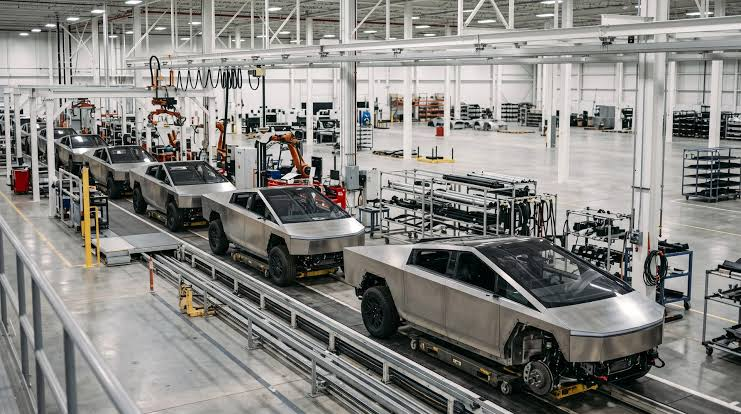
The Cybertruck is nearing an unusually early production wind-down after arriving later, costing more and offering less range than Tesla outlined when it began taking reservations. Elon Musk said Tesla plans to wind down Cybertruck production at Gigafactory Texas around mid-2027, clearing manufacturing capacity for increased Cybercab production.

The narrowly worded announcement applies to Texas production. Musk did not explicitly declare the Cybertruck discontinued worldwide, although Tesla has not identified another factory that will build it. Tesla also gave no schedule for selling remaining inventory and no time-bound commitment for supplying parts or servicing trucks already on the road.
The delivered truck diverged from the 2019 announcement
Tesla revealed the Cybertruck in November 2019 with a planned $39,900 single-motor model, a tri-motor version promising more than 500 miles of range and a production target in 2021. Deliveries instead began at the end of 2023 more than two years after the target year and roughly three years after 2021 began.
The $39,900 entry model never reached customers. The least expensive version cited in current pricing starts at $59,990, a difference of $20,090 from the announced entry price. The configurations are not directly equivalent, but the result for reservation holders is straightforward: Tesla never offered the low-cost choice that anchored the original product presentation.
The range gap followed a similar pattern at the upper end. The delivered lineup’s top range was more than 100 miles below the figure presented for the 2019 tri-motor truck. Tesla planned a separate range extender but canceled it before it reached customers. Buyers who reserved against the original announcement therefore encountered a substantially more expensive product menu with less maximum range, not the price-and-capability combination presented in 2019.
Production capacity met much lower estimated volume
Tesla does not report Cybertruck deliveries separately. It combines the pickup with the Model S, Model X and Semi under “Other Models,” which prevents a precise model-specific count from company figures. That category recorded 8,295 deliveries in the third quarter of 2026, down 48% from a year earlier.
Electrek estimated that 7,000 to 8,000 of those vehicles were Cybertrucks. Engadget separately estimated cumulative Cybertruck deliveries at nearly 71,000 since late 2023. Those are outside estimates rather than Tesla-reported Cybertruck totals, but both indicate a large gap from the company’s stated target of 250,000 trucks annually. Tesla had installed production capacity for 125,000 per year and pushed suppliers toward a 250,000-vehicle scale.
That mismatch matters more for the Cybertruck than it would for a conventional pickup sharing mature components and body processes. Its stainless-steel panels, dedicated castings and unusual supply chain were built around much higher volume. When fixed tooling and supplier costs are spread across fewer vehicles, the economics become increasingly difficult even if the underlying vehicle functions as designed.
Distinctive engineering now creates a support question
The production decision is not evidence that the Cybertruck’s core engineering failed. The truck introduced steer-by-wire without a conventional mechanical steering linkage, rear-wheel steering and a 48-volt low-voltage electrical architecture. Together, the two steering systems reduce the wheel input required at low speed and improve maneuverability for a large pickup. No other production pickup cited here combines both technologies.
Those specialized systems also make long-term factory support particularly important. Owners cannot assume that federal law guarantees ordinary replacement-part availability for a fixed period. In a published interpretation, the National Highway Traffic Safety Administration said the federal Safety Act does not require manufacturers to supply general replacement parts for any particular duration. Separate federal obligations can require a free remedy when a safety defect or noncompliance is determined within 10 years of the vehicle’s first sale.
Musk said the Cybertruck fleet would remain on the road for a long time, but Tesla has not attached a duration to parts or service support. That leaves reservation holders without a schedule for remaining trucks and current owners without a defined support horizon as the only announced production site approaches its mid-2027 wind-down.
| More aerospace and engineering stories, right in your MSN feed. Follow AMI on MSN |
By Robert McKinney — Editor-in-Chief for AMI’s automotive and mobility coverage, with a mechanical engineering background and a decade reporting on powertrain systems, EV innovation, and global vehicle manufacturing.