New Simulations Cut Giant Planets’ Stability From Quintillion to Billion Years
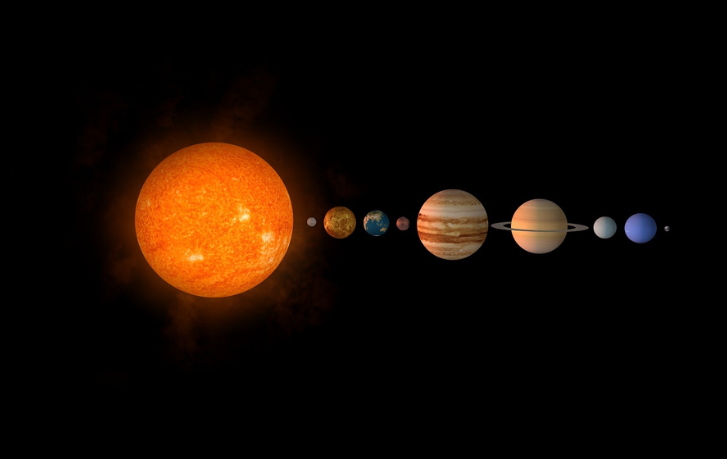
Under the familiar model of the Sun’s death, Jupiter, Saturn, Uranus and Neptune move outward but remain in an orderly configuration for almost unimaginable lengths of time. Under a new model, that order could break down roughly one billion years after the Sun becomes a white dwarf a sharp revision from an intrinsic stability estimate of about a quintillion years.

The difference is not a newly discovered planet or an approaching star. It is how researchers represent the Sun losing nearly half its mass. The study, published in The Astrophysical Journal Letters, replaces a smooth outflow with thousands of discrete, asymmetrical ejections that give the dying Sun small recoils in random directions. Those repeated motions act as stochastic kicks on the planets’ orbits.
Smooth mass loss leaves an enlarged solar system
In the conventional treatment, the Sun sheds mass gradually enough that the giant planets adjust continuously. Their orbital radii expand by about a factor of 1.85 often rounded to twice their current size while the basic spacing and relationships among their orbits remain preserved.
That produces what is effectively an enlarged version of today’s outer solar system. More than 60 smooth-mass-loss control runs remained stable, including integrations extending several billion years. Earlier calculations placed the system’s intrinsic dynamical lifetime near 1018 years, although encounters with passing stars were expected to intervene first and dismantle the configuration after roughly 30 billion to 100 billion years.
The new calculation changes the forcing rather than simply extending the clock. Researchers used 672 realizations across a range of ejected parcel sizes, modeling the Sun and the four giant planets with N-body software. In a representative case, the Sun received about 4,600 small recoils as it lost its envelope. Each individual kick was minor, but their directions and timing varied.
Random kicks accumulate instead of averaging away
A smooth and symmetric reduction in solar mass changes the scale of an orbit without strongly scrambling its shape. Discrete asymmetric ejections do something different: they move the star itself. Because each recoil arrives at a different planetary phase and from a different direction, the resulting orbital changes accumulate as a random walk.
That distinction is the study’s central engineering-style sensitivity: a small change in the assumed input structure produces a radically different system-level outcome. In the simulations, the repeated kicks altered planetary period ratios, eccentricities and separations. Some configurations became compressed or reordered enough for planetary orbits to cross, opening the way to scattering or ejection.
At the study’s representative mass-ejection scale, 40% of the all-phase simulations underwent disruption or strong scattering before the white dwarf formed. Across the relevant simulated end states, roughly 90% became unstable within three billion years. The authors therefore place the characteristic lifetime at approximately one billion years after white-dwarf formation, rather than at the earlier quintillion-year intrinsic estimate.
The exact fate of any individual planet is not predicted. Chaotic trajectories do not remain reproducible as precise, planet-by-planet forecasts over such intervals, so the results are statistical. The outcome also depends strongly on the granularity of the Sun’s eventual mass loss how much material leaves in each independently directed episode. Much finer ejections produced comparatively mild changes, while coarser ejections generated substantially more disruption.
A forecast with an important boundary
The model’s extension of episodic ejections across all giant-branch phases is less firmly calibrated than its treatment of the later asymptotic giant branch. The researchers therefore ran a second set restricted to that later phase. It produced no disruption during the earlier red-giant stage, but 83% of the representative cases still became unstable within three billion years, compared with 96% in the all-phase version.
This is consequently not a direct observation of the future solar system, nor is it an imminent hazard. The Sun still has around five billion years before its red-giant evolution, and the modeled billion-year stability interval begins only after its transformation into a white dwarf. The work instead identifies a potentially decisive uncertainty in long-range orbital forecasts: smooth mass loss preserves the giant planets, while granular, randomly directed mass loss can rearrange them before a passing star gets the chance.
That uncertainty may eventually be tested beyond our solar system. If observations of planets around white dwarfs reveal how frequently their architectures are disordered, resonant or depleted, those systems could provide a record of how dying stars actually shed their envelopes. The next constraint on the distant fate of Jupiter and its neighbors may therefore come from planetary systems that have already survived or failed to survive the same transition.
| More aerospace and engineering stories, right in your MSN feed. Follow AMI on MSN |
By David Whitaker — Associate editor for AMI’s aerospace and drone systems desk, translating flight systems, aircraft programs, spaceflight, and UAV developments into accessible technical stories.