


John F. Kennedy Begins F-35C Fighter Tests Before Final Delivery
The Navy took preliminary acceptance of the future USS John F. Kennedy on September 29, 2026, after acceptance trials in August. The milestone opens an interim period rather than completing delivery: according to the Navy’s preliminary-acceptance announcement, the carrier and its crew can now conduct testing at sea and build underway proficiency while Newport News Shipbuilding finishes systems work ahead of formal delivery planned for spring 2027.
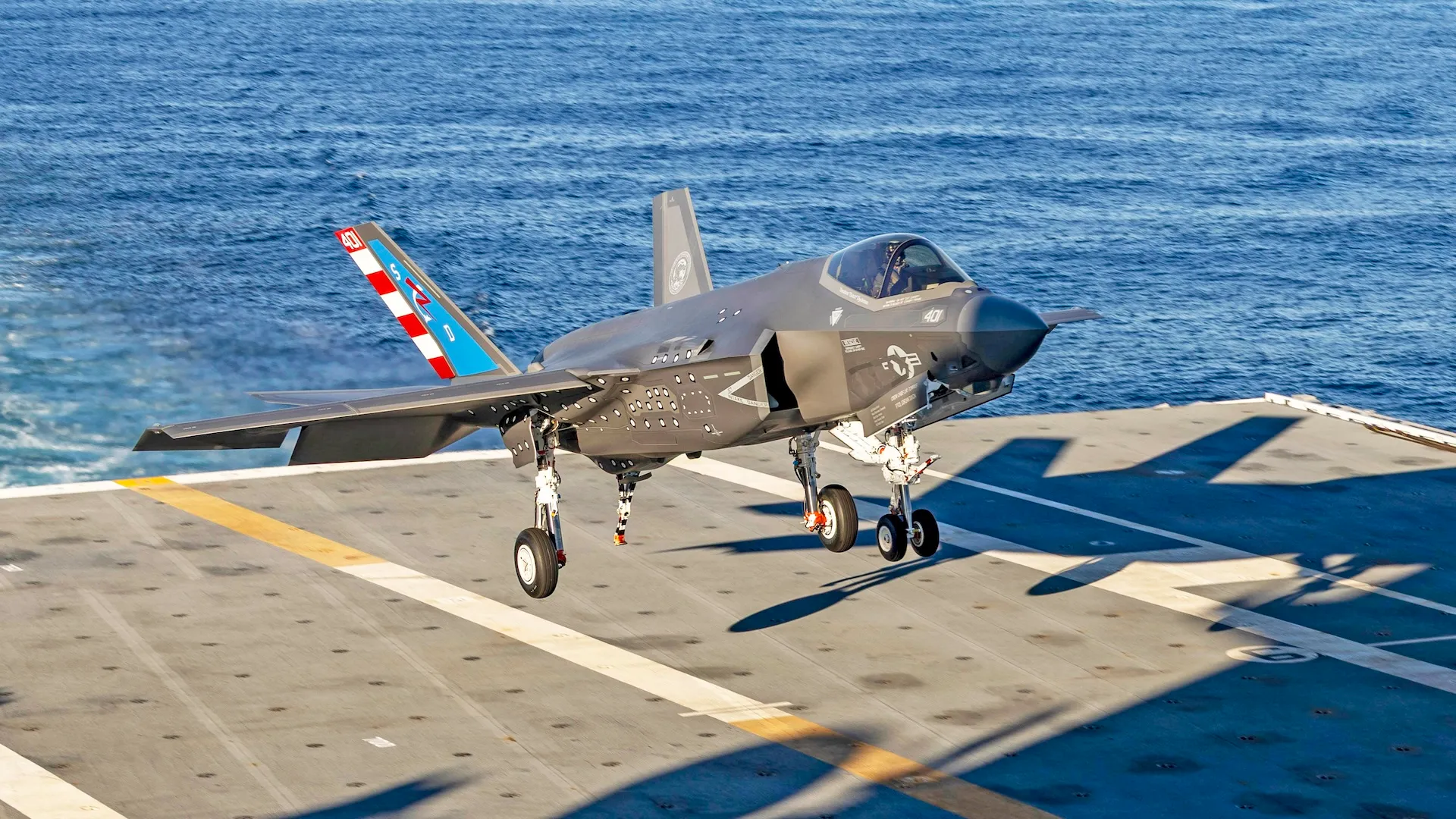
That arrangement quickly produced a major aviation milestone. On October 13, an F-35C Lightning II made the first arrested landing by the carrier-based stealth fighter aboard a Gerald R. Ford-class carrier. The Navy also launched an F-35C from Kennedy during the testing. Yet the carrier remains approximately 99 percent complete, and final ship-system testing continues including work on four of its 11 Advanced Weapons Elevators.
A landing demonstrates compatibility, not full readiness
The F-35C came from Air Test and Evaluation Squadron 23 at Naval Air Station Patuxent River, Maryland. Its landing and launch were part of aircraft compatibility testing intended to evaluate how Navy aircraft interact with Kennedy’s launch and recovery equipment.
The distinction matters. Catching an arresting wire and launching from the flight deck demonstrate that the fighter and carrier have reached a significant compatibility milestone. They do not establish that Kennedy has completed testing, received formal delivery or become ready for an operational deployment. The test campaign and remaining shipyard work are separate pieces of the carrier’s path into service.
Preliminary acceptance allows those tracks to overlap. Sailors gain time at sea to train and collect operating experience while the shipbuilder completes contractual work. For a ship reported as 99 percent complete, the remaining percentage is small numerically but still includes systems that matter to routine carrier operations.
The weapons elevators illustrate that boundary. Seven completed elevators provide access to ammunition magazines, while the remaining four still required final testing when the Navy accepted the ship preliminarily. Their unfinished status does not prevent every form of at-sea testing, but it helps explain why preliminary acceptance is not the same as final delivery.
Kennedy and Ford reached the F-35C differently
The test also highlights a consequential difference between Kennedy and the class’s lead ship, USS Gerald R. Ford. Ford entered service in July 2017 and can launch and recover an F-35C, but it has not received all the infrastructure needed to support an embarked F-35C squadron routinely through an extended deployment. It has continued to use Boeing F/A-18E/F Super Hornets as its principal strike fighters.
Sustained F-35C operations require more than compatible catapults and arresting gear. Shipboard support includes reinforced jet-blast deflectors, specialized maintenance spaces, logistics equipment and other infrastructure needed to service and manage the aircraft over time. A successful landing proves an essential interface between aircraft and ship; keeping a squadron operating at sea requires the larger support system behind that interface.
The Navy originally planned to add Kennedy’s F-35C modifications after delivery. In 2020, it changed strategy and incorporated them during construction so the second Ford-class carrier could deploy with the fighter from the beginning of its operational career. That choice added work to the construction program and contributed to its extended schedule alongside difficulties involving the Advanced Arresting Gear and Advanced Weapons Elevators.
The comparison therefore carries a tradeoff. Ford entered service without the complete set of changes needed for routine, sustained F-35C squadron operations. Kennedy has remained under construction longer while receiving that infrastructure before delivery. Its October flight testing shows the practical benefit of doing the integration work earlier, but not that every qualification or support requirement is complete.
The Navy has not announced which carrier air wing or F-35C squadron will join Kennedy for its first operational deployment. Before that assignment becomes the central question, Newport News Shipbuilding must finish the remaining systems tests and the Navy must move the carrier from preliminary acceptance to formal delivery. For now, Kennedy can land and launch the F-35C while still being, contractually and technically, an unfinished ship.
| More aerospace and engineering stories, right in your MSN feed. Follow AMI on MSN |
By David Whitaker — Associate editor for AMI’s aerospace and drone systems desk, translating flight systems, aircraft programs, spaceflight, and UAV developments into accessible technical stories.



