


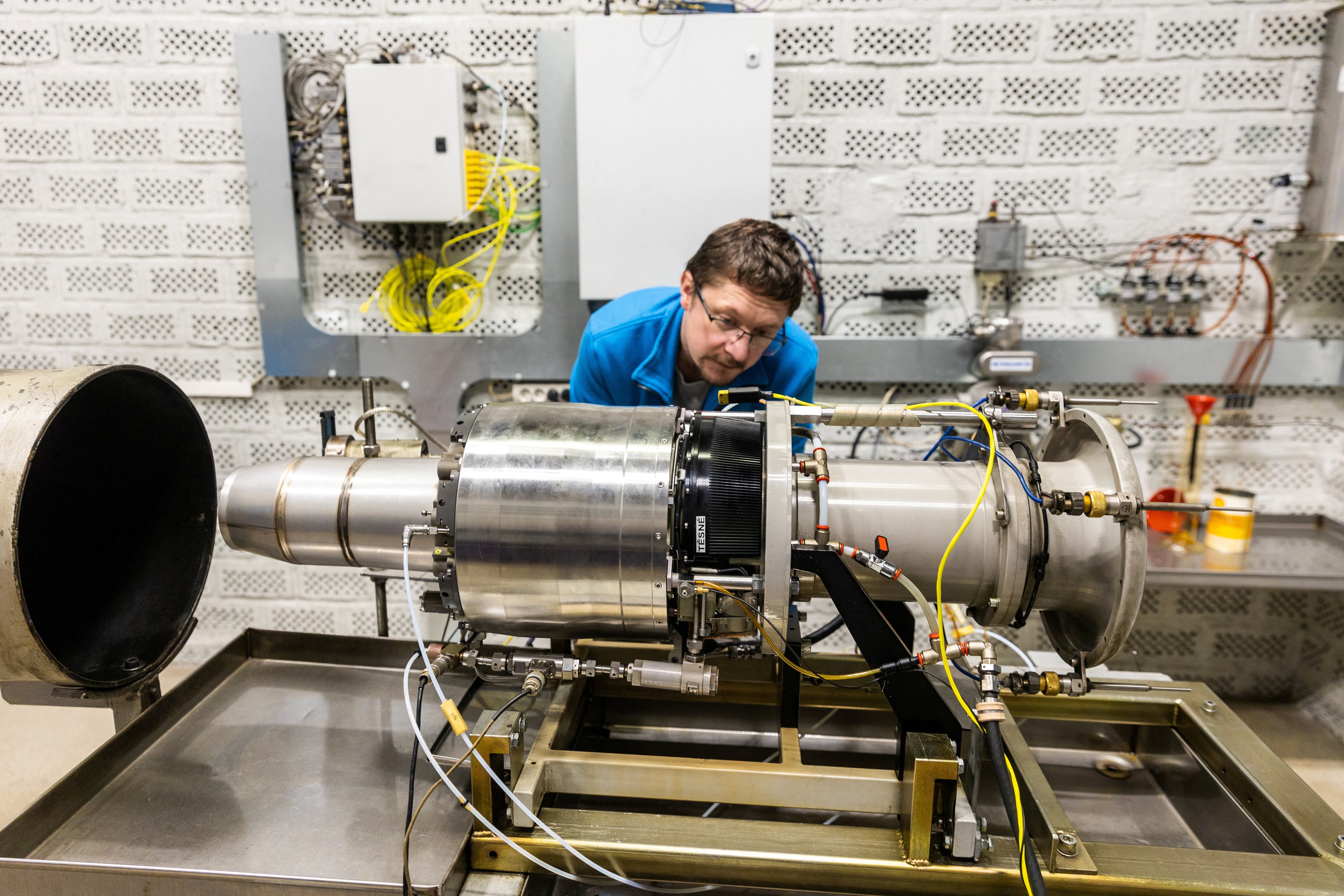
Ukraine Prioritizes Mini Jet Engines as Monthly Demand Could Hit 10,000
Ten thousand engines a month is the scale Ukraine now associates with just one model of mini-turbojet. The figure is a projected requirement for 2027 not a confirmed production rate but it explains why the country has elevated small jet-engine manufacturing to a critical defense-industry priority.
Yevhenii Khmara, identified as Ukraine’s defense minister, said the projected demand would be distributed across roughly 20 Ukrainian manufacturers. The estimate covers one engine type, while demand for jet propulsion extends across interceptor drones, medium-range systems, deep-strike weapons and cruise missiles. No current output, expansion timetable, cost or investment total was disclosed.
That missing baseline is important. A requirement of 10,000 units per month says how many engines users may want, not how many industry can build, test and deliver reliably. It also does not establish that propulsion is the only constraint on higher production. Airframes, guidance equipment, control systems, skilled labor and acceptance testing all have to scale with it.
Why propulsion has moved up the priority list
Ukraine’s earlier interceptor drones were developed around piston-powered targets traveling at speeds of up to 115 mph. Some newer Russian jet-powered attack drones can reach roughly 375 mph, according to the available reporting. That speed gap compresses the time available to detect, position and launch an interceptor, while also demanding more performance from the interceptor itself.
Ukrainian companies are consequently developing faster designs, including turbojet-powered interceptors. Reuters reported in September that Ukraine was racing to field new countermeasures after Russia sharply increased its use of jet-powered drones. A July test also exposed development difficulties: several interceptors reportedly proved hard to control at speeds exceeding 400 kilometers per hour, or about 249 mph.
That result illustrates why installing a jet engine is not a complete solution. Higher speed changes aerodynamic loads, control response, guidance demands and the amount of time available for an operator or automated system to make corrections. An engine can provide the required thrust, but the complete aircraft still has to remain controllable and producible at the intended cost.
Brave1, Ukraine’s state-backed defense innovation platform, said it has prioritized domestic jet-engine production for the past year and a half. It described 20 active government and private engine projects and called large-scale production “crucial for effectively protecting our skies.” Separately, Ukrainian officials have said around 20 manufacturers are involved in the propulsion effort.
Twenty manufacturers add capacity and coordination work
A 20-company base potentially gives Ukraine more production routes and reduces dependence on any single plant. It can also let different manufacturers specialize in separate engine classes or production processes. Ukraine is trying to reduce reliance on imported weapons and components, and domestic propulsion would give its manufacturers more control over supply and production planning.
But distributing demand does not automatically create interchangeable capacity. Engines produced by multiple firms still need consistent materials, tolerances, quality checks and performance acceptance. If the projected 10,000-unit requirement is divided among producers, procurement authorities will also have to manage configuration control and determine which designs are suitable for which aircraft. The disclosed information does not establish whether the 20 manufacturers would all build the same model or contribute across a broader portfolio.
Small turbojets occupy an awkward industrial position: each engine is compact, but demand at this scale turns propulsion into a mass-manufacturing problem. Production equipment, suppliers and end of line testing must support volume without allowing reliability to vary beyond acceptable limits. That is especially consequential for interceptors, where an engine must perform after storage and during a short, demanding flight.
Ukraine has reported that next-generation interceptors have already downed several fast Russian drones, but no supporting test data or independent verification was provided. That makes demonstrated repeatability not isolated results the more meaningful measure of readiness.
Following a late-September meeting on the drone threat, Ukraine announced unspecified “new decisions” concerning domestic jet-engine production. Until those decisions produce disclosed output targets, contracts or factory milestones, the central tension remains unchanged: Ukraine can see demand for one engine model reaching 10,000 units a month, but it has not said how many it builds today or when domestic industry could approach that scale.
| More aerospace and engineering stories, right in your MSN feed. Follow AMI on MSN |
By David Whitaker — Associate editor for AMI’s aerospace and drone systems desk, translating flight systems, aircraft programs, spaceflight, and UAV developments into accessible technical stories.



