Japan Launches First Mission to Bring Back Phobos Samples After Russian Failures
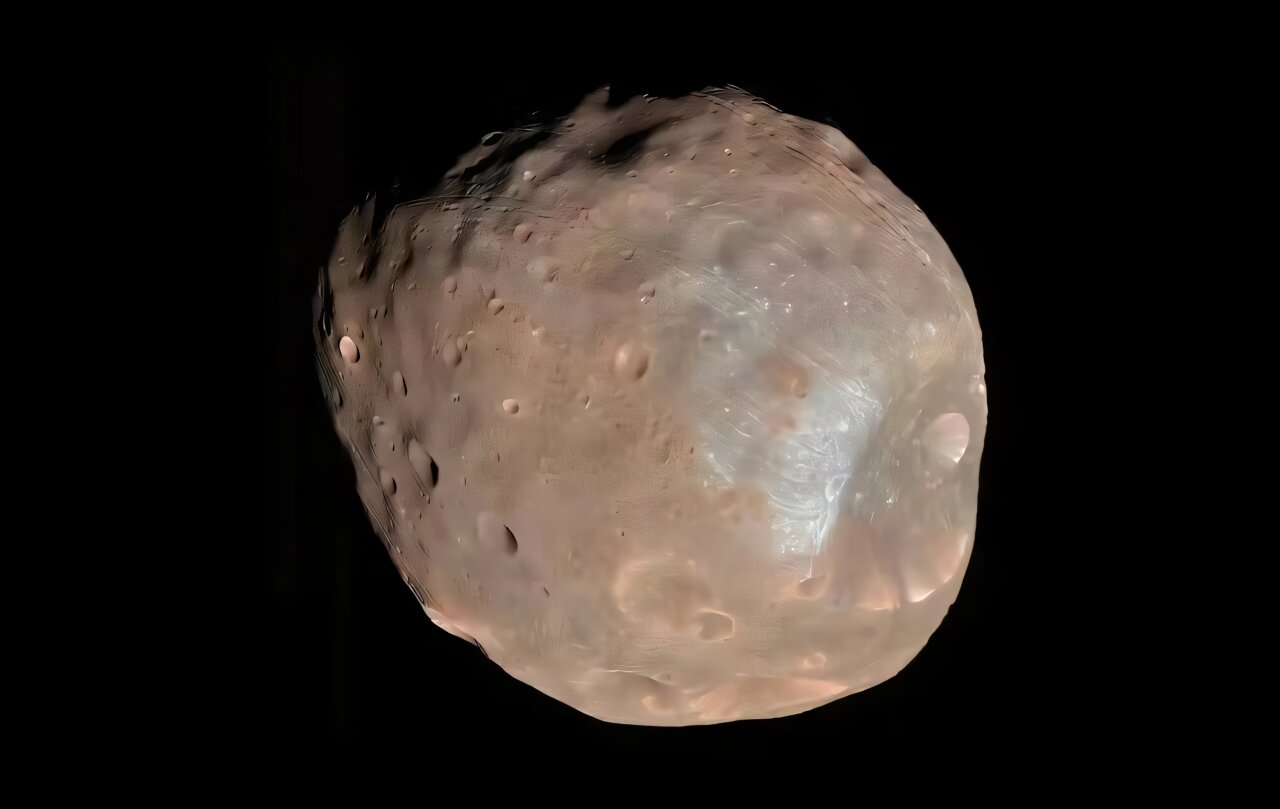
Japan is scheduled to launch the world’s first mission intended to bring samples back from Phobos, the larger of Mars’ two small moons. The Japan Aerospace Exploration Agency has set liftoff for 4:41:03 a.m. Japan time on Tuesday, October 20, using an H3 rocket from the Tanegashima Space Center. If the full mission succeeds, at least 10 grams of soil will return to Earth in 2031.
The attempt is consequential because Phobos has defeated several previous missions. Multiple Russian spacecraft intended to approach or land on the moon failed, including the 2011 Phobos-Grunt mission. The earlier Phobos 2 spacecraft reached Mars in 1989 but was lost while maneuvering for its encounter with the moon.
Japan’s Martian Moons eXploration spacecraft, known as MMX, is therefore pursuing more than a scientific first. It must reach the Mars system, operate near Phobos for roughly three years, land twice in extraordinarily weak gravity, collect material and then send a return module back to Earth.
A five-year round trip
The roughly five-ton spacecraft is divided into propulsion, exploration and return modules. It is expected to arrive in the Mars region around August 2027, after which it will survey Phobos and prepare for surface operations. The mission also includes observational flybys of Deimos, Mars’ smaller moon, but no landing there.
MMX carries 13 instruments supplied through an international partnership led by JAXA. They include NASA sampling and gamma-ray equipment, a European Space Agency communications device, a Japanese radiation monitor and the French-German Idefix rover.
Idefix is planned to begin a roughly 100-day surface mission around 2029. In Phobos’ extremely weak gravity, the rover will move “at a snail’s pace,” according to JAXA. Its measurements will help characterize the surface before the Japanese spacecraft performs its sampling operations.
Phobos has approximately one two-thousandth of Earth’s gravity. That changes the landing problem: a spacecraft cannot rely on its weight to settle firmly onto the surface, and an uncontrolled rebound could disrupt the operation. MMX uses four-legged landing gear with shock-absorption features intended to limit bouncing during touchdown.
Two sampling methods address an uncertain surface
JAXA plans two sampling attempts using different collection mechanisms. NASA’s system will discharge pressurized gas to lift loose surface dust into a container. A separate Japanese coring system is designed to retrieve material from about two centimeters below the surface.
The paired approach gives the mission access to both exposed grains and shallow subsurface material. That distinction is scientifically useful because surface material has been subjected directly to the space environment, while the core may preserve less-altered grains. It also provides two ways to pursue the minimum target of 10 grams on a surface whose mechanical behavior cannot be fully reproduced on Earth.
Japan has already returned asteroid material through the Hayabusa missions in 2010 and 2020. MMX adds a harder transportation problem: Phobos orbits only about 6,000 kilometers above Mars, so the spacecraft must operate deep within the planet’s gravity field before beginning the trip home.
The samples could settle how Mars’ moons formed
The central science question is whether Phobos and Deimos formed from debris thrown into orbit by a major collision with Mars or began as asteroids later captured by the planet’s gravity. Remote observations have not resolved the competing hypotheses. A 2025 spectral comparison found similarities between the moons and several dark asteroid types, but those similarities are not sufficient to determine their origin.
Laboratory analysis can examine the returned grains at a level unavailable to instruments operating remotely. MMX principal investigator Kiyoshi Kuramoto has said scientists can “almost certainly come to a conclusion” about Phobos’ formation by analyzing its soil.
Phobos may also hold small amounts of material blasted off Mars by ancient impacts. JAXA officials expect Martian material to make up about 0.1% of the collected sample. Even within a 10-gram return, those grains could provide multiple pieces of Mars from different places and periods rather than material taken from one landing site.
The mission has a human-exploration component as well. Its Japanese radiation monitor will gather data relevant to future crewed operations, while the broader investigation will help researchers assess whether a Martian moon could serve as a base during expeditions near Mars. That remains a planning concept rather than an approved crewed mission architecture.
After the Phobos operations and Deimos flybys, only MMX’s return module will head back to Earth. Its capsule is designed to survive atmospheric reentry and land in Australia in 2031 before being transported to Japan. Reaching that point would make Japan the first nation to retrieve material from a Martian moon and the first to complete the Phobos landing challenge that earlier missions never reached.
| More aerospace and engineering stories, right in your MSN feed. Follow AMI on MSN |
By David Whitaker — Associate editor for AMI’s aerospace and drone systems desk, translating flight systems, aircraft programs, spaceflight, and UAV developments into accessible technical stories.