


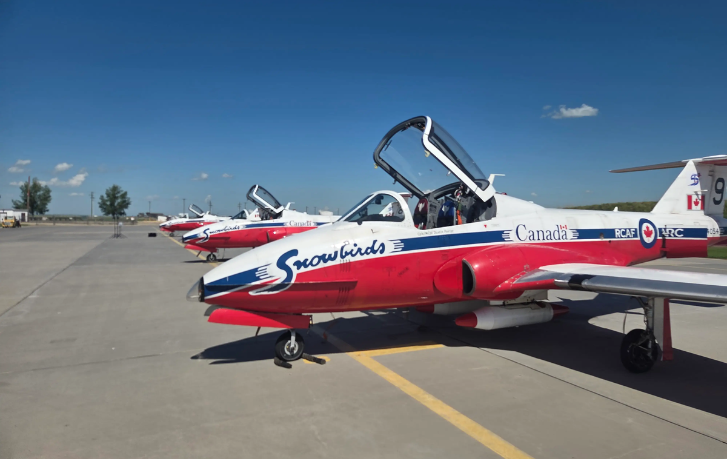
Snowbirds End 55-Year Tutor Display Era, Begin Multi-Year Airshow Hiatus
Canada’s Snowbirds have flown their last display with the CT-114 Tutor, ending a 55-year partnership between the aerobatic team and its small red-and-white jet. Nine Tutors started, taxied and took off for the farewell performance on October 16 at Canadian Forces Base Moose Jaw in Saskatchewan, before an audience of military personnel and invited families and friends.
The departure also removes the Snowbirds from air shows for several years. Canada has selected the Pilatus PC-21 turboprop as the Tutor’s successor, but aircraft acquired specifically for the demonstration team are expected to enter service only around 2030. Until then, a familiar Canadian aviation symbol will be absent from the seasonal airshow circuit.
Ladies and gentlemen, boys and girls, welcome to one last ride. Start them up, Major Maciej Hatta, the team’s lead pilot flying as Snowbird 1, said as he opened the final Tutor display from the flight line.
A long service life met its economic limit
The Tutor’s retirement closes more than the Snowbirds chapter. The type entered Canadian service in the 1960s and served as the country’s primary jet trainer until 2000. It had flown with the Snowbirds continuously since the team formed in 1971, giving generations of pilots and maintainers experience with an aircraft that ultimately remained in military service for more than six decades.
Canada had intended to operate the Tutor through 2030. A life-extension effort successfully added updated cockpits and other avionics, but it could not resolve every problem created by the age of the underlying platform. Officials cited engineering challenges, escalating sustainment costs and competing budget priorities when bringing the retirement forward.
Engine support illustrates the pressure. The Department of National Defence said obsolescence had affected components for the Tutor’s GE Aerospace J85 engines. With some parts no longer commercially available, maintainers had to recover usable components from decommissioned engines. That practice can keep a small fleet operating, but it depends on a finite pool of donor hardware and adds complexity to inspection, inventory and maintenance planning.
Life-extension programmes bought time, but they could not change the long-term reality, said Nolan Kiely, chief executive of Crimson Air Services. The farewell therefore also credits the pilots, technicians and support crews who kept an increasingly demanding aircraft available long after its original training role had ended.
The escape system added another constraint
Modernizing the Tutor’s aging escape equipment also proved difficult and expensive. The issue carried additional weight after the fatal 2020 Snowbirds crash near Kamloops, British Columbia, in which RCAF public affairs officer Captain Jenn Casey died and pilot Captain Richard MacDougall was injured.
The RCAF’s flight-safety investigation found that a bird entered the engine shortly after takeoff, causing a compressor stall and loss of thrust. The aircraft subsequently entered an aerodynamic stall during an attempted return. Both occupants ejected at low altitude and outside the safe operating parameters of the aged escape system, leaving insufficient time for their parachutes to work as designed.
Engine and escape-system modernization presented a different problem from installing new displays or communications equipment. Those systems must be integrated with an old airframe, qualified across demanding operating conditions and supported for the remaining service period. RCAF leadership concluded that the cost, time and engineering feasibility no longer supported maintaining a full airshow schedule through 2030.
The replacement changes the Snowbirds’ character
The future aircraft will be the Swiss-built Pilatus PC-21, designated CT-157 Siskin II in Canadian service. Canada already ordered 19 for intermediate pilot training, and the first two were delivered in September. Those trainers are separate from the Department of National Defence plan to acquire up to 17 additional PC-21s under the Snowbird Aircraft Replacement Project.
The PC-21 will make the revived team look and sound different. It is a turboprop rather than a jet, so future performances will be slower and quieter than Tutor displays. RCAF commander Lieutenant General Jamie Speiser-Blanchet has defended the choice as powerful, highly maneuverable and more capable than older propeller aircraft might lead spectators to expect.
Aircraft delivery is only part of rebuilding the team. The RCAF must also preserve formation-flying knowledge during a four-to-five-year interruption, prepare pilots for the new platform and establish a maintenance organization distinct from the contractor-supported training fleet. Options under consideration include assigning Snowbirds personnel to training duties at Moose Jaw and arranging exchanges with allied demonstration teams.
For Canadian spectators, however, the immediate consequence is straightforward: there will be no Snowbirds airshow season while the replacement fleet is acquired and the team is reconstituted. The Tutor’s sound and nine-aircraft silhouette have disappeared after 55 years; the Snowbirds are intended to return around 2030 in a fundamentally different machine.
| More aerospace and engineering stories, right in your MSN feed. Follow AMI on MSN |
By David Whitaker — Associate editor for AMI’s aerospace and drone systems desk, translating flight systems, aircraft programs, spaceflight, and UAV developments into accessible technical stories.



