


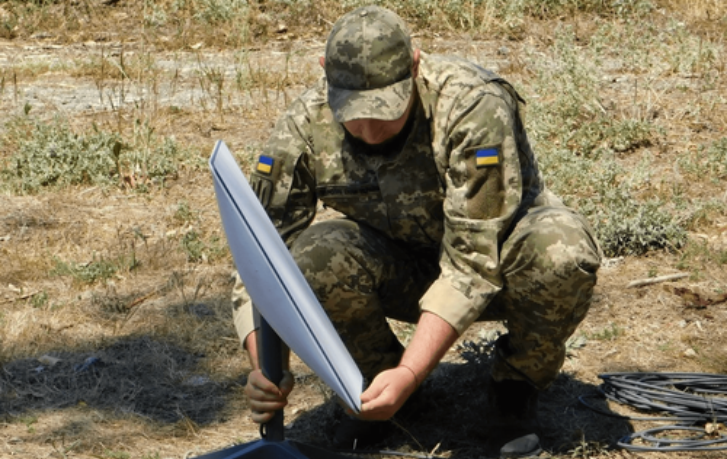
Ukraine Reports SpaceX Starshield Speed Recovery, but Military Service Remains Unclear
Ukraine says SpaceX’s Starshield satellite service has recovered from a slowdown that disrupted military connectivity, but conflicting updates leave the extent and durability of that restoration unresolved. Ukrainian Charge d’Affaires Denys Sienik told NBC News on October 15 that functionality had returned to its previous speeds “for the moment,” following restrictions that affected communications, logistics, drone operations and air defense.
The recovery matters because Starshield is more than a conventional internet connection in Ukrainian service. It supports data links for units and moving platforms, making connection speed and availability part of the operating chain rather than an administrative convenience. Speed is critical for logistics, and for intercepting the jet-powered Shahed drones,” Sienik said. “We hope it will remain unchanged.
That hope remains an important qualifier. An official told NBC News that Ukraine had received no explanation from either SpaceX or the Pentagon for the limitations. A subsequent October 18 account of the dispute reported that Ukrainian President Volodymyr Zelenskyy considered normal access not fully restored. The available updates therefore indicate an improvement, but not a settled service baseline accepted by all parties.
A performance limit can become a readiness limit
Starshield is SpaceX’s government- and national-security-focused service, built on the company’s broader Starlink satellite network. Its military role changes what counts as acceptable performance. A household user may experience degraded satellite service as slower downloads or an interrupted call. For a defense organization, the same category of restriction can interrupt communications between distributed units, delay logistics information and reduce the availability of connected defensive systems.
Ukrainian officials initially described a restriction affecting terminals on fast-moving platforms. An Associated Press account said the connection was cut when a terminal moved faster than 160 kilometers per hour, or 100 mph. Ukraine began discussions with SpaceX and the Pentagon over removing that cap or shifting to a different service package. An adviser to Zelenskyy said an aviation-oriented package without the same limit would cost considerably more.
The episode exposes a basic constraint in commercially derived military communications: owning terminals does not necessarily give the user control over service rules. Network access can depend on software-defined policies, contract terms and decisions made outside the deployed organization. A restriction can therefore change effective capability without requiring a hardware failure or the physical loss of a satellite or ground terminal.
Responsibility for the slowdown remains disputed. Elon Musk said limits on Starshield use were determined by the U.S. military and ultimately the president because the system used by Ukraine is government-controlled. Reuters reported, citing two U.S. officials and a Western official briefed on the matter, that the direction to slow the service came from within the White House, although those officials did not identify who made or implemented the decision. A senior U.S. official said no such request came from the president, while the White House did not answer whether another administration official had requested it.
Restored speed does not resolve dependence
The broader engineering issue is resilience. Alternative satellite capacity can reduce dependence on one provider, but replacing an established service is not as simple as exchanging terminals. A substitute must provide suitable coverage, mobile performance, security, ground equipment and enough capacity, then be integrated into the user’s communications architecture. Those requirements carry procurement costs and can take time to test under operational conditions.
NATO’s own satellite communications structure illustrates the value of using multiple sources. The alliance obtains capacity from several member nations and is developing frameworks that combine military and commercial services. That model does not eliminate service disruptions, but it gives planners more paths for maintaining communications when one network, contract or operating policy changes.
For Ukraine, Starshield’s reported return to earlier speeds restores at least some of the connectivity officials said was lost during a large Russian drone wave. Yet the later disagreement over whether normal service has been fully recovered leaves the central readiness issue open: units can use the network, but Ukraine still lacks a public explanation for the restriction and assurance that the recovered performance will hold.
| More aerospace and engineering stories, right in your MSN feed. Follow AMI on MSN |
By David Whitaker — Associate editor for AMI’s aerospace and drone systems desk, translating flight systems, aircraft programs, spaceflight, and UAV developments into accessible technical stories.



